Crepuscular

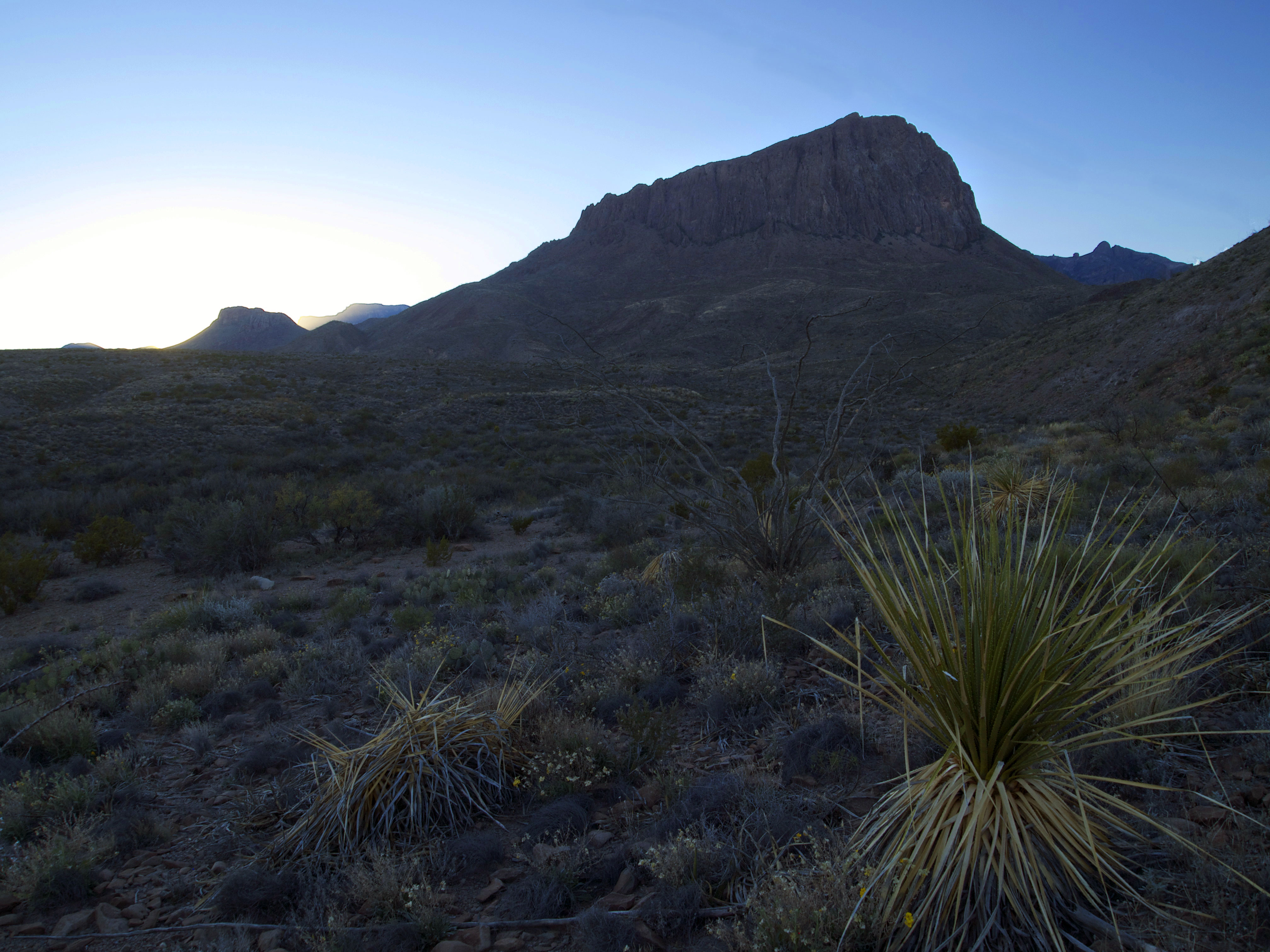
Nugent Mountain, Big Bend N.P. -Photo by Time Giller

Nugent Mountain, Big Bend N.P. -Photo by Tim Giller

Only a clear desert sunset sky can be so seamless. A complex landscape of buttes and mesas with the Chisos Mountains beyond has become a sharp black silhouette but rising from that is a prefect gradient, the glowing horizon of pastel yellow bleeding incrementally upward into oranges and reds eventually becoming a deep electric blue. The colors deepen imperceptibly defying measurement and obscuring time; my eyes struggle to adjust with the growing twilight. Puncturing the tapestry are the first celestial lights, Venus tonight, with Mars not far behind and over her shoulder. The varieties of daytime birds that populate the scrub and evade view have ceased their chattering end of day crescendo leaving silence in the still air. It is so silent that I can hear the leathery wings of a single bat that is breaking the perfection of the skyline, erratically hunting tiny insect prey. Soon high chirps from his companions tell me that he’s not alone. Suddenly a whirl of barely audible wing beats rises from the creosote in front of me tracing a few odd loops before abruptly becoming an oblong rock in the gravel before me. A Poorwill has mottled feathers that make it hard to distinguish in the dim light it prefers to hunt in, taking quick fights after moths then alighting back to the ground. Straining my eyes to make out this rarely seen bird I manage to notice that a Kangaroo Rat has also chosen to venture out now that the darkness has thickened. Light brown with a white belly and large black eyes, it has strong, oversized back legs that carry it around unpredictably and a long tufted tail whips along behind. If the Poorwill hadn’t drawn my eyes the other little critter would have been just another soft mysterious noise rising from the dusk.

It’s a really great word, crepuscular. From the Latin word for twilight, it refers to those creatures that are active primarily at dawn and dusk. The word has an exotic, enigmatic sound that matches these transition times between light and dark, the shadowy zone between worlds. In the desert this can be an especially useful time to be active. The heat of the day can be unforgiving for most animals and a majority of them take advantage of the cooler nighttime temperatures, especially predators. A little fella like a Kangaroo Rat avoids the daytime raptors who have gone to bed well as the nocturnal snakes who may not yet have awakened by slipping into the in between time. The subtle changes in lighting provide venue for camouflage.

Coyote Yosemite N.P. - Photo by Tim Giller

Coyote Yosemite N.P. – Photo by Tim Giller

Wildlife doesn’t always conform to our labels though. I’ve seen owls awake at midday and like us, many diurnal creatures stay up late to finish their business. We humans clearly defy this categorization. Perhaps the coyote got his trickster reputation because of his refusal to conform to such labels. Generally considered a nocturnal animal they can be spotted at any hour, sometimes boldly making their presence known like the beautifully healthy one Rachael and I caught traipsing midday through the Presidio in San Francisco. These savvy animals also traverse the twilight period and we’ve heard their evening cackles on more evenings than not during our travels so far. Often deep into the night their yips and howls punctuate the darkness and on until the first hint of light in the east. I will never tire of this sound. At close range the disembodied laughing of coyote conversation on three sides of me does raise the hair on the back of my neck but it also ignites a primitive joy.
Strange Worlds

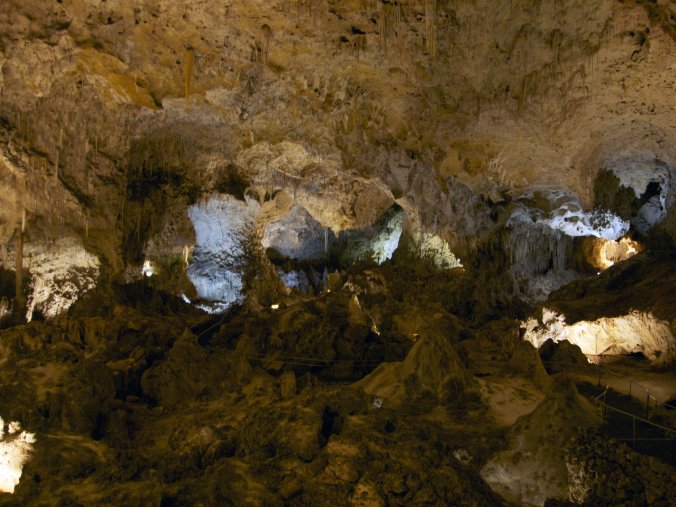
Carlsbad Caverns Photo by Tim GillerCarlsbad Caverns Photo by Tim Giller

Carlsbad Caverns Photo by Tim Giller

Rachael and I have been traveling through a world that has long since past and was much different from the one we all live in now. I don’t mean the rural cowboy world and down-home hospitality of West Texas. That world is alive and well and we were lucky enough to share Jell-O shots and a few beers at a tiny, small town pizza joint with some of these folks on Super Bowl Sunday. I’m thinking of a world that is much older and even more exotic.

From the Prehistoric Trackways in Las Cruces, to lakes formed in limestone sinkholes near Roswell and past the Guadalupe Mountains into the bootheel of Texas the landscape has been dominated by a biosphere that almost entirely died out a quarter billion years ago. Humans have already visited another planet. When paleontologists scratched into these layers of fossils they became the first visitors to a world full of strange creatures and plants, most of which have no relation to the one ones we share the planet with today. Scientists are still trying to pin down why, but at the end of this period as much as 90% of all species on Earth had been extinguished.

The Earth really has been any number of different planets over time and towards the end of the Permian period more than 250 million years ago, almost all land was bunched into the supercontinent Pangea. The ground I’m on now was down south of the equator and California wouldn’t even rise into existence for millions of years. This ground I’m on now actually spent much of its time submerged as a shallow sea, parts of which formed a reef composed of fanciful marine life. Unlike the coral reefs we are familiar with on Earth now, these reefs were built up by sponges and algae producing the building material for limestone and a rich organic layer that later became hydrocarbon. As the Earth shifted and the sea dried all this was deeply buried.

The puzzle pieces that form the Earth’s crust shifted around and parts of those reefs were pushed upward shedding the layers that had been covering them for ages and forming ridges and mountain ranges. In the meantime as surface water percolated into the rising limestone it mixed with the hydrocarbons creating sulfuric acid that carved elaborate caves and sinkholes. A new underground world was created. Later, a weak carbonic acid dripped into these caves creating, over hundreds of thousands of years, an infinite variety of mystifying shapes and formations in places like Carlsbad Caverns. Surface creatures found their way into these pitch-black regions evolving into sightless and colorless beasties. Sharing this space and extending much deeper under the earth are whole classes of extremophiles, microbes that live in places and in ways that we had thought impossible just a few decades ago, deriving energy without the sun using chemical processes. A whole fantastical ecosystem of bizarre creatures and shapes that could never be seen, unless an entrance was formed and someone was lucky enough to find it. It has recently been suggested that half of the Earth’s total biomass may exist deep underground and is nearly unknown to science.

El Capitan and the Salt Basin from Guadalupe Pk - Photo by Tim GillerEl Capitan and the Salt Basin from Guadalupe Pk - Photo by Tim Giller

El Capitan and the Salt Basin from Guadalupe Pk – Photo by Tim Giller

We made the effort of hiking to “The Top of Texas” at Guadalupe Peak, climbing the reef with fossil evidence at our feet as we traveled millions of years per mile of steep trail. Surrounded by the Chihuahuan Desert you have to use your imagination that this was once an equatorial sea. Our imaginations were overwhelmed the next day as we wandered the bowels of these mountains, fortunate enough to have the winding paths of Carlsbad Caverns nearly to ourselves. It was as if time didn’t exist and we literally lost a couple hours mesmerized by the elegant forms created drop by drop, one spec of calcified deposit at a time.

107in Struve Telescope, MacDonald Observatory - Photo by Tim Giller107in Struve Telescope, MacDonald Observatory - Photo by Tim Giller

107in Struve Telescope, MacDonald Observatory – Photo by Tim Giller

Exiting the caves into the fading daylight, looking for a place to sleep on the wide flat expanse of public land that spreads out to the East of the Guadalpues, yet another world revealed itself. This one was an industrialized landscape out of a dark science fiction imagination. Across the horizon were the flares of oil wells, pumpjacks working at those ancient hydrocarbons embedded in stone, the fracking boom in full effect. Having camped in this area in the mid 90’s I was expecting the clear unobstructed night skies that West Texas is famous for. Instead the air had a grim haze and the cumulative lights of hundreds of wells overwhelmed the Milky Way. Stopping in at the prestigious MacDonald Observatory a couple days later we learned that this new development is a severe issue for the astronomical research they do. I was struck at the far reaching the effects of our thirst for oil. We dig into the distant past for this resource pushing off the bulk of the consequences onto those in the future, forcing a top secret mélange of toxic ingredients into an ecosystem deep underground before we’ve have had any chance to learn anything about it while obscuring the vision of those who would teach us about the most distant mysterious worlds we have yet to see in the vastness of the universe.

Cave Sasquatch? - Photo by Tim GillerCave Sasquatch? - Photo by Tim Giller

Cave Sasquatch? – Photo by Tim Giller

Who knows what creatures we may never find because we didn’t care to look in the first place.

Strange Worlds


Carlsbad Caverns Photo by Tim Giller

Carlsbad Caverns Photo by Tim Giller

Rachael and I have been traveling through a world that has long since past and was much different from the one we all live in now. I don’t mean the rural cowboy world and down-home hospitality of West Texas. That world is alive and well and we were lucky enough to share Jell-O shots and a few beers at a tiny, small town pizza joint with some of these folks on Super Bowl Sunday. I’m thinking of a world that is much older and even more exotic.

From the Prehistoric Trackways in Las Cruces, to lakes formed in limestone sinkholes near Roswell and past the Guadalupe Mountains into the bootheel of Texas the landscape has been dominated by a biosphere that almost entirely died out a quarter billion years ago. Humans have already visited another planet. When paleontologists scratched into these layers of fossils they became the first visitors to a world full of strange creatures and plants, most of which have no relation to the one ones we share the planet with today. Scientists are still trying to pin down why, but at the end of this period as much as 90% of all species on Earth had been extinguished.

The Earth really has been any number of different planets over time and towards the end of the Permian period more than 250 million years ago, almost all land was bunched into the supercontinent Pangea. The ground I’m on now was down south of the equator and California wouldn’t even rise into existence for millions of years. This ground I’m on now actually spent much of its time submerged as a shallow sea, parts of which formed a reef composed of fanciful marine life. Unlike the coral reefs we are familiar with on Earth now, these reefs were built up by sponges and algae producing the building material for limestone and a rich organic layer that later became hydrocarbon. As the Earth shifted and the sea dried all this was deeply buried.

The puzzle pieces that form the Earth’s crust shifted around and parts of those reefs were pushed upward shedding the layers that had been covering them for ages and forming ridges and mountain ranges. In the meantime as surface water percolated into the rising limestone it mixed with the hydrocarbons creating sulfuric acid that carved elaborate caves and sinkholes. A new underground world was created. Later, a weak carbonic acid dripped into these caves creating, over hundreds of thousands of years, an infinite variety of mystifying shapes and formations in places like Carlsbad Caverns. Surface creatures found their way into these pitch-black regions evolving into sightless and colorless beasties. Sharing this space and extending much deeper under the earth are whole classes of extremophiles, microbes that live in places and in ways that we had thought impossible just a few decades ago, deriving energy without the sun using chemical processes. A whole fantastical ecosystem of bizarre creatures and shapes that could never be seen, unless an entrance was formed and someone was lucky enough to find it. It has recently been suggested that half of the Earth’s total biomass may exist deep underground and is nearly unknown to science.


El Capitan and the Salt Basin from Guadalupe Pk - Photo by Tim Giller

El Capitan and the Salt Basin from Guadalupe Pk – Photo by Tim Giller

We made the effort of hiking to “The Top of Texas” at Guadalupe Peak, climbing the reef with fossil evidence at our feet as we traveled millions of years per mile of steep trail. Surrounded by the Chihuahuan Desert you have to use your imagination that this was once an equatorial sea. Our imaginations were overwhelmed the next day as we wandered the bowels of these mountains, fortunate enough to have the winding paths of Carlsbad Caverns nearly to ourselves. It was as if time didn’t exist and we literally lost a couple hours mesmerized by the elegant forms created drop by drop, one spec of calcified deposit at a time.


107in Struve Telescope, MacDonald Observatory - Photo by Tim Giller

107in Struve Telescope, MacDonald Observatory – Photo by Tim Giller

Exiting the caves into the fading daylight, looking for a place to sleep on the wide flat expanse of public land that spreads out to the East of the Guadalpues, yet another world revealed itself. This one was an industrialized landscape out of a dark science fiction imagination. Across the horizon were the flares of oil wells, pumpjacks working at those ancient hydrocarbons embedded in stone, the fracking boom in full effect. Having camped in this area in the mid 90’s I was expecting the clear unobstructed night skies that West Texas is famous for. Instead the air had a grim haze and the cumulative lights of hundreds of wells overwhelmed the Milky Way. Stopping in at the prestigious MacDonald Observatory a couple days later we learned that this new development is a severe issue for the astronomical research they do. I was struck at the far reaching the effects of our thirst for oil. We dig into the distant past for this resource pushing off the bulk of the consequences onto those in the future, forcing a top secret mélange of toxic ingredients into an ecosystem deep underground before we’ve have had any chance to learn anything about it while obscuring the vision of those who would teach us about the most distant mysterious worlds we have yet to see in the vastness of the universe.


Cave Sasquatch? - Photo by Tim Giller

Cave Sasquatch? – Photo by Tim Giller

Who knows what creatures we may never find because we didn’t care to look in the first place.

Landscape that speaks

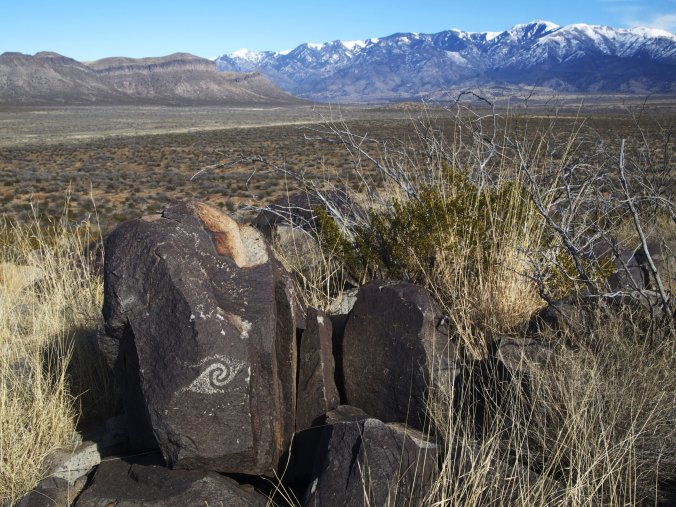
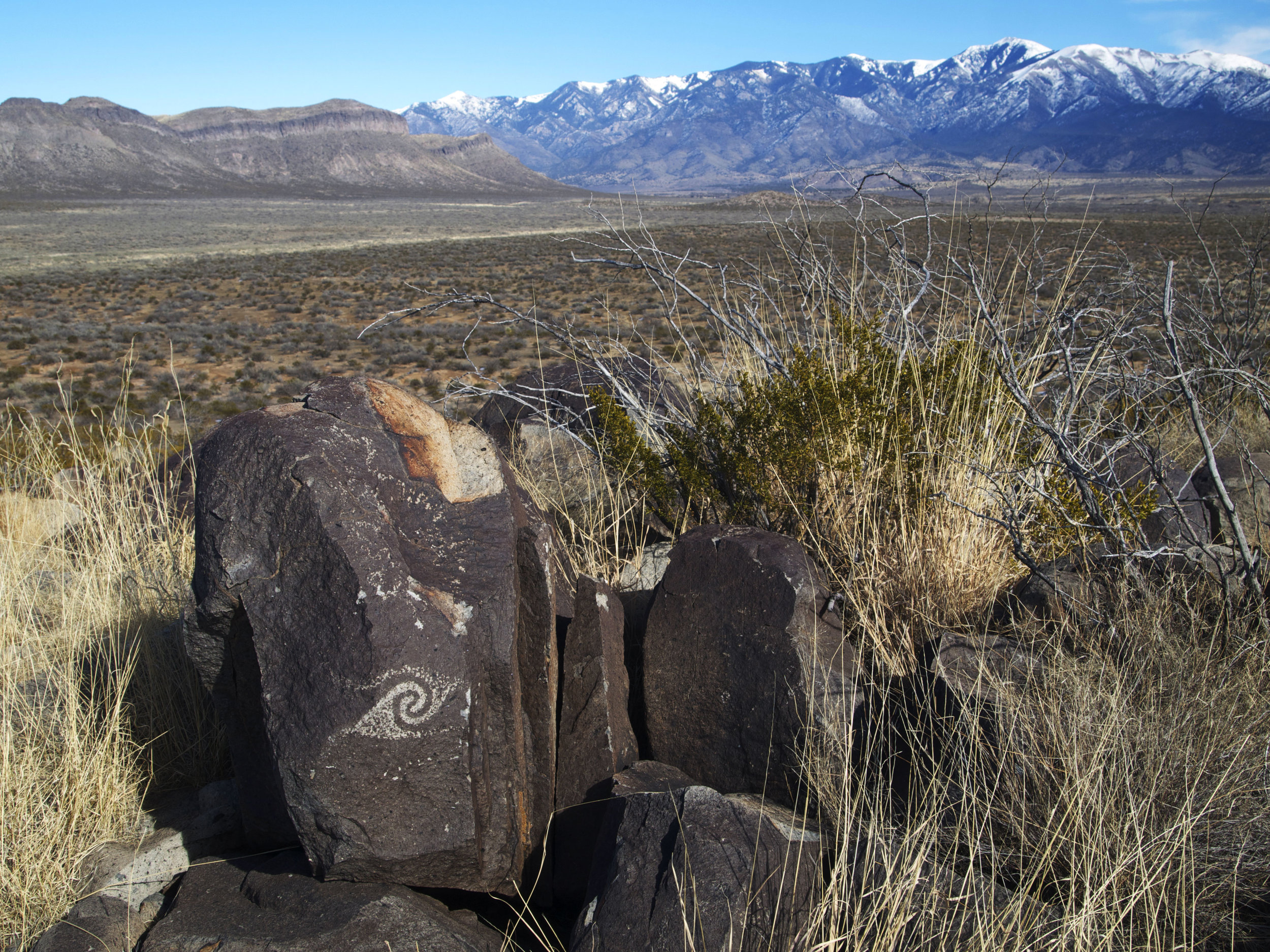
Three Rivers Petroglyph Site -Photo by TIm GillerThree Rivers Petroglyph Site -Photo by TIm Giller

Three Rivers Petroglyph Site -Photo by TIm Giller

The colors of the desert are subtle but there is plenty of color if you take time to look. Except sometimes it can be black or white. That is what you’ll find on the two ends of the Tularosa Basin in southern New Mexico. On the south end are sands of pure white gypsum covering 275 square miles and creeping northward with the prevailing winds. Towards the north end is a 44 mile tongue of lava field that poured southward down valley. These two disparate features are relative newcomers to a sprawling basin out of which no water flows to the ocean.

The sand is a product of this fact, the mountains ringing the basin are rich in gypsum from ancient uplifted seabeds and waters draining from them deposit the dissolved mineral in the low southern end. As the shallow lake formed by this runoff evaporates into a playa the deposits form soft crystals easily eroded by the strong winds, the resulting grains piling up into otherworldly bright white dunes. This process has been going on a mere 25,000 years. This is plenty of time however for plants and animals to adapt to a new landscape. Yucca plants try to outgrow the rising dunes by stretching their stems. Grasses have a quick life cycle, spreading their seed before being engulfed. A species of lizard has evolved from its darker cousins to a nearly white color that blends into the sand.

About 5000 years ago vents on the higher north end began extruding the lava that reached southward eventually covering 127 square miles. Cooling into a nearly black basalt it is the newest land to be found in the region. Still there are creatures that have adapted, including a similar lizard that in the ensuing years has become very dark skinned to blend into its contrary landscape.

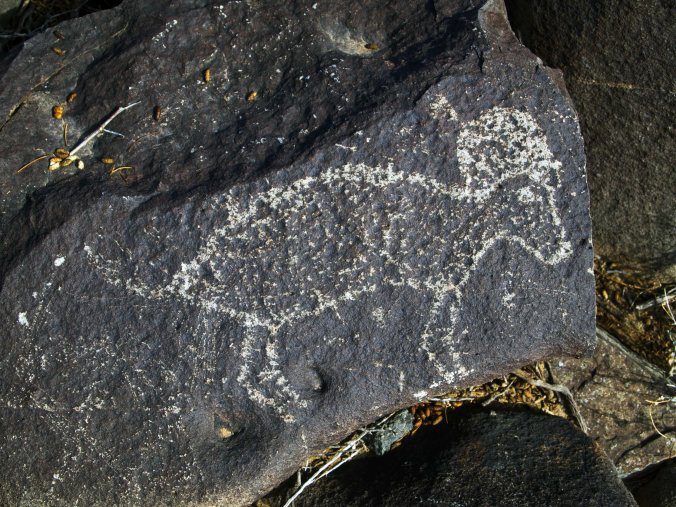
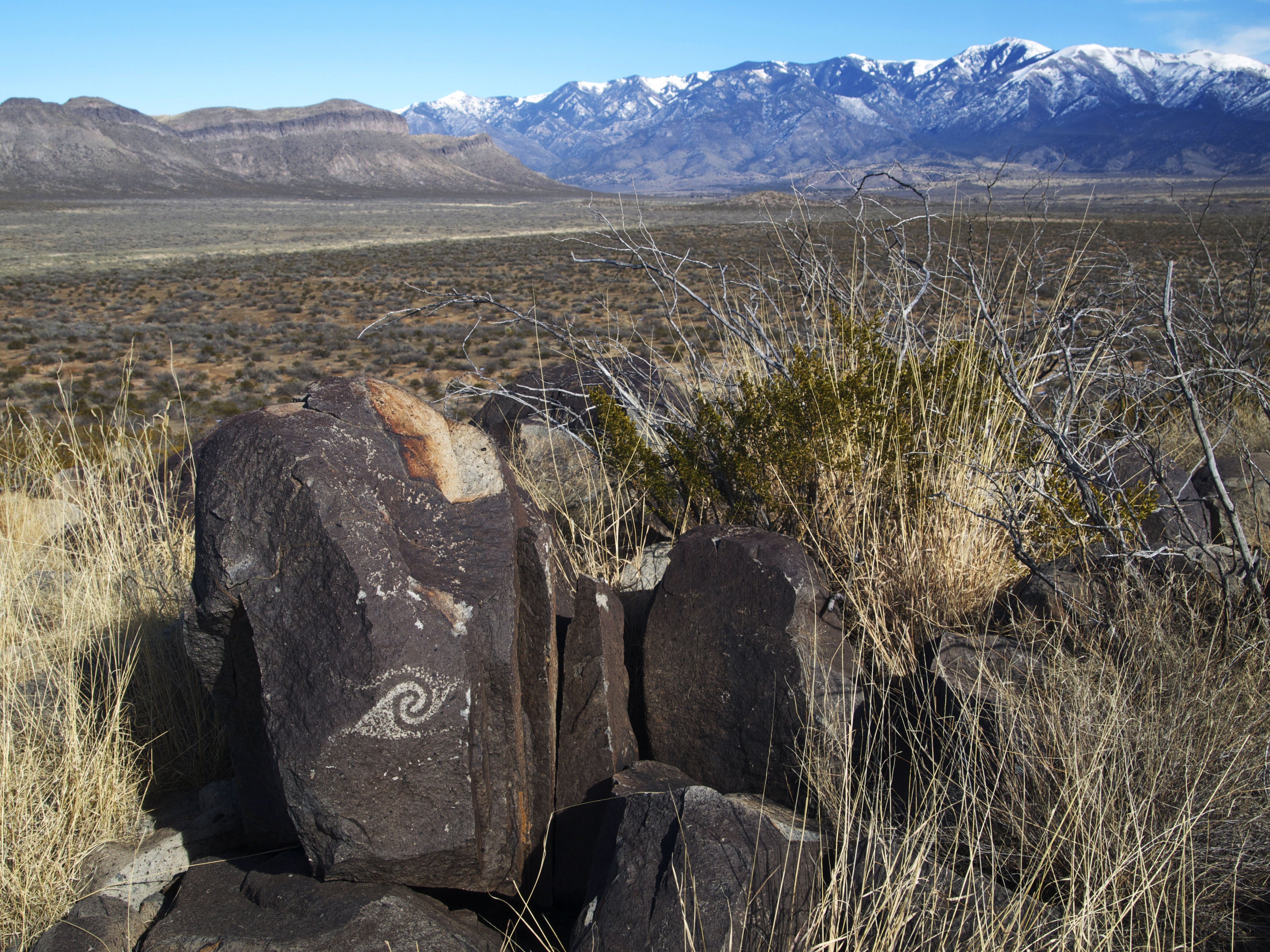
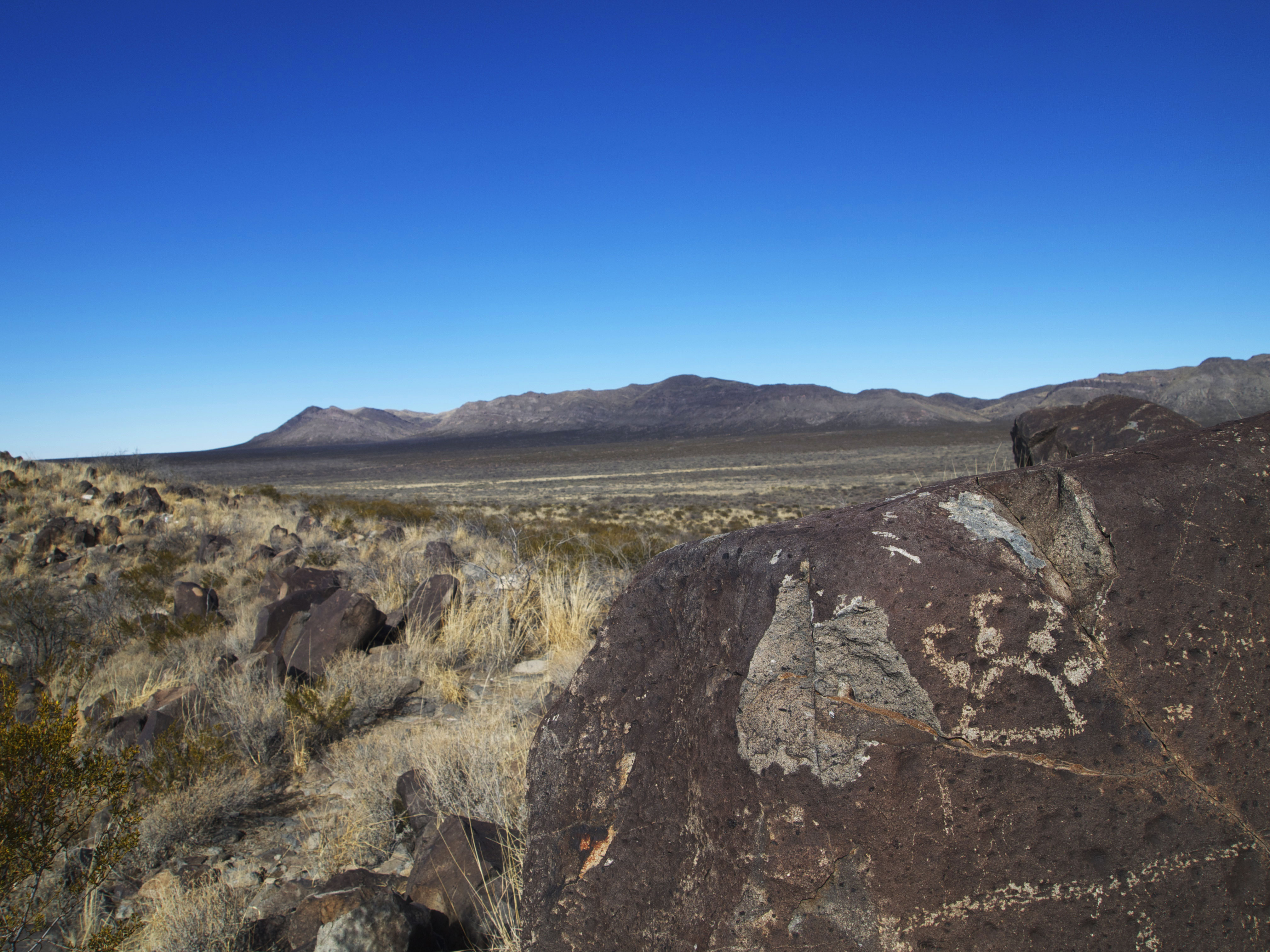
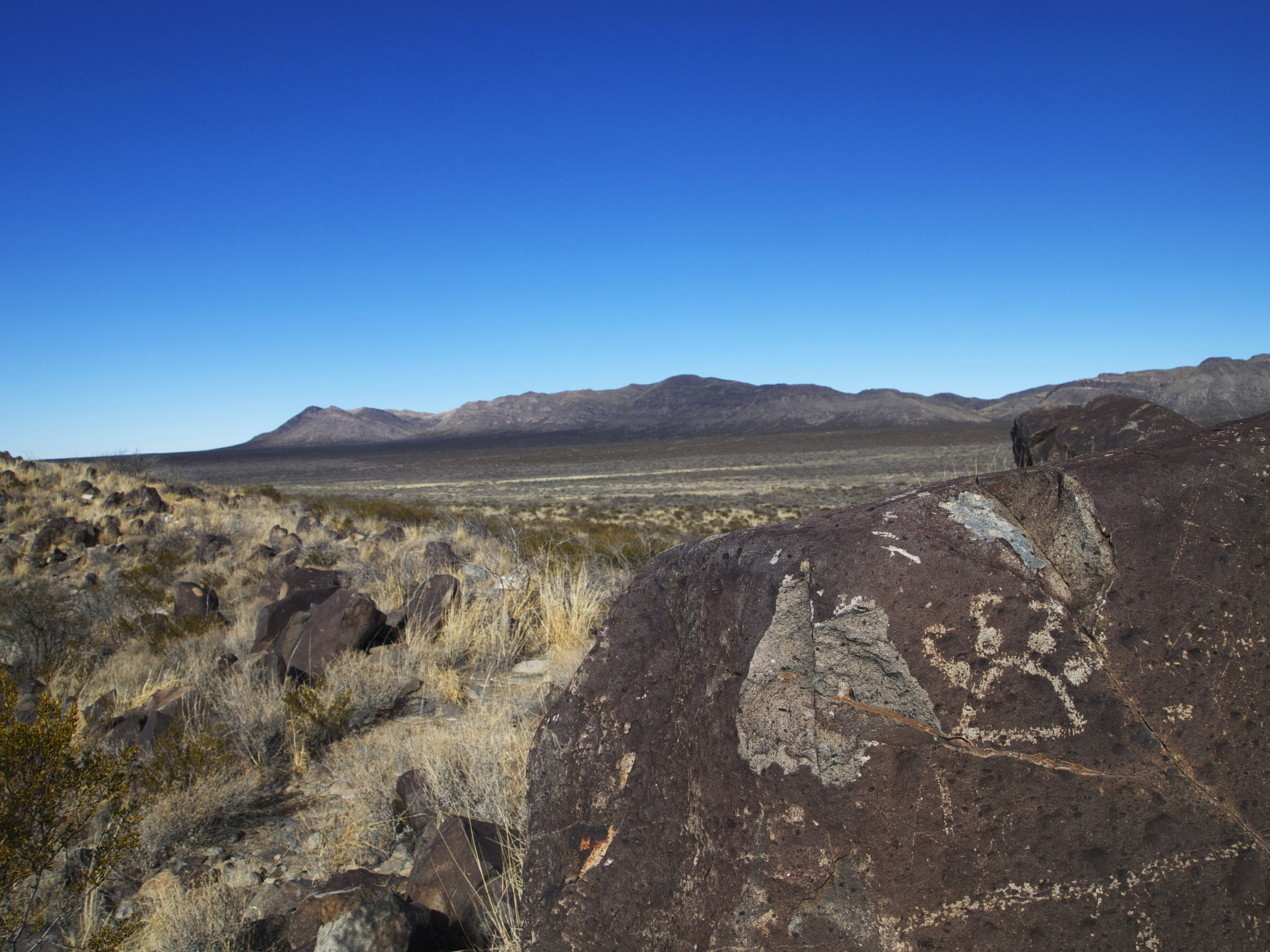
There were surely people on hand to witness the birth of this black landscape, possibly during the early days of the white sands as well. No clues as to what this all might have meant to them remain. Their successors some millennia later left us cryptic messages in a spot nearly halfway between these contrasting landscapes. The Three Rivers Petroglyph site has an incredible amount of rock art, but again we can only speculate about the specific message. And folks speculate wildly from nonsense graffiti to evidence of extraterrestrial contact. What is clear from the hillside full of inscribed images is a commitment to art and a strong relationship to the landscape over generations.

Three Rivers Petroglyph Site -Photo by TIm GillerThree Rivers Petroglyph Site -Photo by TIm Giller

Three Rivers Petroglyph Site -Photo by TIm Giller

Some time later the Apache made a stronghold here first against the furthest outpost of Spanish empire, then for raids on Mexican pioneers before the land was commandeered by the United States. American ranchers came next denuding the grassland, altering most of the basin into a creosote scrubland.

The most dramatic new edition is an increased radiation level. The first glowing plume of the atomic age was seen here on July 16, 1945 when frantic theory became awesome fact in the first mushroom cloud rising from the Trinity site on the basin’s northwest corner.

3rivers13rivers1

3rivers1

The contrasts are compelling. The ephemeral landscape of shifting white and the hardened river of black stone, two opposing features in a gesture of connection, their trajectories striving to meet somewhere in an inhospitable basin. A basin that has seen the pastoral hands of people living softly with the land and witnessed the blinding force of absolute will frighteningly manifested.

Landscape that speaks

Three Rivers Petroglyph Site -Photo by TIm Giller

Three Rivers Petroglyph Site -Photo by TIm Giller

The colors of the desert are subtle but there is plenty of color if you take time to look. Except sometimes it can be black or white. That is what you’ll find on the two ends of the Tularosa Basin in southern New Mexico. On the south end are sands of pure white gypsum covering 275 square miles and creeping northward with the prevailing winds. Towards the north end is a 44 mile tongue of lava field that poured southward down valley. These two disparate features are relative newcomers to a sprawling basin out of which no water flows to the ocean.

The sand is a product of this fact, the mountains ringing the basin are rich in gypsum from ancient uplifted seabeds and waters draining from them deposit the dissolved mineral in the low southern end. As the shallow lake formed by this runoff evaporates into a playa the deposits form soft crystals easily eroded by the strong winds, the resulting grains piling up into otherworldly bright white dunes. This process has been going on a mere 25,000 years. This is plenty of time however for plants and animals to adapt to a new landscape. Yucca plants try to outgrow the rising dunes by stretching their stems. Grasses have a quick life cycle, spreading their seed before being engulfed. A species of lizard has evolved from its darker cousins to a nearly white color that blends into the sand.

About 5000 years ago vents on the higher north end began extruding the lava that reached southward eventually covering 127 square miles. Cooling into a nearly black basalt it is the newest land to be found in the region. Still there are creatures that have adapted, including a similar lizard that in the ensuing years has become very dark skinned to blend into its contrary landscape.

There were surely people on hand to witness the birth of this black landscape, possibly during the early days of the white sands as well. No clues as to what this all might have meant to them remain. Their successors some millennia later left us cryptic messages in a spot nearly halfway between these contrasting landscapes. The Three Rivers Petroglyph site has an incredible amount of rock art, but again we can only speculate about the specific message. And folks speculate wildly from nonsense graffiti to evidence of extraterrestrial contact. What is clear from the hillside full of inscribed images is a commitment to art and a strong relationship to the landscape over generations.

Three Rivers Petroglyph Site -Photo by TIm Giller

Three Rivers Petroglyph Site -Photo by TIm Giller

Some time later the Apache made a stronghold here first against the furthest outpost of Spanish empire, then for raids on Mexican pioneers before the land was commandeered by the United States. American ranchers came next denuding the grassland, altering most of the basin into a creosote scrubland.

The most dramatic new edition is an increased radiation level. The first glowing plume of the atomic age was seen here on July 16, 1945 when frantic theory became awesome fact in the first mushroom cloud rising from the Trinity site on the basin’s northwest corner.

The contrasts are compelling. The ephemeral landscape of shifting white and the hardened river of black stone, two opposing features in a gesture of connection, their trajectories striving to meet somewhere in an inhospitable basin. A basin that has seen the pastoral hands of people living softly with the land and witnessed the blinding force of absolute will frighteningly manifested.3rivers1

Keeping Warm

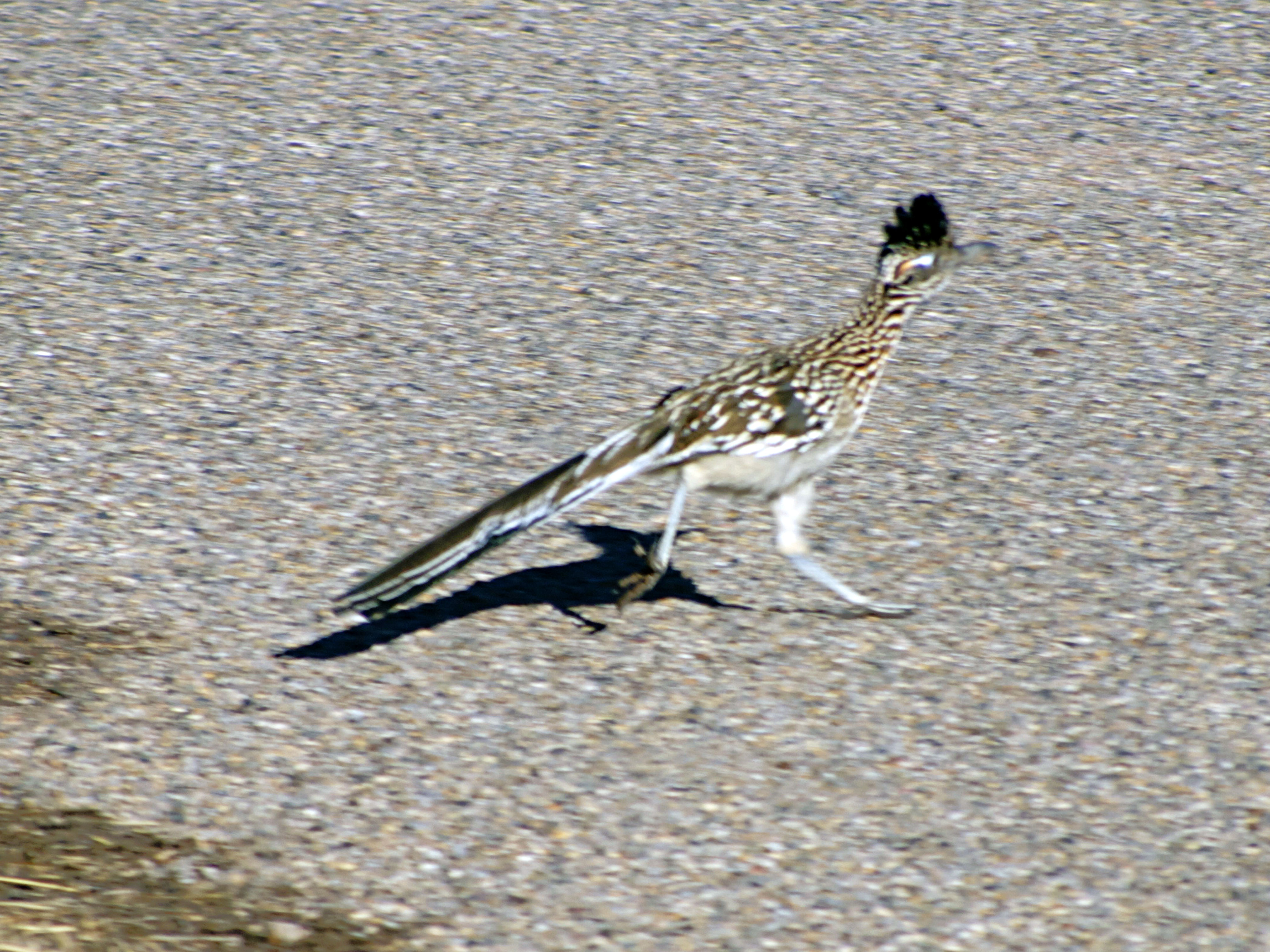
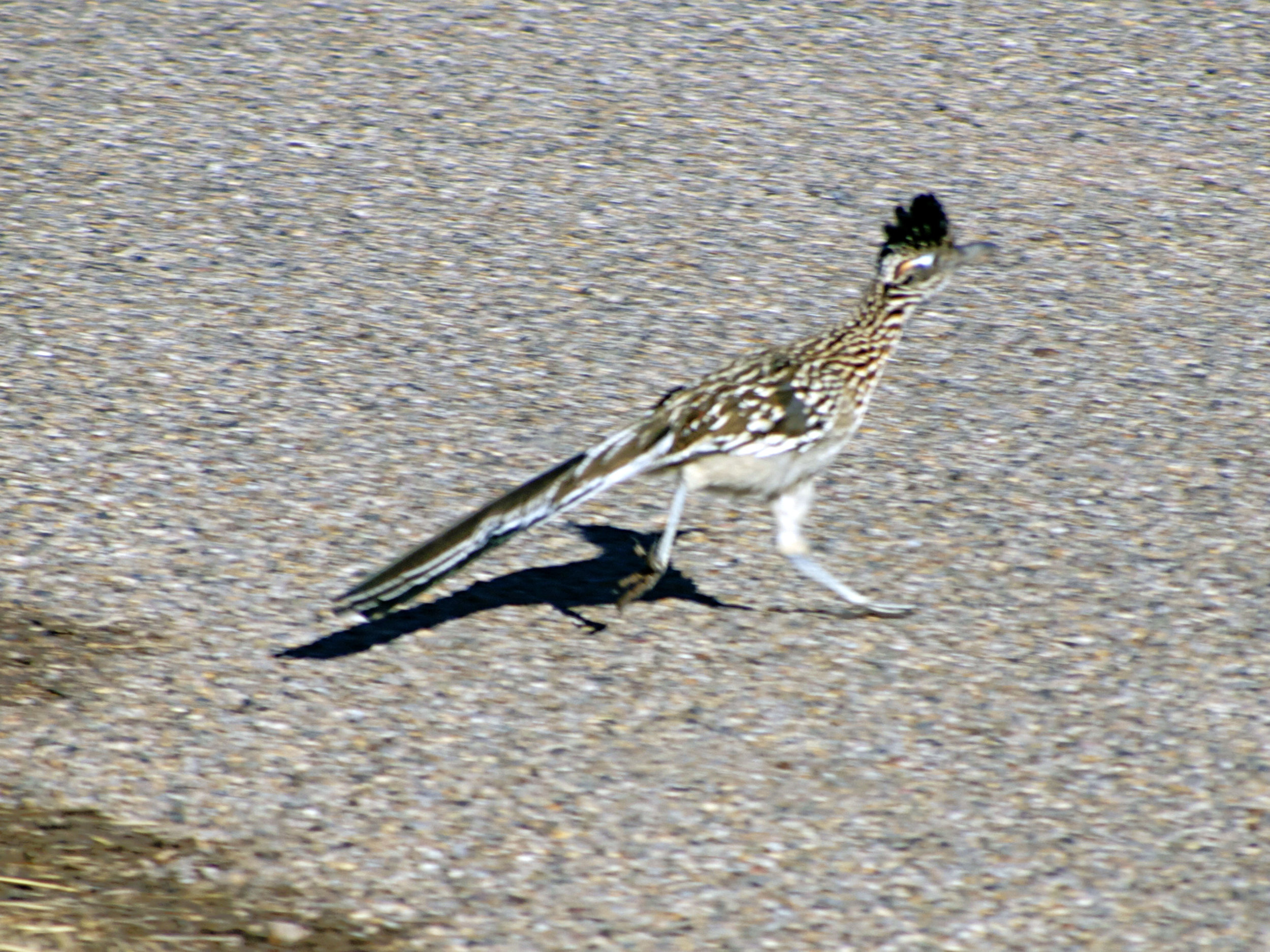
Roadrunner - Photo by Tim GillerRoadrunner - Photo by Tim Giller

Roadrunner – Photo by Tim Giller

I was beginning to feel real empathy toward ol’ Wile E Coyote and had started to wonder if Acme Co. sold wildlife cameras online. Those roadrunners are aptly named. Nine out of ten of them that we’ve seen were running across or along side the road and being able to get up to 20 mph or more were too elusive for me to photograph. The 10th bird was just causally hunting in the grass a few yards away from Lil’ Squatch the other morning proving once again that sometimes calm patience is a naturalist’s best tool.

There are lots of interesting details about North America’s largest member of the cuckoo family including the fact that they are indeed cuckoos and make sounds appropriate to that name. They also get almost all their water from the animals and plant matter that they eat and in order to conserve moisture they secrete body salt through a gland near their eyes. Roadrunners are able to eat poisonous and venomous creatures including rattlesnakes. They often do this in pairs; one distracting the snake while the other sneaks up, grabs it behind the head and then smacks it to death before swallowing. If the snake is too long you may see a roadrunner dashing around with a tail hanging from its mouth while it’s digesting.

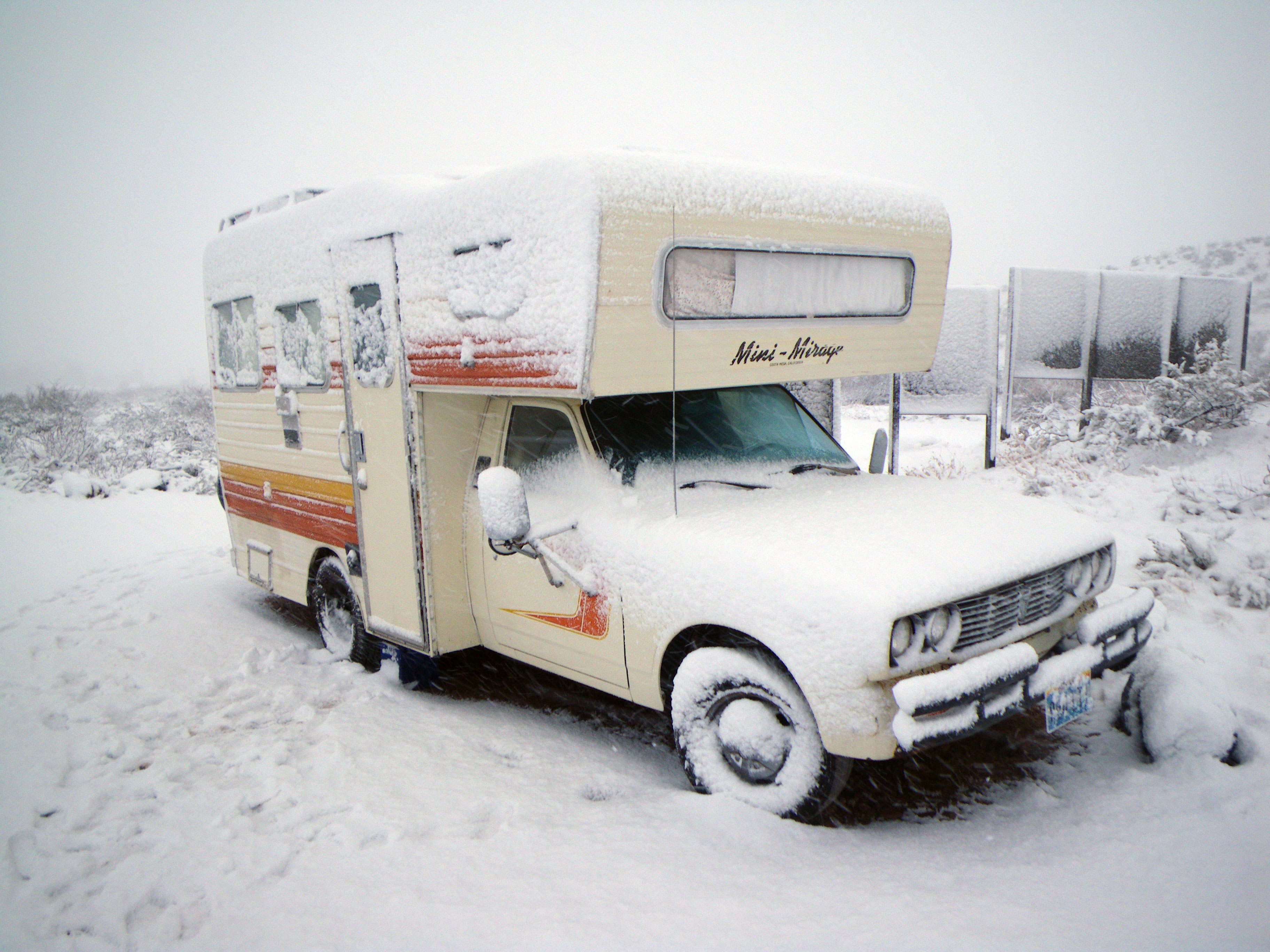
I think the most curious detail about roadrunners is that they have solar panels. I might be biased because I spent quite a few hours (and busted a few knuckles) installing solar panels on Lil’ Squatch with some help from my friend Chris. Having spent a number of subfreezing nights in our unheated and poorly insulated home we’ve also come to appreciate having good placement for the morning sun.

Snow at Prehistoric Trackways NM -Photo by Tim GillerSnow at Prehistoric Trackways NM -Photo by Tim Giller

Snow at Prehistoric Trackways NM -Photo by Tim Giller

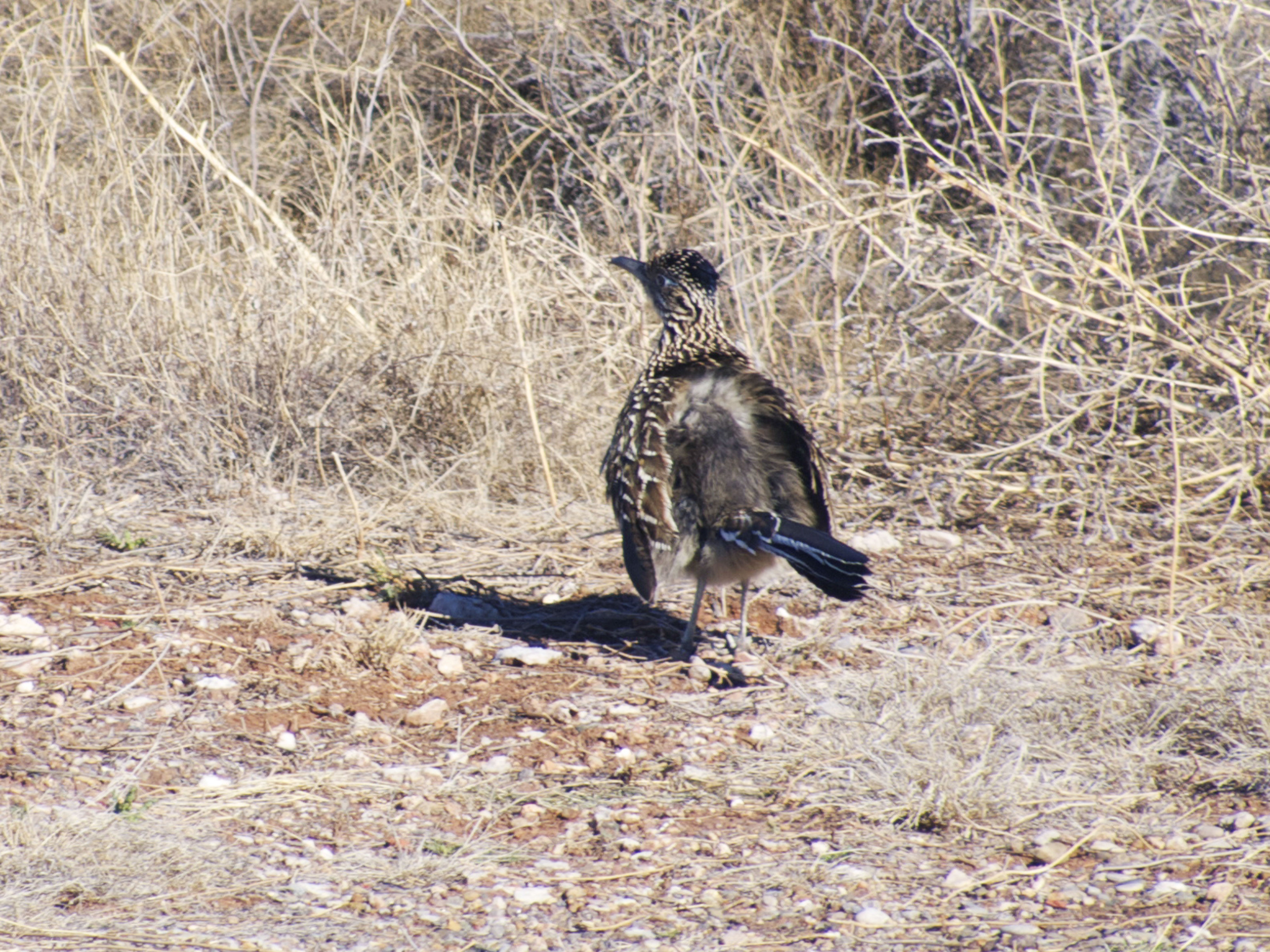
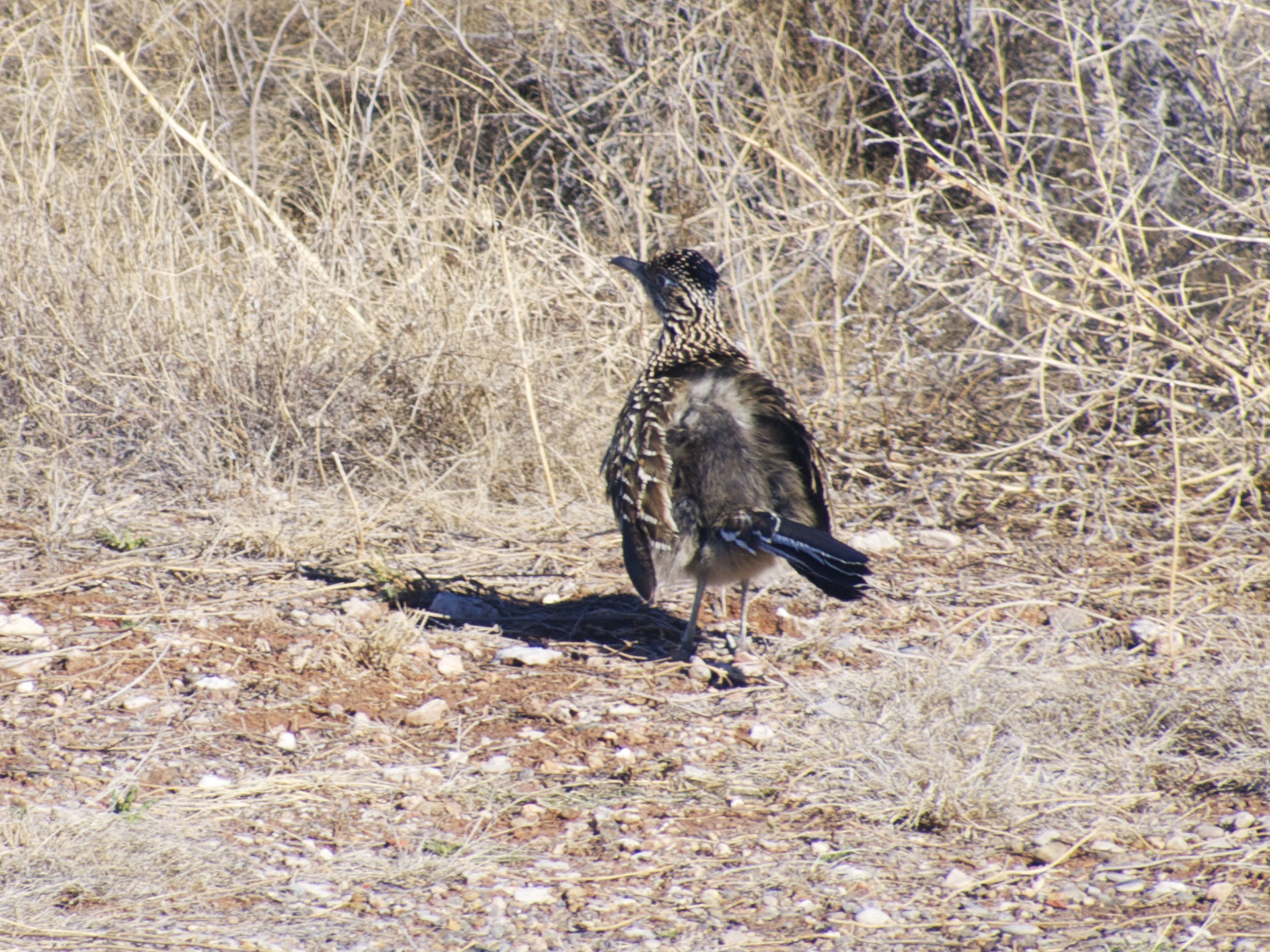
The cold can make it hard for us to get out of our cozy bed, but roadrunners go into a state of torpor, lowering their metabolism during the cold nights, and use the sun to jump start their day. On their lower back they have dark skin and they turn their tails toward the desert sun unfolding their feathers to let the solar energy warm their blood. It was a chilly morning and while I was making a second cup of coffee to get me out of my state of torpor our new friend was alternating between snatching up little critters from the grass for breakfast and flashing us his rear end toward the morning sun.

Roadrunner Solar Panels - Photo By Tim GillerRoadrunner Solar Panels - Photo By Tim Giller

Roadrunner Solar Panels – Photo By Tim Giller

Keeping Warm

I was beginning to feel real empathy toward ol’ Wile E Coyote and had started to wonder if Acme Co. sold wildlife cameras online. Those roadrunners are aptly named. Nine out of ten of them that we’ve seen were running across or along side the road and being able to get up to 20 mph or more were too elusive for me to photograph. The 10th bird was just causally hunting in the grass a few yards away from Lil’ Squatch the other morning proving once again that sometimes calm patience is a naturalist’s best tool.

Roadrunner - Photo by Tim Giller

Roadrunner – Photo by Tim Giller

There are lots of interesting details about North America’s largest member of the cuckoo family including the fact that they are indeed cuckoos and make sounds appropriate to that name. They also get almost all their water from the animals and plant matter that they eat and in order to conserve moisture they secrete body salt through a gland near their eyes. Roadrunners are able to eat poisonous and venomous creatures including rattlesnakes. They often do this in pairs; one distracting the snake while the other sneaks up, grabs it behind the head and then smacks it to death before swallowing. If the snake is too long you may see a roadrunner dashing around with a tail hanging from its mouth while it’s digesting.

I think the most curious detail about roadrunners is that they have solar panels. I might be biased because I spent quite a few hours (and busted a few knuckles) installing solar panels on Lil’ Squatch with some help from my friend Chris. Having spent a number of subfreezing nights in our unheated and poorly insulated home we’ve also come to appreciate having good placement for the morning sun.

Snow at Prehistoric Trackways NM -Photo by Tim Giller

Snow at Prehistoric Trackways NM -Photo by Tim Giller

The cold can make it hard for us to get out of our cozy bed, but roadrunners go into a state of torpor, lowering their metabolism during the cold nights, and use the sun to jump start their day. On their lower back they have dark skin and they turn their tails toward the desert sun unfolding their feathers to let the solar energy warm their blood. It was a chilly morning and while I was making a second cup of coffee to get me out of my state of torpor our new friend was alternating between snatching up little critters from the grass for breakfast and flashing us his rear end toward the morning sun.

Roadrunner Solar Panels - Photo By Tim Giller

Roadrunner Solar Panels – Photo By Tim Giller

Wolves and Wilderness

It’s as if we resent those things that are truly wild. As if, having slowly tamed ourselves, we recognize subconsciously that something is missing and we harbor animosity towards those raw and wild things that remind us of what we’ve given up. That could be one way to look at how shabbily we’ve treated some of the things we share this place with. The black bear who steals your picnic basket is only following a biological imperative to acquire easy calories. It is our behavior that is aberrant when we go to its home and expect it have our table manners.
No creature better embodies our ambivalence than the wolf. At some point, perhaps when we were more wild than civilized, wolves and humans chose to cohabitate and thus we now have man’s best friend. Do we feel jilted by those that stuck to the woods and did not approach our prehistoric campfires? Our fairy tales and mythologies show the wolf as blood thirsty and sinister and we spent the better part of American history eradicating them from our surroundings while giving their docile brethren a spot on the couch.

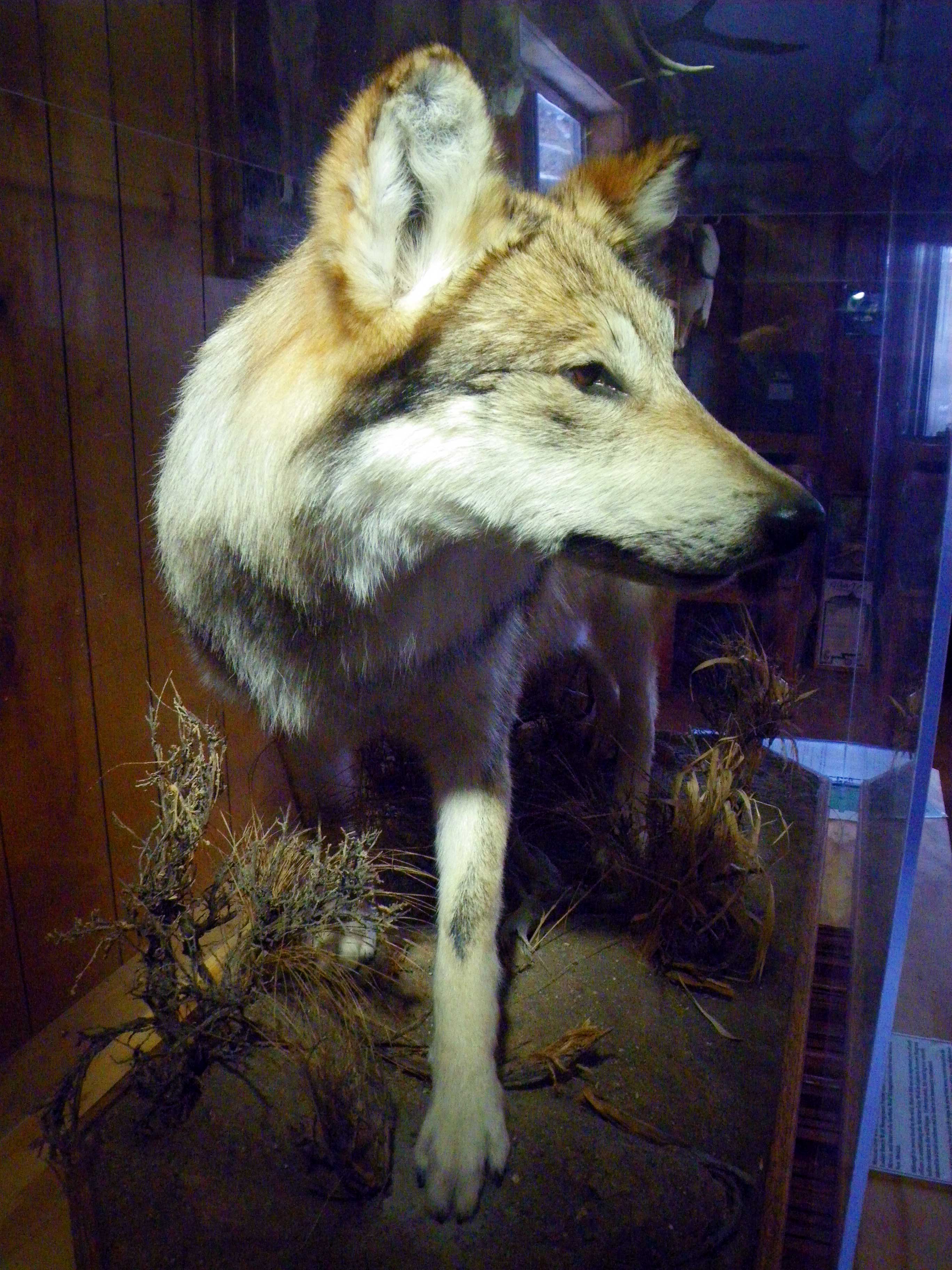
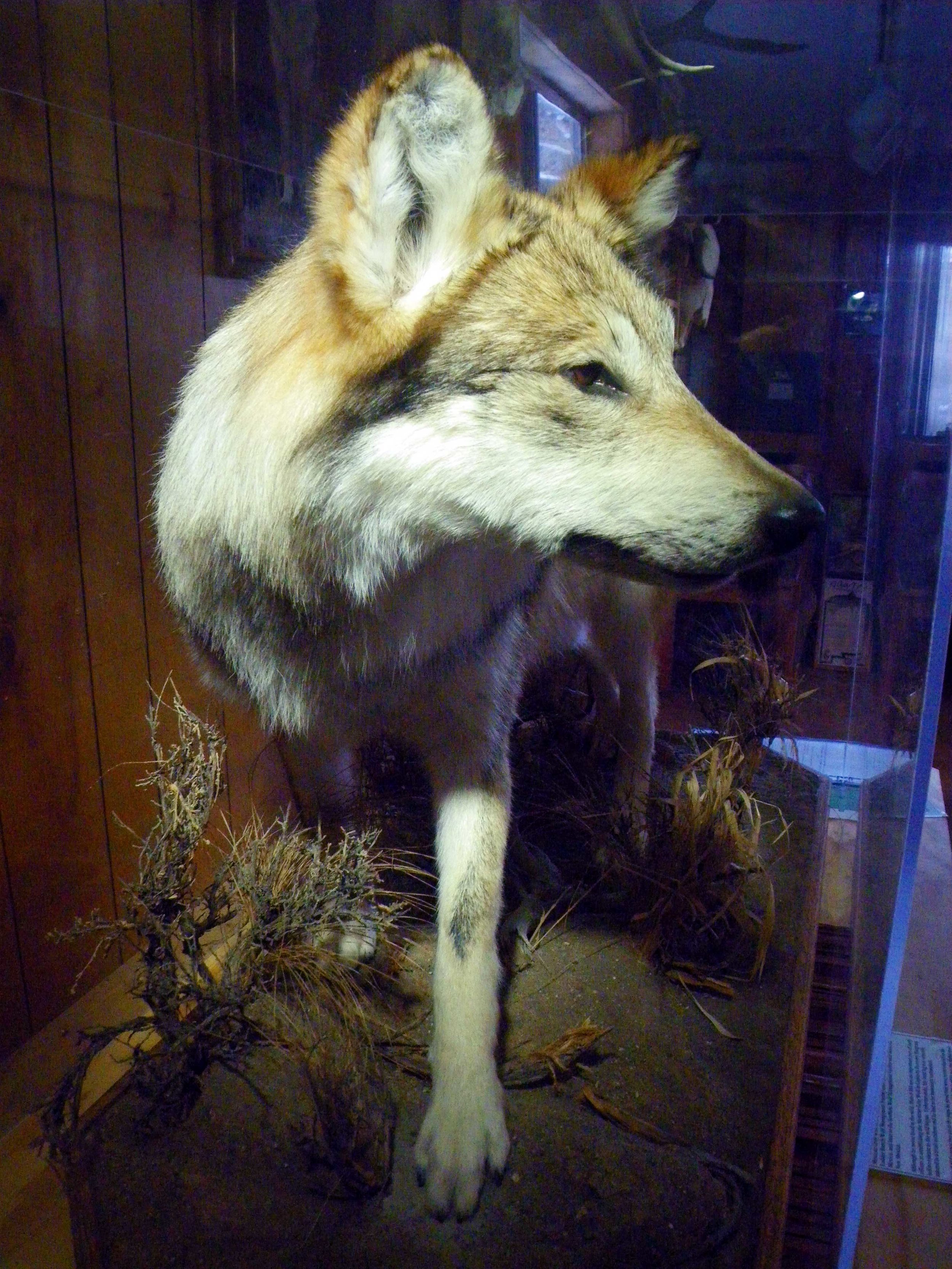
Display at Nature Center near Gila Wilderness - Photo by Tim GillerDisplay at Nature Center near Gila Wilderness - Photo by Tim Giller

Display at Nature Center near Gila Wilderness – Photo by Tim Giller

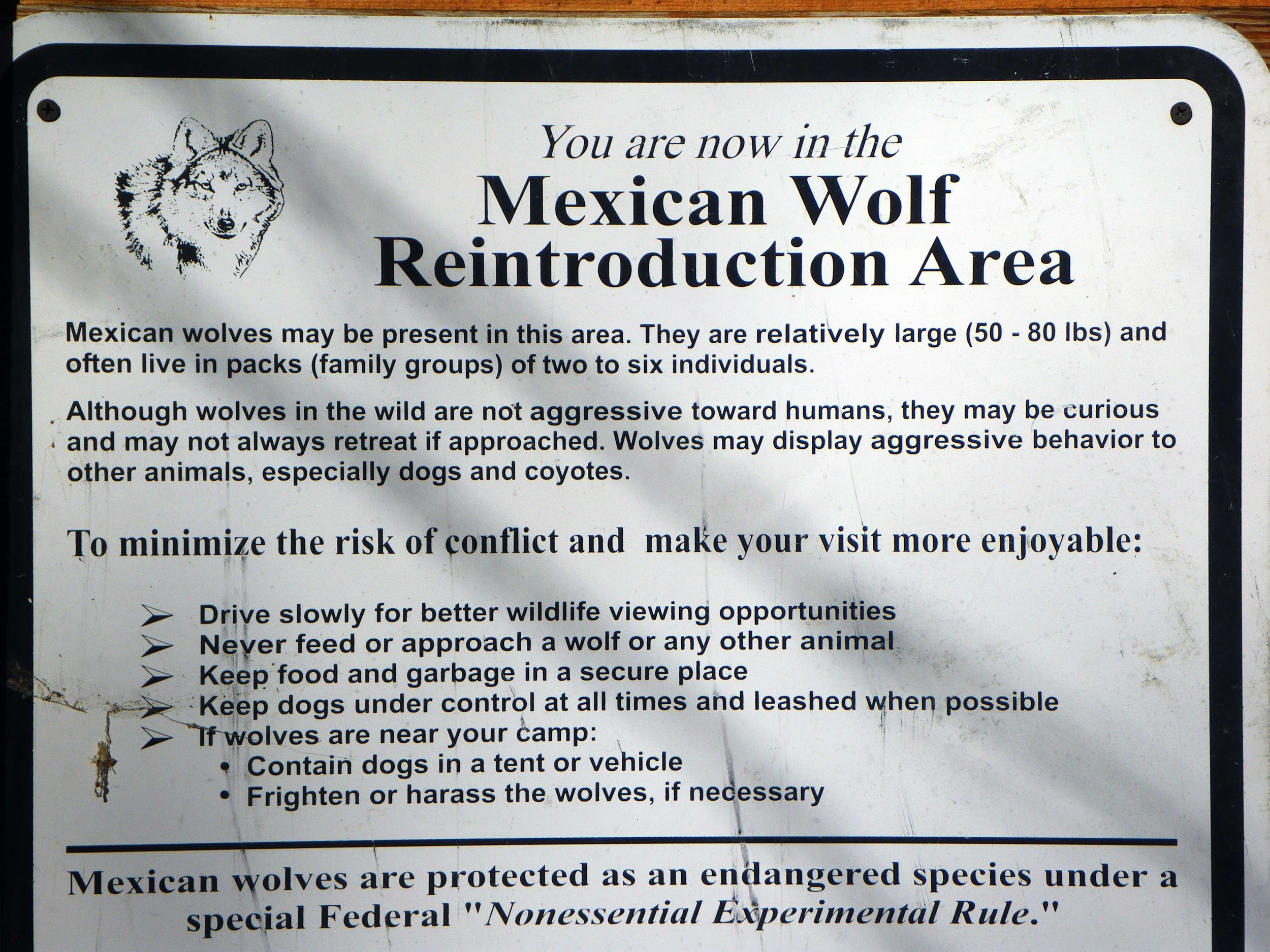
They are still out there though. In the far north wolves still roam relatively strong despite our continued bloodlust. You might have also heard of the Yellowstone wolf reintroduction or of wandering Lobos making their way to Oregon and one that traipsed briefly into California, a state that hasn’t seen Canis lupus since 1924. Less well known are the Mexican wolves of the Southwest. A subspecies or cousin, Canis lupus baileyi, is smaller and tends to be more rusty colored. It is also the rarest breed of wolf. They had been wiped out in the US by the 1970s with a handful left in Mexico and just enough in captivity for a breeding program. But they needed a place to go where we could hope they wouldn’t face animosity and slaughter.

Our ambivalence toward the wild reflects on the landscape as well. We maintain an American ethos of wide-open spaces and rugged individualists who test themselves against the elements. In reality those individualists today sit in boardrooms plotting fracking wells, suburban sprawl or board feet of lumber.

Out of similar excesses on public land in the 19th century came the movement that created the National Park System, what has been called “America’s best idea”. I’d say it was a great one, however maybe an improvement was the Wilderness System. The National Parks have the often conflicting mandate to preserve the landscape for future generations while also making it accessible to people (generally meaning pavement, cars, snack bars, etc.). Designated wilderness maintain that the land be left to it’s own natural devices and that people are welcome to visit, but without mechanized forms of travel. These relatively simple ideas represent a shift in how we view the natural world. Rather than only a place from which we extract, nature has its own intrinsic value. These ideas can apply a sort of preciousness to nature, as if it were something external from ourselves that we put in a pretty box and go visit when the mood strikes. They are strictly bureaucratic concepts as well. They may just save us from ourselves though.

The world in which humanity has thrived is unique, one that is much different than the worlds that came before us and much different than the world we seem to be creating. Can we count on the earth to support us if we drastically degrade its natural systems? Do we deserve to? Wilderness areas are America’s best opportunities to create refugia. In natural history terms refugia are places where biodiversity has found sanctuary during extreme environmental events such as warm pockets during a massive ice age or the Sky Islands of the Desert Southwest that Rachael wrote about. This concept has been adopted in conservation as an approach to save biodiversity by protecting areas with strong functioning ecosystems and the creatures they harbor. For those who like a good economic metaphor it’s like a savings account where the genetic diversity that keeps all life strong and adaptable can be maintained through what is hopefully a temporary crisis.

Gila Wilderness Trailhead - Photo by Tim GillerGila Wilderness Trailhead - Photo by Tim Giller

Gila Wilderness Trailhead – Photo by Tim Giller

What happened to those wolves though? We had the chance to stay a few nights near the range of a couple of reintroduced wolfpacks. While camped near Gila Cliff Dwellings National Monument, we learned that wolves are active and successfully adapting in the backcountry. In 1924, the same year California eliminated it’s last wolf, Aldo Leopold a visionary conservationist, while working as a Forest Service supervisor, helped develop the first designated wilderness in this area. These wildlands where we had the foresight to allow nature to thrive unmolested can now cradle these beautiful animals. We can hope that at some time in the future when we better recognize the value of sharing space with wild things these animals will be here to show us what that means.

Wolves and Wilderness

It’s as if we resent those things that are truly wild. As if, having slowly tamed ourselves, we recognize subconsciously that something is missing and we harbor animosity towards those raw and wild things that remind us of what we’ve given up. That could be one way to look at how shabbily we’ve treated some of the things we share this place with. The black bear who steals your picnic basket is only following a biological imperative to acquire easy calories. It is our behavior that is aberrant when we go to its home and expect it have our table manners.

No creature better embodies our ambivalence than the wolf. At some point, perhaps when we were more wild than civilized, wolves and humans chose to cohabitate and thus we now have man’s best friend. Do we feel jilted by those that stuck to the woods and did not approach our prehistoric campfires? Our fairy tales and mythologies show the wolf as blood thirsty and sinister and we spent the better part of American history eradicating them from our surroundings while giving their docile brethren a spot on the couch.


Display at Nature Center near Gila Wilderness - Photo by Tim Giller

Display at Nature Center near Gila Wilderness – Photo by Tim Giller

They are still out there though. In the far north wolves still roam relatively strong despite our continued bloodlust. You might have also heard of the Yellowstone wolf reintroduction or of wandering Lobos making their way to Oregon and one that traipsed briefly into California, a state that hasn’t seen Canis lupus since 1924. Less well known are the Mexican wolves of the Southwest. A subspecies or cousin, Canis lupus baileyi, is smaller and tends to be more rusty colored. It is also the rarest breed of wolf. They had been wiped out in the US by the 1970s with a handful left in Mexico and just enough in captivity for a breeding program. But they needed a place to go where we could hope they wouldn’t face animosity and slaughter.

Our ambivalence toward the wild reflects on the landscape as well. We maintain an American ethos of wide-open spaces and rugged individualists who test themselves against the elements. In reality those individualists today sit in boardrooms plotting fracking wells, suburban sprawl or board feet of lumber.

Out of similar excesses on public land in the 19th century came the movement that created the National Park System, what has been called “America’s best idea”. I’d say it was a great one, however maybe an improvement was the Wilderness System. The National Parks have the often conflicting mandate to preserve the landscape for future generations while also making it accessible to people (generally meaning pavement, cars, snack bars, etc.). Designated wilderness maintain that the land be left to it’s own natural devices and that people are welcome to visit, but without mechanized forms of travel. These relatively simple ideas represent a shift in how we view the natural world. Rather than only a place from which we extract, nature has its own intrinsic value. These ideas can apply a sort of preciousness to nature, as if it were something external from ourselves that we put in a pretty box and go visit when the mood strikes. They are strictly bureaucratic concepts as well. They may just save us from ourselves though.

The world in which humanity has thrived is unique, one that is much different than the worlds that came before us and much different than the world we seem to be creating. Can we count on the earth to support us if we drastically degrade its natural systems? Do we deserve to? Wilderness areas are America’s best opportunities to create refugia. In natural history terms refugia are places where biodiversity has found sanctuary during extreme environmental events such as warm pockets during a massive ice age or the Sky Islands of the Desert Southwest that Rachael wrote about. This concept has been adopted in conservation as an approach to save biodiversity by protecting areas with strong functioning ecosystems and the creatures they harbor. For those who like a good economic metaphor it’s like a savings account where the genetic diversity that keeps all life strong and adaptable can be maintained through what is hopefully a temporary crisis.

Gila Wilderness Trailhead - Photo by Tim Giller

Gila Wilderness Trailhead – Photo by Tim Giller

What happened to those wolves though? We had the chance to stay a few nights near the range of a couple of reintroduced wolfpacks. While camped near Gila Cliff Dwellings National Monument, we learned that wolves are active and successfully adapting in the backcountry. In 1924, the same year California eliminated it’s last wolf, Aldo Leopold a visionary conservationist, while working as a Forest Service supervisor, helped develop the first designated wilderness in this area. These wildlands where we had the foresight to allow nature to thrive unmolested can now cradle these beautiful animals. We can hope that at some time in the future when we better recognize the value of sharing space with wild things these animals will be here to show us what that means.

Whiskey & Cranes

If we hadn’t stopped at a bar in Tombstone we probably would have gotten to Whitewater Draw in time to see the massive flocks of cranes coming in for the evening. It was worth it though because where else are you going to find yourself sitting next to a real life gunslinger (reenactor) drinking whiskey? As he left to go to rehearsal we left to camp next to the Sandhill cranes. Even though in was getting dark and most of the birds had settled in, as soon as we shut off Lil’ Squatch’s engine you could hear them. The conversation at the bar was fun but these creatures speak an ancient tongue that is beyond description. It was so compelling that both Rachael and I, without speaking, began walking towards the sound. The cranes rest for the night standing in shallow water as protection from predators and the sound of thousands of their trilling voices carrying across the wetland penetrates you and reaches some primal part of your brain. It’s as if you can feel the thousands of years that this chorus has been raised nightly and it connects you to prehistoric ancestors who surely knew this sound well.
Whitewater Draw is a wildlife management area and one of several seasonal wetlands in the center of Sulphur Springs Valley an expansive example of basin and range country in the southeast corner of Arizona. With prairie and agricultural fields to feed in by day it is the perfect winter home for the cranes. It is also an excellent place to camp and we stayed here two nights, the all night conversations of the birds infiltrating my dreams. With some of the least light polluted skies in the US it is also an amazing place to see the stars, though with a bitter chill it was hard to bundle up enough to enjoy for very long. I was picturing the cranes huddled in together for warmth and gossip.

As dawn approaches the chattering trills begin to escalate. The sound grows to a crescendo as the sun is rising and with the sun the birds rise in groups of 20 or 30, then groups in the hundreds. The horizon fills with long lines of cranes flocked up to go to their chosen feeding sites in the valley. For some hours you can spot the now scattered groups rising and dispersing across the sky. As I said the sound of these magnificent birds is indescribable so even though this recording is also a poor substitution for hearing and feeling it in person, I’ll let the Sandhill cranes speak for themselves in this video I made: https://www.youtube.com/watch?v=WdQETjnDYik&feature=youtu.be