Wild Caught

carcasscarcass

carcass

Alaska is literally made from salmon. At least a certain widely distributed portion of it is. Inland, thousands of river miles from the nearest ocean you can find deep sea nutrients, specific isotopes of nitrogen, carbon, sulfur and phosphorous, in the plants and soil. Every summer for millions of years, fish have returned from the Pacific to the streams from which they were born, powerfully compelled by some internal mechanism, following imperceptible chemical clues that bring them back to the exact stream where their mothers deposited eggs a few seasons before. Bodies transformed in color and shape by new hormones they no longer eat and are fixated on this ultimate act that culminates in death. The lucky ones that survive the gauntlet along the way successfully leave behind many millions of offspring. All are consumed by bears, birds, humans and a whole array of other scavengers. Carcasses decompose streamside nourishing their own spawning beds. Others are dragged abroad into forests, meadows and tundra bringing exotic nutrients to wider ecosystems. The drama plays out on innumerable rivers, streams, creeks and lakes along the 45,000 mile Alaskan coastline from the Inside Passage around to the high arctic. The five species, Chinook, Coho, Sockeye, Chum and Pinks have staggered timing throughout the season between thaw and freeze.

Alaska is metaphorically made from salmon. Many resources have been harvested from this wild land but it probably safe to say that over time none can match the value of these fish. Overfishing by industrialists from outside the region helped inspire the push for statehood and written into the state constitution is language that mandates the sustainable management of the fishery. Other fisheries around the world have collapsed, including formerly rich salmon runs in the Atlantic, Japan and California. Learning from these lessons the Alaskan fishery has been carefully managed and appears to be achieving sustainability. It is a huge part of the daily tapestry of life in Alaska. We’ve encountered conversations about whose turn it was on a local fish wheel. We’ve come across the weekly river sonar readings that determine daily catch limits. Dip nets and fishing tackle decorate cabins and country stores. After tuning in the on-air classifieds (“My black lab, Tug is still on the loose if anyone spots him let me know. Oh yeah I still have those burn barrels for sale too.”), we listen to a detailed fishery report on the local radio station. There are jobs on fishing boats and in canneries and a rich supply of healthy food on thousands of diner tables. The boisterous weekend-warrior fishermen who woke us at 3am at our creekside campsite are spending money in the local community. With restraint the resource is essentially infinite; we could expect these species to outlive ours.
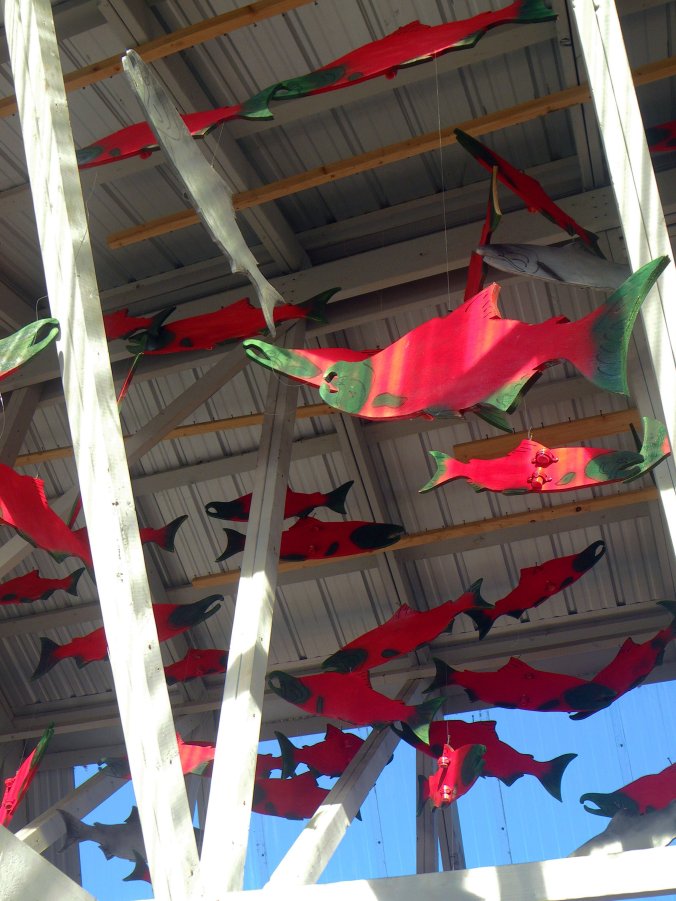
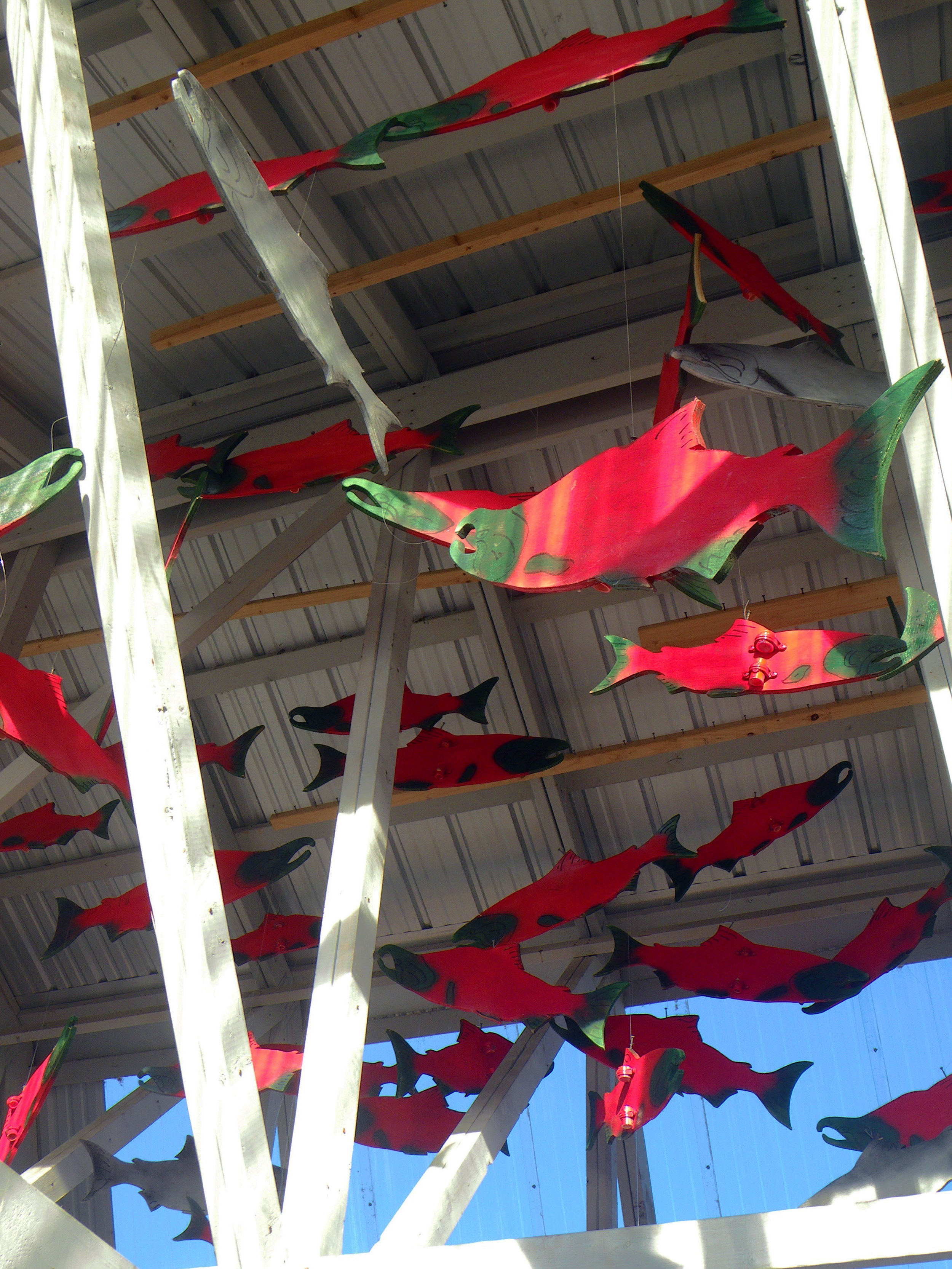
Sculpture, Ninilchik, AK Fairgrounds -Photo by Tim GillerSculpture, Ninilchik, AK Fairgrounds -Photo by Tim Giller

Sculpture, Ninilchik, AK Fairgrounds -Photo by Tim Giller

Alaska is spiritually made from salmon. The esteem for these animals is ancient. Tlingit totem poles honor them. Native songs are sung to them. They are thanked for giving themselves so abundantly. Modern folks have fetishized them with t-shirts, murals, sculptures, the earrings on a woman at the county fair. The first massive Chinook of the season is ceremonially flown into Seattle. When a creature is so abundant that the biggest version of Brown bear can cohabitate in large numbers peacefully sharing them, that is weighty mojo. Kodiak Brown bears know the power of salmon. By gorging on fish all summer they have become the largest carnivore on any continent. Their flesh also sustains us. Our spirits are thrilled when we see them leaping a four-foot beaver dam or an eight-foot waterfall. Rachael and I stood on the bank of the Chulitna River watching them, one after another darting up a rocky channel half out of the water, tails furiously thrashing, an embodiment of collective ambition. By feeding our bodies and our minds they also feed our souls.

Salmon2Salmon2

Salmon2

We are vulnerable if we don’t recognize this. This hard won balance of modern commerce with age-old subsistence and healthy ecosystems can only be sustained with vigilance. There seems to be a never-ending desire to trade this elegant system for short term gain. Every season there is pressure to allow for a larger catch. Clear-cutting in the Tongass National Forest has damaged spawning streams. A large scale gold mine is proposed in one of the richest areas of the Bristol Bay drainage. Dam projects, the clearest devastator of salmon are continually proposed. Oil is always the elephant in the room in Alaska. I write this aboard a ferry crossing Prince William Sound, Lil’ Squatch strapped down below decks while abundant sea life, including salmon swims beneath. We see the spouting of large sea mammals. Tall, intermittent clouds of mist are the exhalations of Humpback whales. Quick clusters just above water level mark the furtive risings of porpoises. The Exxon Valdez oil spill is still on the minds of locals here because its residue can still be found on the rocks. We can thank the raw fecundity of this place for the fact that it has rebounded. No place should be repeatedly asked to face such threats.

In the wild salmon of these northern waters there is no better example of the total interconnectedness of the natural world and how we are a part of it. It’s hard to imagine a better example of humans recognizing this and finding a solution. It’s hard not to want to apply this model further and it’s hard no to be worried that our collective memory is too short.

Wild Caught

carcass

Photo by Tim Giller

Alaska is literally made from salmon. At least a certain widely distributed portion of it is. Inland, thousands of river miles from the nearest ocean you can find deep sea nutrients, specific isotopes of nitrogen, carbon, sulfur and phosphorous, in the plants and soil. Every summer for millions of years, fish have returned from the Pacific to the streams from which they were born, powerfully compelled by some internal mechanism, following imperceptible chemical clues that bring them back to the exact stream where their mothers deposited eggs a few seasons before. Bodies transformed in color and shape by new hormones they no longer eat and are fixated on this ultimate act that culminates in death. The lucky ones that survive the gauntlet along the way successfully leave behind many millions of offspring. All are consumed by bears, birds, humans and a whole array of other scavengers. Carcasses decompose streamside nourishing their own spawning beds. Others are dragged abroad into forests, meadows and tundra bringing exotic nutrients to wider ecosystems. The drama plays out on innumerable rivers, streams, creeks and lakes along the 45,000 mile Alaskan coastline from the Inside Passage around to the high arctic. The five species, Chinook, Coho, Sockeye, Chum and Pinks have staggered timing throughout the season between thaw and freeze.

Alaska is metaphorically made from salmon. Many resources have been harvested from this wild land but it probably safe to say that over time none can match the value of these fish. Overfishing by industrialists from outside the region helped inspire the push for statehood and written into the state constitution is language that mandates the sustainable management of the fishery. Other fisheries around the world have collapsed, including formerly rich salmon runs in the Atlantic, Japan and California. Learning from these lessons the Alaskan fishery has been carefully managed and appears to be achieving sustainability. It is a huge part of the daily tapestry of life in Alaska. We’ve encountered conversations about whose turn it was on a local fish wheel. We’ve come across the weekly river sonar readings that determine daily catch limits. Dip nets and fishing tackle decorate cabins and country stores. After tuning in the on-air classifieds (“My black lab, Tug is still on the loose if anyone spots him let me know. Oh yeah I still have those burn barrels for sale too.”), we listen to a detailed fishery report on the local radio station. There are jobs on fishing boats and in canneries and a rich supply of healthy food on thousands of diner tables. The boisterous weekend-warrior fishermen who woke us at 3am at our creekside campsite are spending money in the local community. With restraint the resource is essentially infinite; we could expect these species to outlive ours.

Sculpture, Ninilchik, AK Fairgrounds -Photo by Tim Giller

Sculpture, Ninilchik, AK Fairgrounds -Photo by Tim Giller

Alaska is spiritually made from salmon. The esteem for these animals is ancient. Tlingit totem poles honor them. Native songs are sung to them. They are thanked for giving themselves so abundantly. Modern folks have fetishized them with t-shirts, murals, sculptures, the earrings on a woman at the county fair. The first massive Chinook of the season is ceremonially flown into Seattle. When a creature is so abundant that the biggest version of Brown bear can cohabitate in large numbers peacefully sharing them, that is weighty mojo. Kodiak Brown bears know the power of salmon. By gorging on fish all summer they have become the largest carnivore on any continent. Their flesh also sustains us. Our spirits are thrilled when we see them leaping a four-foot beaver dam or an eight-foot waterfall. Rachael and I stood on the bank of the Chulitna River watching them, one after another darting up a rocky channel half out of the water, tails furiously thrashing, an embodiment of collective ambition. By feeding our bodies and our minds they also feed our souls.

Salmon2

Sockeye -Photo by Tim Giller

We are vulnerable if we don’t recognize this. This hard won balance of modern commerce with age-old subsistence and healthy ecosystems can only be sustained with vigilance. There seems to be a never-ending desire to trade this elegant system for short term gain. Every season there is pressure to allow for a larger catch. Clear-cutting in the Tongass National Forest has damaged spawning streams. A large scale gold mine is proposed in one of the richest areas of the Bristol Bay drainage. Dam projects, the clearest devastator of salmon are continually proposed. Oil is always the elephant in the room in Alaska. I write this aboard a ferry crossing Prince William Sound, Lil’ Squatch strapped down below decks while abundant sea life, including salmon swims beneath. We see the spouting of large sea mammals. Tall, intermittent clouds of mist are the exhalations of Humpback whales. Quick clusters just above water level mark the furtive risings of porpoises. The Exxon Valdez oil spill is still on the minds of locals here because its residue can still be found on the rocks. We can thank the raw fecundity of this place for the fact that it has rebounded. No place should be repeatedly asked to face such threats.

In the wild salmon of these northern waters there is no better example of the total interconnectedness of the natural world and how we are a part of it. It’s hard to imagine a better example of humans recognizing this and finding a solution. It’s hard not to want to apply this model further and it’s hard no to be worried that our collective memory is too short.

Off Trail

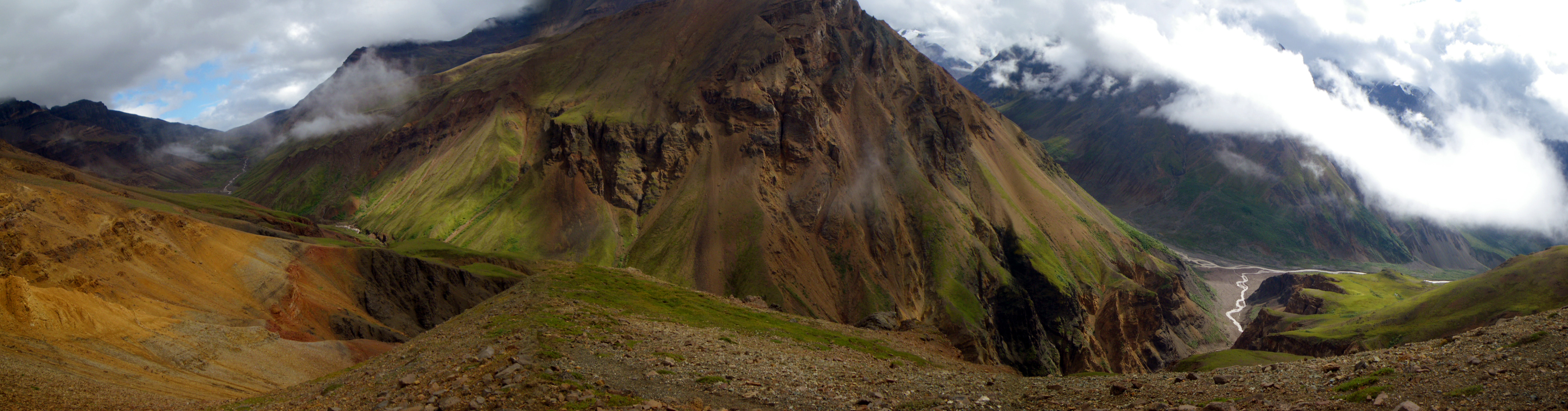
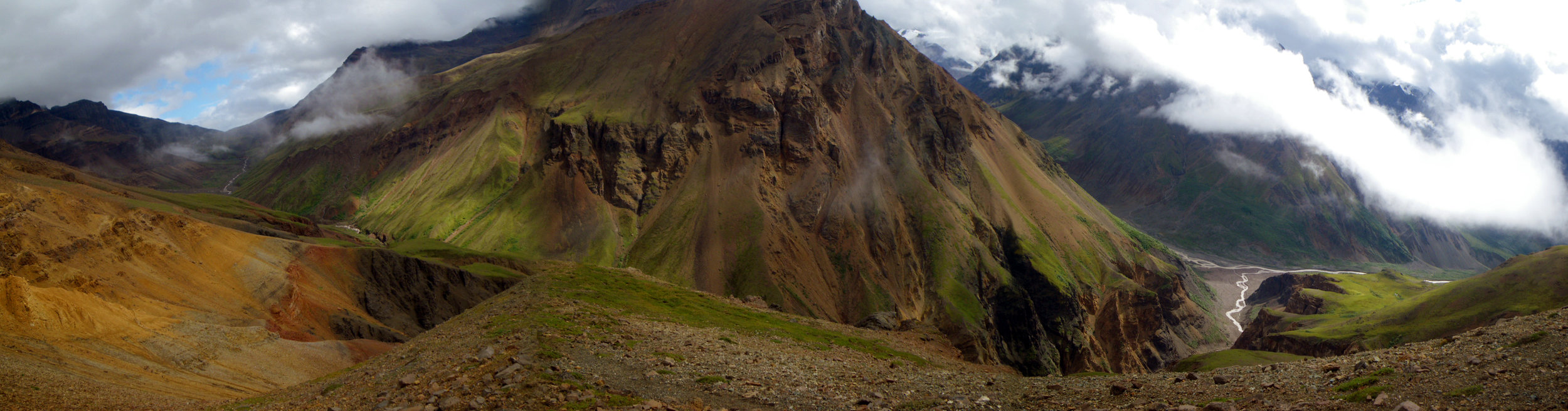
Chitistone Canyon, Wrangell-St Elias NP - Photo by Tim GillerChitistone Canyon, Wrangell-St Elias NP - Photo by Tim Giller

Chitistone Canyon, Wrangell-St Elias NP – Photo by Tim Giller

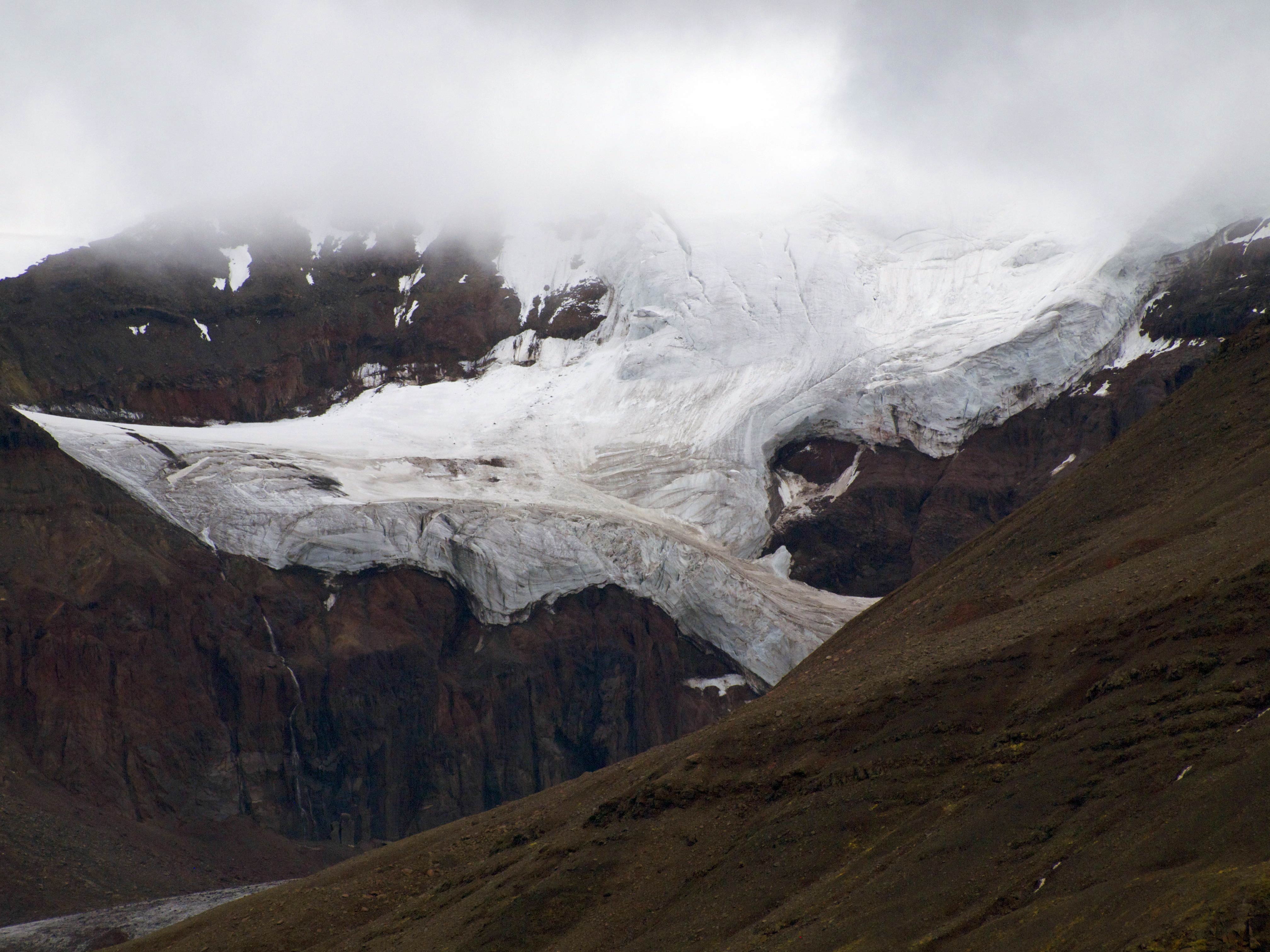
When our bush plane flew away we immediately felt awfully small in an awfully big place. All our vehicles and modern modes of transportation, even slow and diminutive houses with wheels, have abstracted the size of the world giving us the impression that it’s not the large place it really is. Standing in the heart of a truly immense wilderness that has no real trails to speak of, the silence settled in and we began to sense the true size of things. The land in the Wrangell Mountains is vast and open with tree line at this latitude a thousand feet below us. Our plateau is covered with moss, lichen, miniature shrubs and ground hugging berry bushes, just enough vegetation to soften the landscape and obscure some of its surprises. Towering around us are peaks capped in overhangs of permanent ice and the buttes of Wolverine Mountain slope down to our boots.

Hanging Glacier, Wrangell-St Elias NP - Photo by Tim GillerHanging Glacier, Wrangell-St Elias NP - Photo by Tim Giller

Hanging Glacier, Wrangell-St Elias NP – Photo by Tim Giller

In Alaska nobody holds your hand. We are expected to know how to handle ourselves out here and find our way over the next six days to our exit point.

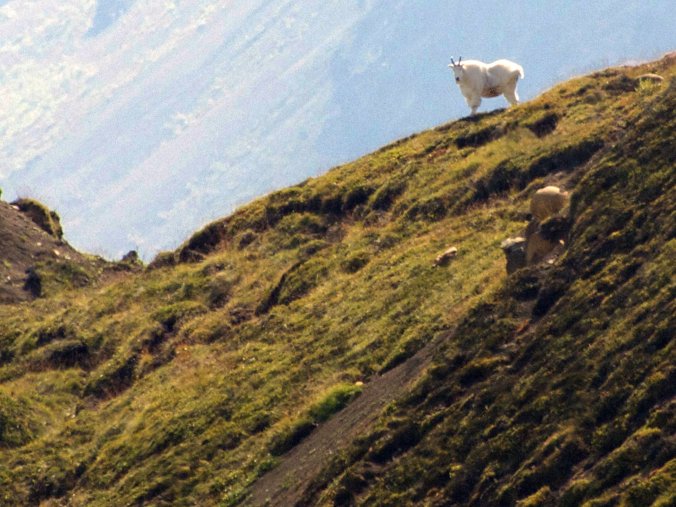
Mountain Goat, Wrangell-St Elias NP - Photo by Tim GillerMountain Goat, Wrangell-St Elias NP - Photo by Tim Giller

Mountain Goat, Wrangell-St Elias NP – Photo by Tim Giller

We have a route, many others have been here before, but we are utterly alone and will see no one until the very end of our walk. In my pack are the most detailed maps available, which in Alaska means that you can clearly see the major features, but that long gradual ridgeline we’re about to traverse has a half dozen uncharted 80ft deep gullies that we’ll just have to discover for ourselves. It’s a terrain one measures not in miles but in hours and vistas.

It is also a terrain that demands a lot of focused attention and this is one of the joys of wilderness travel. I can definitely appreciate a well-constructed trail that allows you walk into a wild place. However on a long march over an easy to follow path your mind can and will wander to any old thought. When you travel cross-country charting out your own route you need to be present. The peaks and ridges become your guideposts. The slopes, cliffs and rivers shape your route. Each boulder and willow thicket alters your course. The soil, stones and plants influence each footstep. You pay attention. You see the place.

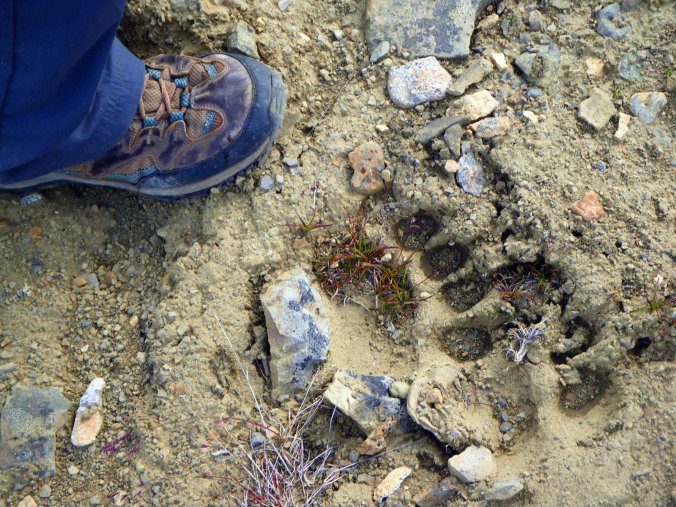
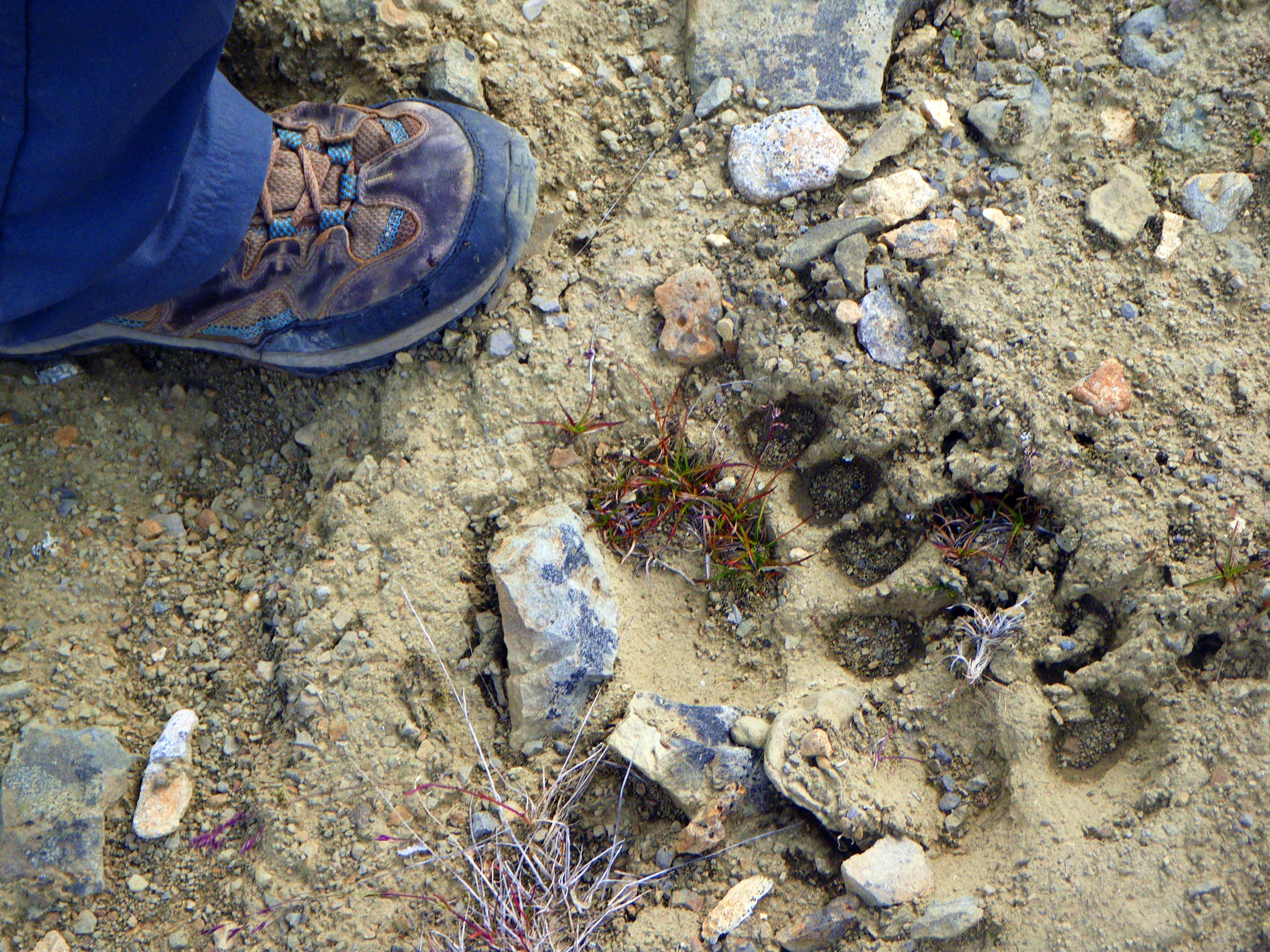
Bear Tracks, Wrangell-St Elias NP - Photo by Tim GillerBear Tracks, Wrangell-St Elias NP - Photo by Tim Giller

Bear Tracks, Wrangell-St Elias NP – Photo by Tim Giller

When you pay this kind of attention to the land it will show you things. On high cliffs are quiet creatures slowly moving and easily missed. Unconcerned Mountain Goats and Dall Sheep, white dots on tan ledges, look down with the confidence that few can stomach the climb. We hear the denial of a Ptarmigan mumbling “uh-uh” from the willows just a couple yards away, sitting still and indistinguishable from the local rock. Our first afternoon is spent repeatedly crossing the tracks of a Grizzly bear, confirming that this just might be the most sensible route over the pass. How old are these tracks? Old enough we decide, although we both had noticed plenty of berries to attract others. A big place is made up of small things. Even the rocks revealed their stories.

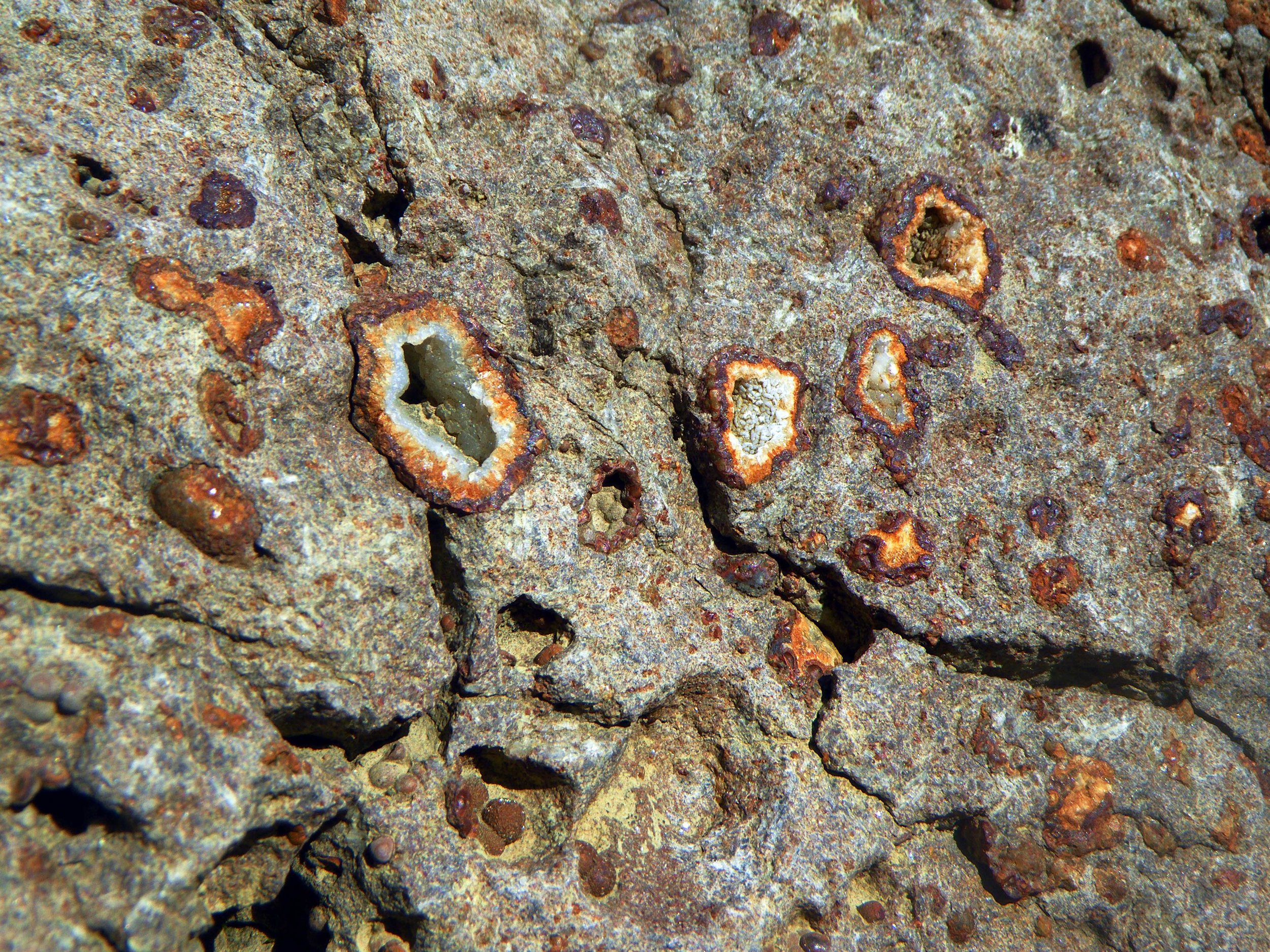
Geodes, Wrangell-St Elias NP - Photo by Tim GillerGeodes, Wrangell-St Elias NP - Photo by Tim Giller

Geodes, Wrangell-St Elias NP – Photo by Tim Giller

We stopped to examine fossils; sea life of some far distant time turned to stone and lifted way up here. The mountain flanks and valleys were filled with crystals encased in broken stones called geodes, clues to eons of subterranean activity.

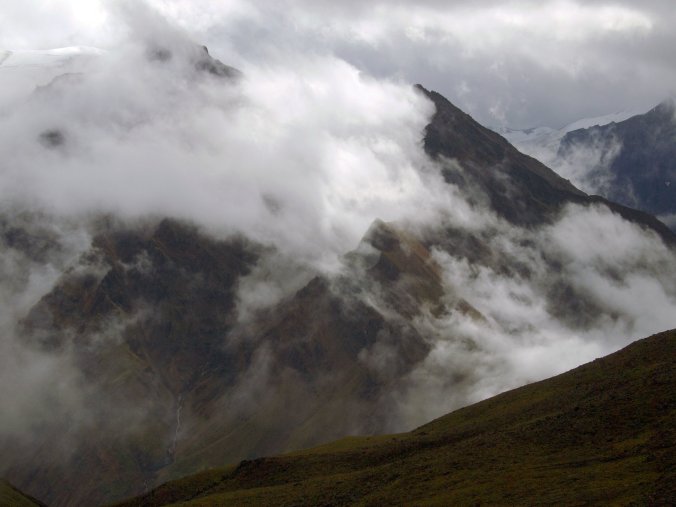
Wrangell-St Elias NP - Photo by Tim GilerWrangell-St Elias NP - Photo by Tim Giler

Wrangell-St Elias NP – Photo by Tim Giler

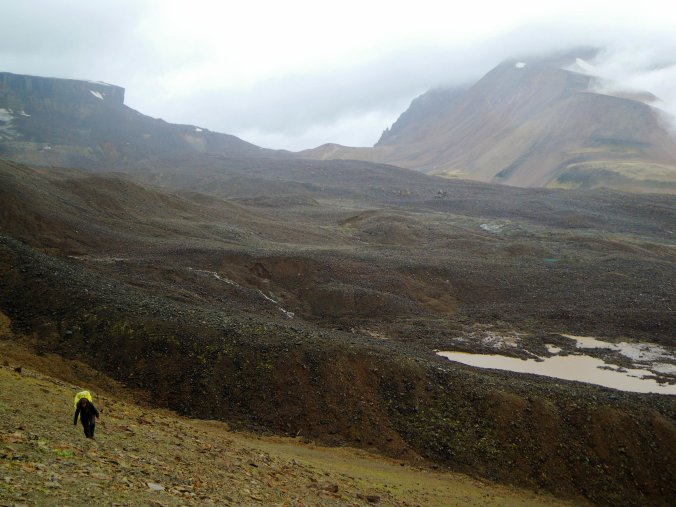
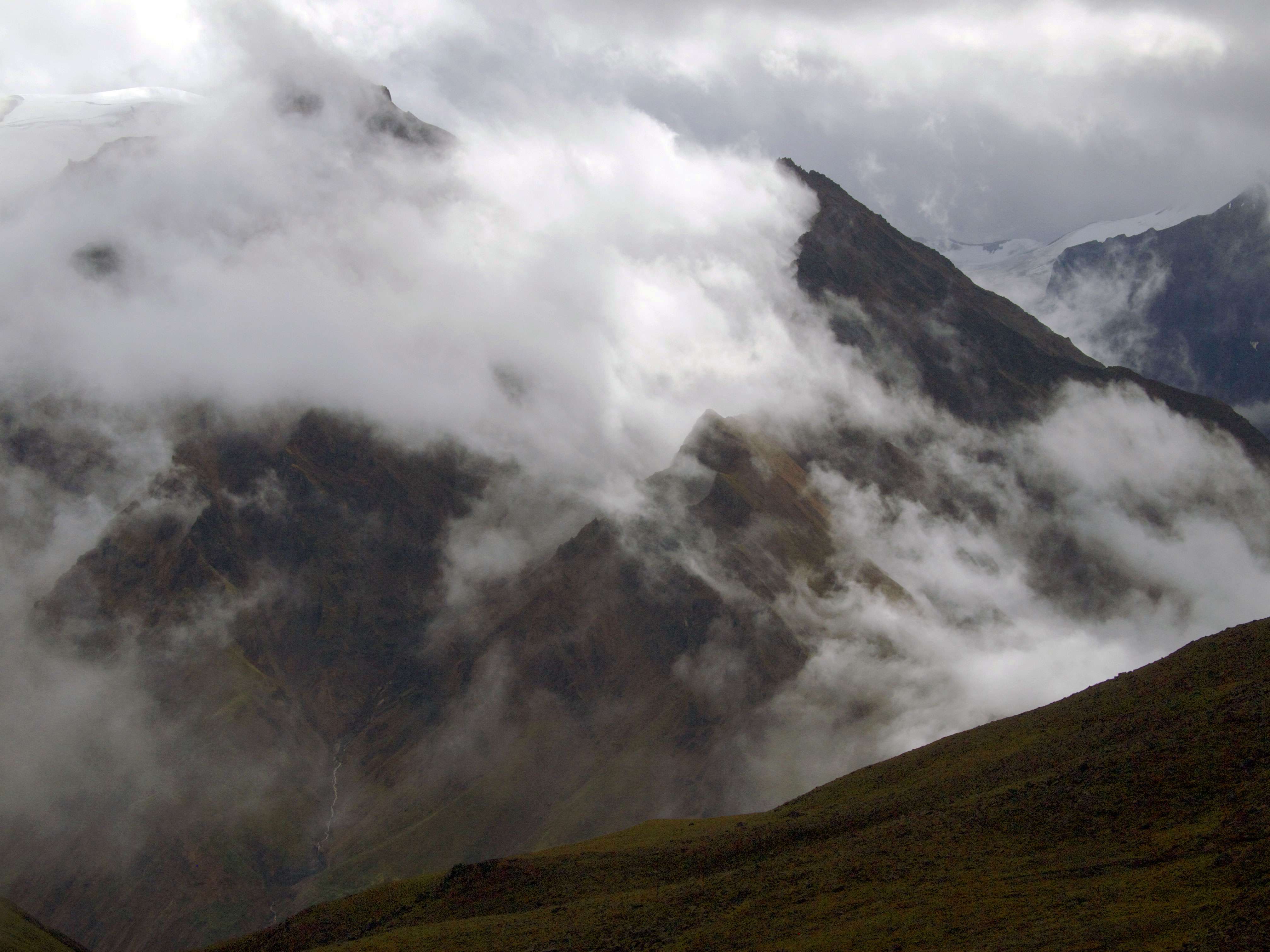
The big mountains create big weather and the long northern daylight makes the hours slip by. Swirls of mist wrap the arêtes and couloirs as we boulder hop across a mile wide rock glacier consuming an afternoon before we notice.

Rock Glacier, Wrangell-St Elias NP - Photo by Tim GillerRock Glacier, Wrangell-St Elias NP - Photo by Tim Giller

Rock Glacier, Wrangell-St Elias NP – Photo by Tim Giller

Weather and time and landscape intertwine, clouds and rainfall settling in on us then blowing away leaving new snow on the cliff faces above as we slog with sodden boots across a rain soaked hill side. The ground squishes, barely solid. Our boots squish, our woolen socks saturated.

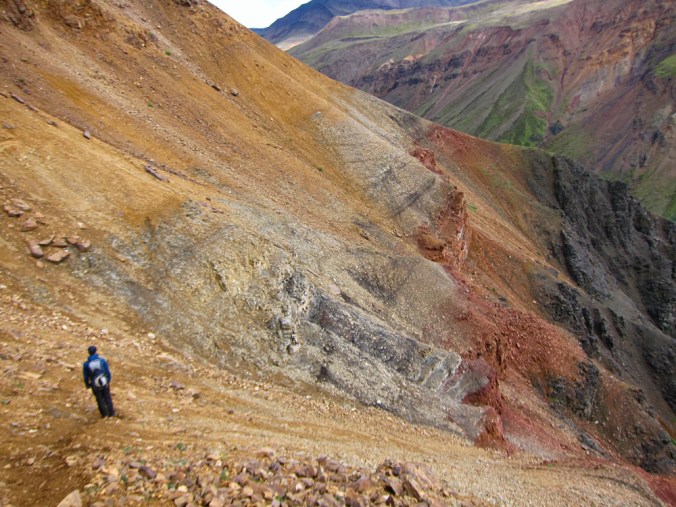
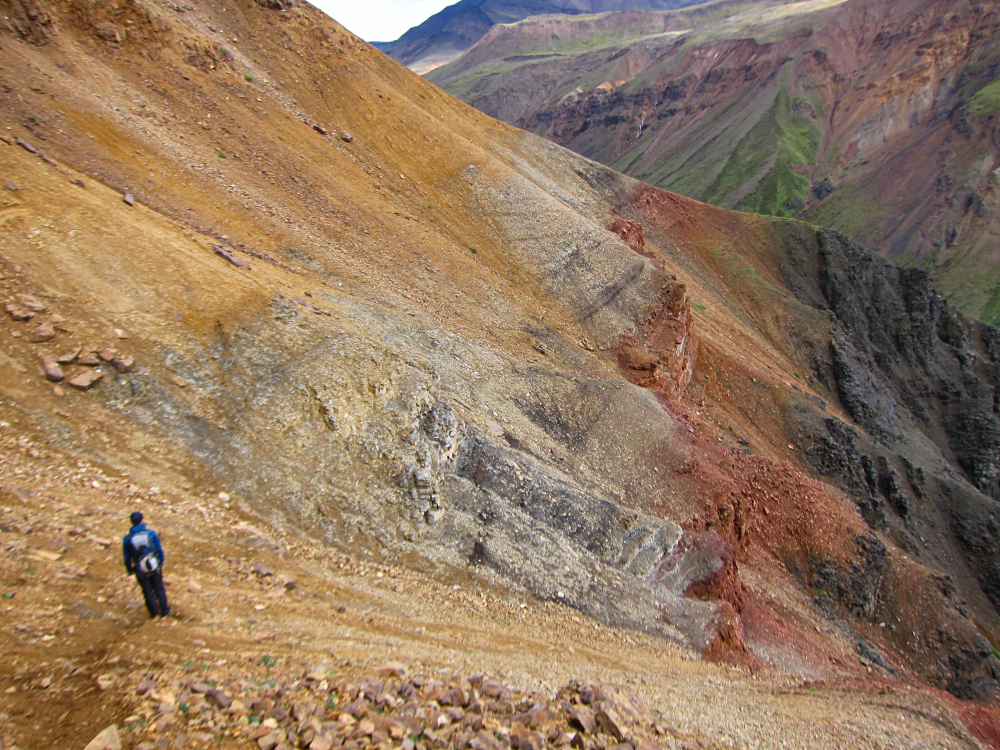
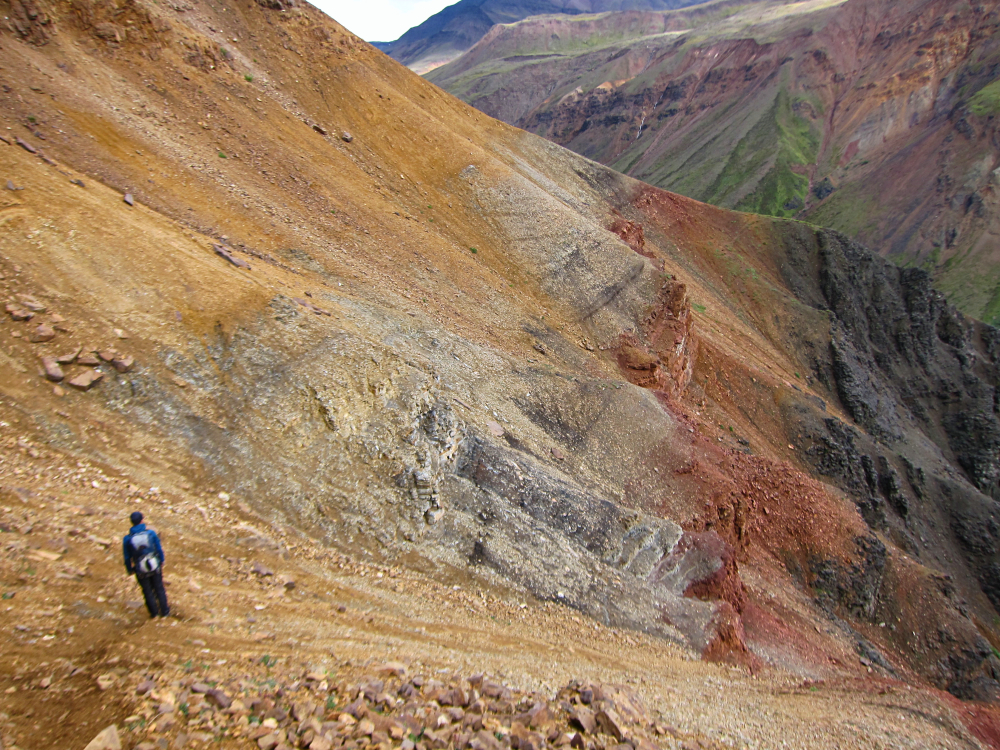
One afternoon we are grateful that the rain, fog and wind give pause as we navigate across a 60-degree slope of loose scree above a 1500 cliff.

Scree Slopes, Wrangell-St Elias NP - Photo by Rachael BrownScree Slopes, Wrangell-St Elias NP - Photo by Rachael Brown

Scree Slopes, Wrangell-St Elias NP – Photo by Rachael Brown

Brazen sheep tracks here create confusing and dangerous alternative routes.

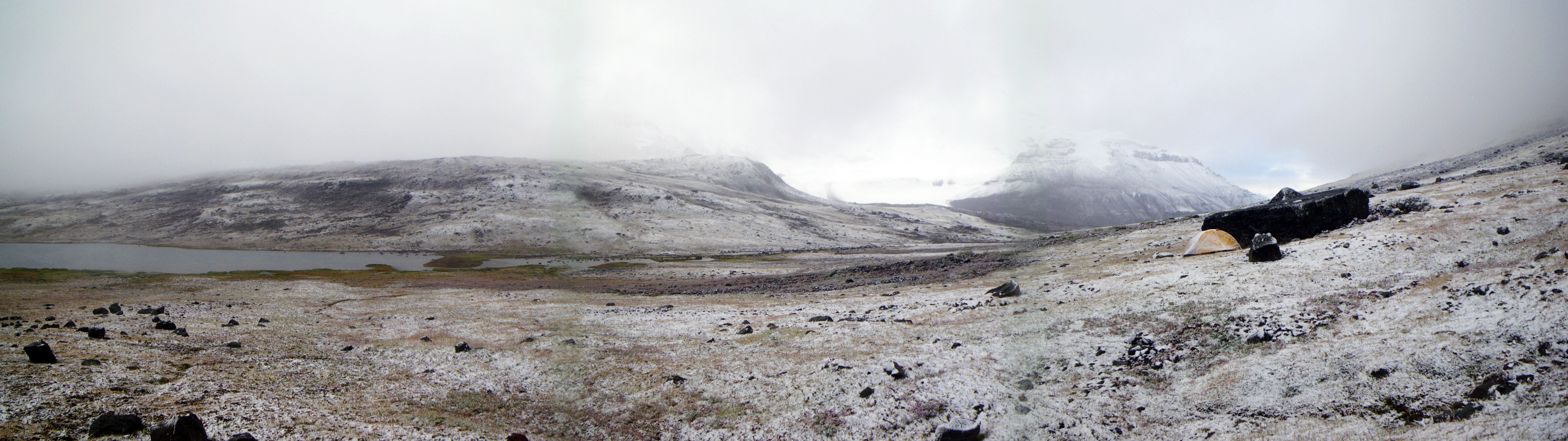
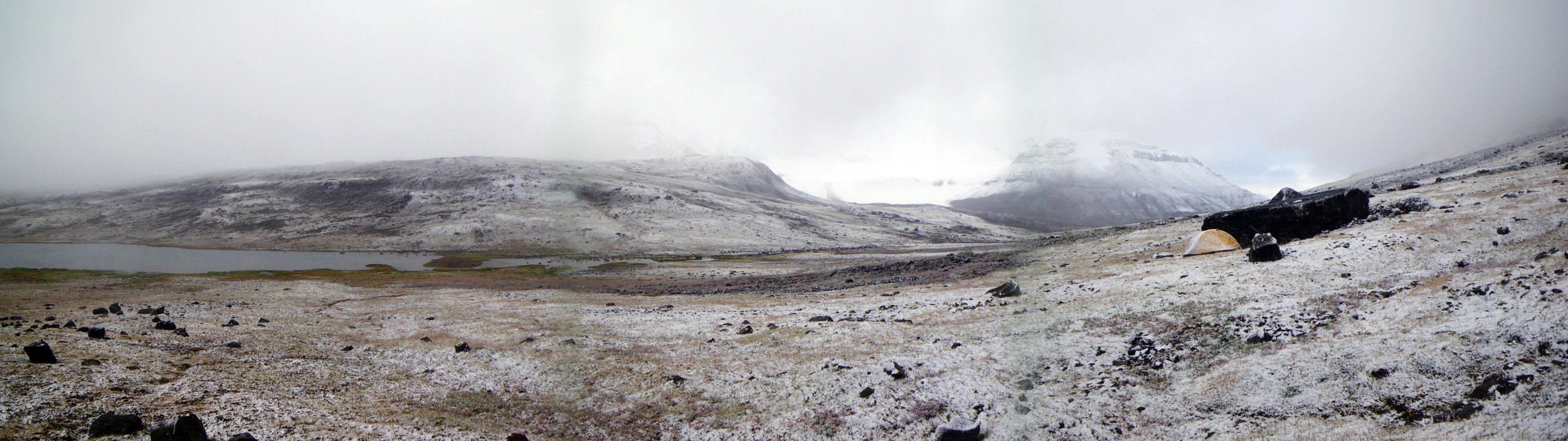
Four nights in we make camp at a beautiful cold lake just below a high pass, chill winds pouring on us from icefields on three sides above and the whistles of Hoary Marmots announcing our arrival. We bed down during a heavy drizzle as a band of twenty Caribou wander past, slowly and continuously moving unfazed by our presence. When we wake the next morning the drizzle has become a crust of ice and snow; the ground, the sky and the glaciers are hard to differentiate in the loose fog.

Chitistone Pass, Wrangell-St Elias NP - Photo by Tim GillerChitistone Pass, Wrangell-St Elias NP - Photo by Tim Giller

Chitistone Pass, Wrangell-St Elias NP – Photo by Tim Giller

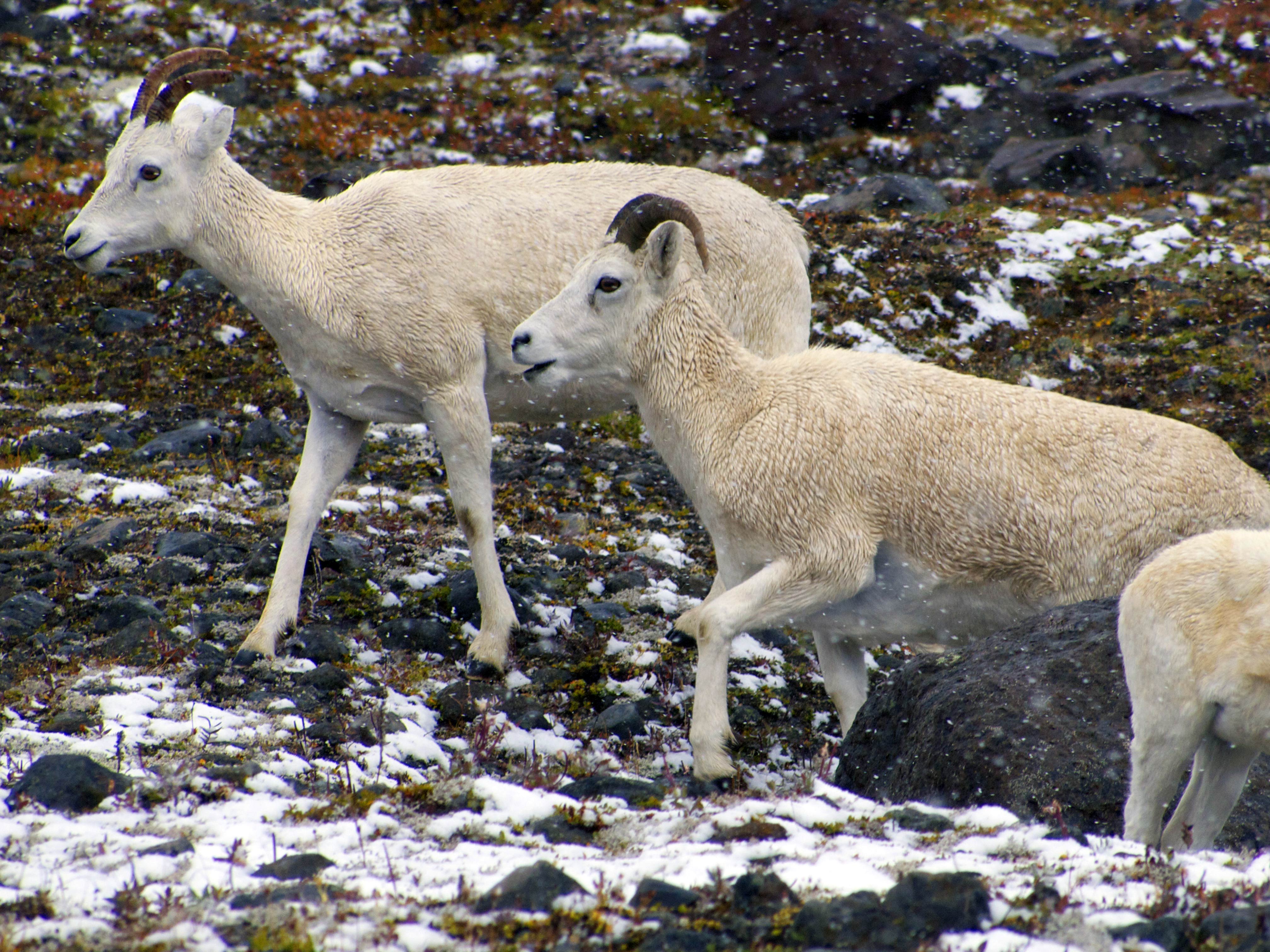
We are grateful of our modest preparation for the elements and some wet weather methods we’ve scrabbled together. The new aspect of the landscape is compelling and we are in no hurry, walking just quickly enough to keep warm. As we come to the crest of our last pass we can see through the snow flurries a long sun-dappled valley well below and a clear snow line melting upward to meet us as the storm breaks all around. The recent weather is pouring off the cliff tops in a myriad of evanescent waterfalls. The snow, the stunning land, the whole place has calmed us. At this moment we notice that a group of Dall Sheep is moving our way. They notice us but barely pause. They continue toward us, browsing the thin vegetation as they continue on their route towards the high tundra where we were just camped. In the long moment shared with them we can see their breath and the wetness in their hides, can hear the hoof steps and the chewing of plants. We are all present. We are all calmly paying attention.

Dall Sheep, Wrangell-St Elias NP - Photo by Tim GillerDall Sheep, Wrangell-St Elias NP - Photo by Tim Giller

Dall Sheep, Wrangell-St Elias NP – Photo by Tim Giller

Off Trail

Chitistone Canyon, Wrangell-St Elias NP - Photo by Tim Giller

Chitistone Canyon, Wrangell-St Elias NP – Photo by Tim Giller

When our bush plane flew away we immediately felt awfully small in an awfully big place. All our vehicles and modern modes of transportation, even slow and diminutive houses with wheels, have abstracted the size of the world giving us the impression that it’s not the large place it really is. Standing in the heart of a truly immense wilderness that has no real trails to speak of, the silence settled in and we began to sense the true size of things. The land in the Wrangell Mountains is vast and open with tree line at this latitude a thousand feet below us. Our plateau is covered with moss, lichen, miniature shrubs and ground hugging berry bushes, just enough vegetation to soften the landscape and obscure some of its surprises. Towering around us are peaks capped in overhangs of permanent ice and the buttes of Wolverine Mountain slope down to our boots.

Hanging Glacier, Wrangell-St Elias NP - Photo by Tim Giller

Hanging Glacier, Wrangell-St Elias NP – Photo by Tim Giller

In Alaska nobody holds your hand. We are expected to know how to handle ourselves out here and find our way over the next six days to our exit point.


Mountain Goat, Wrangell-St Elias NP - Photo by Tim Giller

Mountain Goat, Wrangell-St Elias NP – Photo by Tim Giller

We have a route, many others have been here before, but we are utterly alone and will see no one until the very end of our walk. In my pack are the most detailed maps available, which in Alaska means that you can clearly see the major features, but that long gradual ridgeline we’re about to traverse has a half dozen uncharted 80ft deep gullies that we’ll just have to discover for ourselves. It’s a terrain one measures not in miles but in hours and vistas.

It is also a terrain that demands a lot of focused attention and this is one of the joys of wilderness travel. I can definitely appreciate a well-constructed trail that allows you walk into a wild place. However on a long march over an easy to follow path your mind can and will wander to any old thought. When you travel cross-country charting out your own route you need to be present. The peaks and ridges become your guideposts. The slopes, cliffs and rivers shape your route. Each boulder and willow thicket alters your course. The soil, stones and plants influence each footstep. You pay attention. You see the place.

Bear Tracks, Wrangell-St Elias NP - Photo by Tim Giller

Bear Tracks, Wrangell-St Elias NP – Photo by Tim Giller

When you pay this kind of attention to the land it will show you things. On high cliffs are quiet creatures slowly moving and easily missed. Unconcerned Mountain Goats and Dall Sheep, white dots on tan ledges, look down with the confidence that few can stomach the climb. We hear the denial of a Ptarmigan mumbling “uh-uh” from the willows just a couple yards away, sitting still and indistinguishable from the local rock. Our first afternoon is spent repeatedly crossing the tracks of a Grizzly bear, confirming that this just might be the most sensible route over the pass. How old are these tracks? Old enough we decide, although we both had noticed plenty of berries to attract others. A big place is made up of small things. Even the rocks revealed their stories.

Geodes, Wrangell-St Elias NP - Photo by Tim Giller

Geodes, Wrangell-St Elias NP – Photo by Tim Giller

We stopped to examine fossils; sea life of some far distant time turned to stone and lifted way up here. The mountain flanks and valleys were filled with crystals encased in broken stones called geodes, clues to eons of subterranean activity.

Wrangell-St Elias NP - Photo by Tim Giler

Wrangell-St Elias NP – Photo by Tim Giler

The big mountains create big weather and the long northern daylight makes the hours slip by. Swirls of mist wrap the arêtes and couloirs as we boulder hop across a mile wide rock glacier consuming an afternoon before we notice.

Rock Glacier, Wrangell-St Elias NP - Photo by Tim Giller

Rock Glacier, Wrangell-St Elias NP – Photo by Tim Giller

Weather and time and landscape intertwine, clouds and rainfall settling in on us then blowing away leaving new snow on the cliff faces above as we slog with sodden boots across a rain soaked hill side. The ground squishes, barely solid. Our boots squish, our woolen socks saturated.

One afternoon we are grateful that the rain, fog and wind give pause as we navigate across a 60-degree slope of loose scree above a 1500 cliff.

Scree Slopes, Wrangell-St Elias NP - Photo by Rachael Brown

Scree Slopes, Wrangell-St Elias NP – Photo by Rachael Brown

Brazen sheep tracks here create confusing and dangerous alternative routes.

Four nights in we make camp at a beautiful cold lake just below a high pass, chill winds pouring on us from icefields on three sides above and the whistles of Hoary Marmots announcing our arrival. We bed down during a heavy drizzle as a band of twenty Caribou wander past, slowly and continuously moving unfazed by our presence. When we wake the next morning the drizzle has become a crust of ice and snow; the ground, the sky and the glaciers are hard to differentiate in the loose fog.

Chitistone Pass, Wrangell-St Elias NP - Photo by Tim Giller

Chitistone Pass, Wrangell-St Elias NP – Photo by Tim Giller

We are grateful of our modest preparation for the elements and some wet weather methods we’ve scrabbled together. The new aspect of the landscape is compelling and we are in no hurry, walking just quickly enough to keep warm. As we come to the crest of our last pass we can see through the snow flurries a long sun-dappled valley well below and a clear snow line melting upward to meet us as the storm breaks all around. The recent weather is pouring off the cliff tops in a myriad of evanescent waterfalls. The snow, the stunning land, the whole place has calmed us. At this moment we notice that a group of Dall Sheep is moving our way. They notice us but barely pause. They continue toward us, browsing the thin vegetation as they continue on their route towards the high tundra where we were just camped. In the long moment shared with them we can see their breath and the wetness in their hides, can hear the hoof steps and the chewing of plants. We are all present. We are all calmly paying attention.

Dall Sheep, Wrangell-St Elias NP - Photo by Tim Giller

Dall Sheep, Wrangell-St Elias NP – Photo by Tim Giller

Roads North

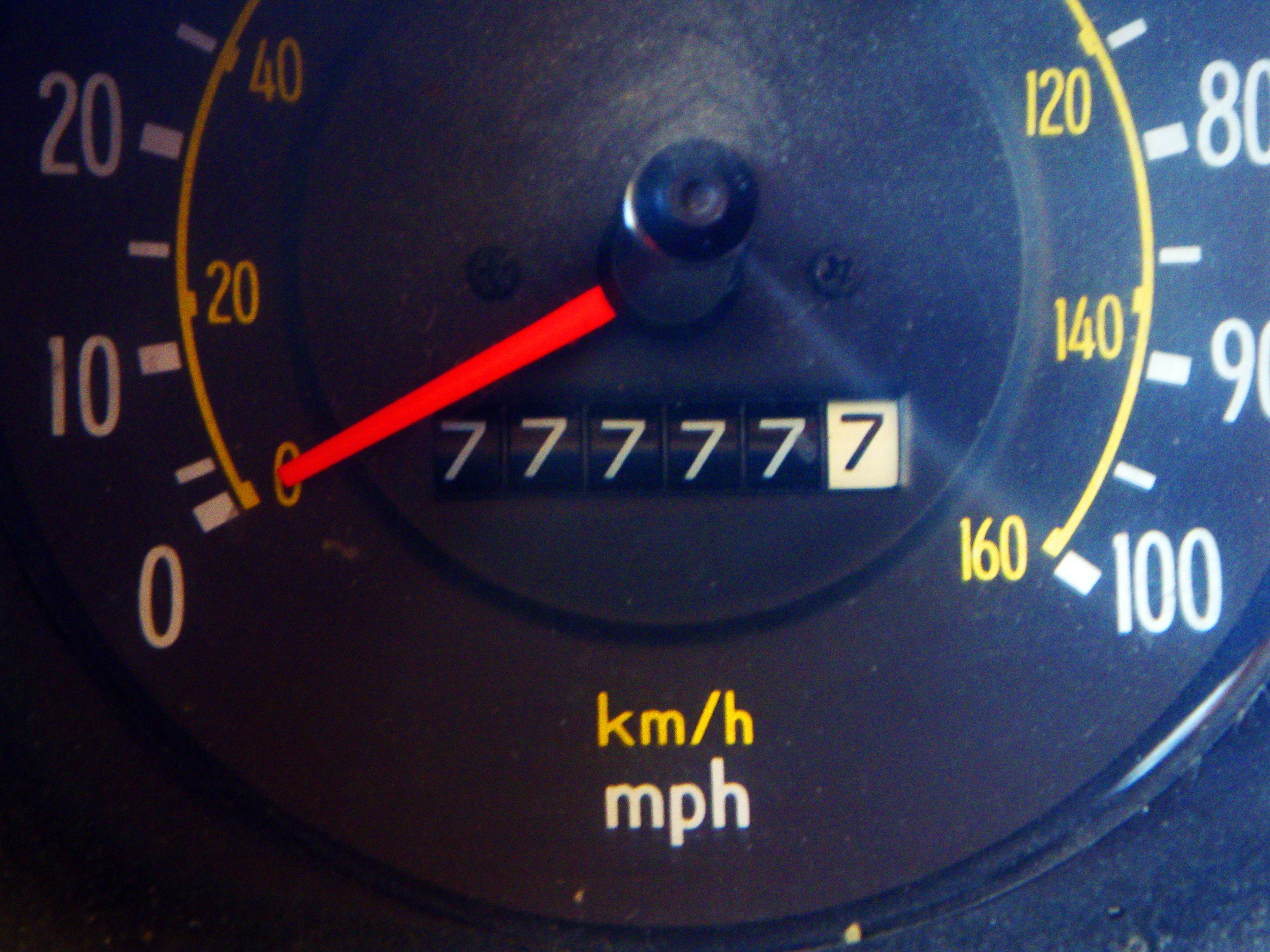
Lil' Squatch hit the Jackpot near the Alaskan border.Lil' Squatch hit the Jackpot near the Alaskan border.

Lil’ Squatch hit the Jackpot near the Alaskan border.

One nice thing about being the slowest little jalopy on the road is that we most often have a long unobstructed view of the landscape ahead. This also means that we sometimes have a long string of less than patient vehicles trailing behind us, but we’re considerate people and we get out of the way when there’s a chance to let folks pass. My hopes are that most people can understand the obvious limitations of our ride and that the ambiguous “Keepin’ it Squatchy” bumper sticker is less aggravating than having one that says, “I may be slow but I’m ahead of you”.

Spending a week on the Alaskan highway or “Al-Can” is giving us plenty of stretches of unobstructed views. This road was built during World War 2 in order to give better supply access to our territory in Alaska when it was otherwise much more accessible to the Japanese. It was built rather quickly by U.S. Army road crews who dealt with mud and muskegs, dense forests thick with bugs and sub- freezing conditions all while improvising the route and inventing building techniques for the tough environment. It was tough to build and tough to drive and when opened to the public after the war it became an adventurous route to the Last Frontier of the North.

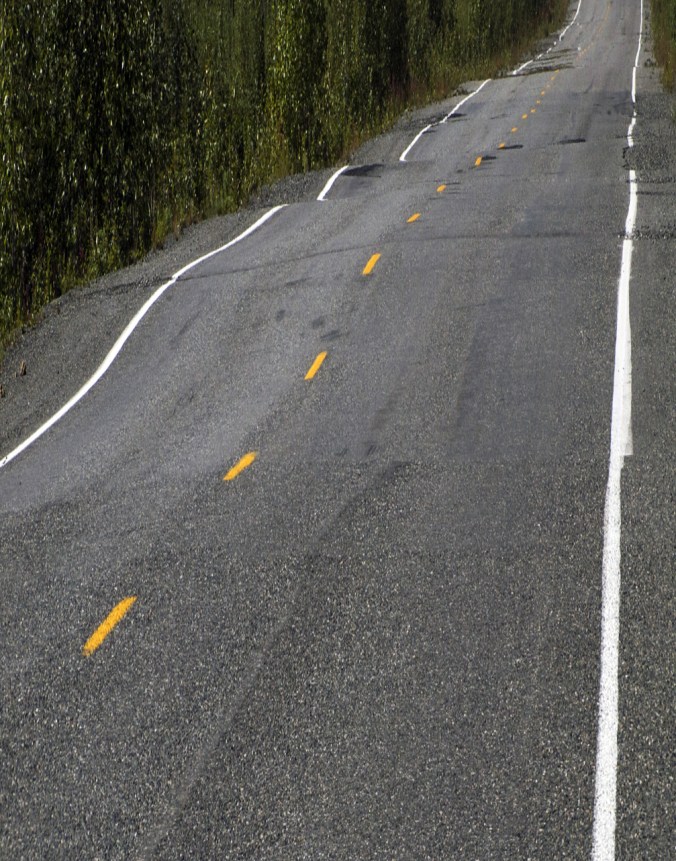
Frost Heave on the Al-Can - Photo by Tim GillerFrost Heave on the Al-Can - Photo by Tim Giller

Frost Heave on the Al-Can – Photo by Tim Giller

Today the adventure is steering clear of overloaded logging trucks and oversized rigs carrying massive equipment for the oil and gas fields in remote Alberta and British Columbia. The road has been re-routed in many areas and is almost entirely paved, except in long gravel sections where road crews are busy cramming a years worth of maintenance into a short summer. The log “corduroy” across soggy permafrost and mud grades of 26% are long gone but the land refuses to hold a road in places that freeze and thaw so dramatically. Lil’ Squatch still has to dodge bathtub sized

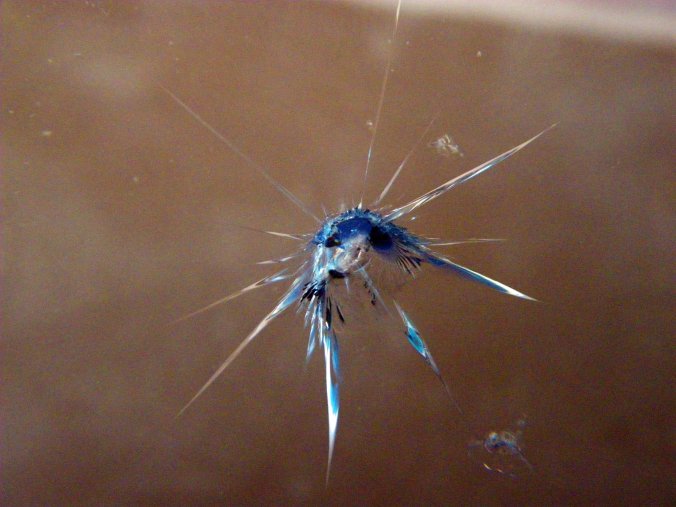
Squatch's windshield - Photo by Tim GillerSquatch's windshield - Photo by Tim Giller

Squatch’s windshield – Photo by Tim Giller

chuckholes and ride long miles of frost-heave rollercoaster and when tractor trailers are barreling down on you flinging gravel it’s not if you’ll get a chip in your windshield but how many.

What remains remarkably wild about this journey though is the land. In these far corners of Canada and where it meets Alaska are some of the best-protected swaths of wilderness anywhere on Earth. The rush to extract from these vast acres is visible along the drive, but there is still a lot land that supports all the wildest things in North America. The Boreal Forest stretches around the northern globe as the largest ecoregion on the planet. A land for Bears, Moose, Caribou, Wolves, innumerable summer birds and all the other creatures hidden in the dense spruce. Where the road cuts through is an opportunity to see many of these animals as they come to edge zone and a 1500 mile drive means it’s almost a guarantee to spot some of them.

Roadside Grizzly, Yukon Territory - Photo by Tim GillerRoadside Grizzly, Yukon Territory - Photo by Tim Giller

Roadside Grizzly, Yukon Territory – Photo by Tim Giller

Crossing the Yukon Territory we’ve left the Rocky Mountains but to the south and west rise the biggest region of mountains on the continent. Vast icefields cling to the Kluane range with the St. Elias Mountains beyond stretching into Alaska where they bump into the Wrangells. This bent and folded land is still experiencing the powerful subduction of the Pacific plate and these mountains are still rising, the volcanoes are still smoking and the Earth still quakes with regularity.

It’s hard not to feel ambivalent about roads, especially roads that take you into wild and beautiful places. It is an incredible privilege to have access to places where you experience nature that is untamed and free. But access comes at a cost. I’ve never felt more ambivalent about a road than when I had the chance to share the drive up the Dalton Highway into the farthest north of Alaska and fulfill a long dream of seeing the Brooks Range. It is an incredible land of long tundra horizons and open country where you are free to roam across if you can endure the long miles of unstable and slow squishy ground. There I saw Dall sheep and tiny tree species that didn’t grow above the toe of my boot. I also sat for close to an hour watching a mother grizzly and her cub of the year lolling around together on the soft tussocks between bouts of digging for roots and critters. However the only reason I could be there was this road that was nothing more that an enormous piece of industrial infrastructure servicing the Trans-Alaska oil pipeline and built across the last chance we have to keep a truly immense environment intact.

Roads don’t get built so that naturalists can go visit remote places. One might argue that we have plenty of roads already. Alaska seems to have it’s own ambivalence about the issue. It’s a place that so many dream of coming to, for adventure or to try and live more directly from the land. One look at a road map of Alaska and you see right away that there aren’t many. Access to most of the remote places and to many substantial towns is by plane or by boat or in winter via snowmachine. Even dogsleds are still used. However this big land, and it really is a big land, is not inexhaustible. Roads tend to lead to more roads; access in one place creeps inevitably toward the next and every newcomer wants just one little piece for themselves. It gets played out on a complex tapestry of land use and ownership: federal, state, native, pioneer, visitor vs. local.

A generous gift from an Alaska dipnet fishermanA generous gift from an Alaska dipnet fisherman

A generous gift from an Alaska dipnet fisherman

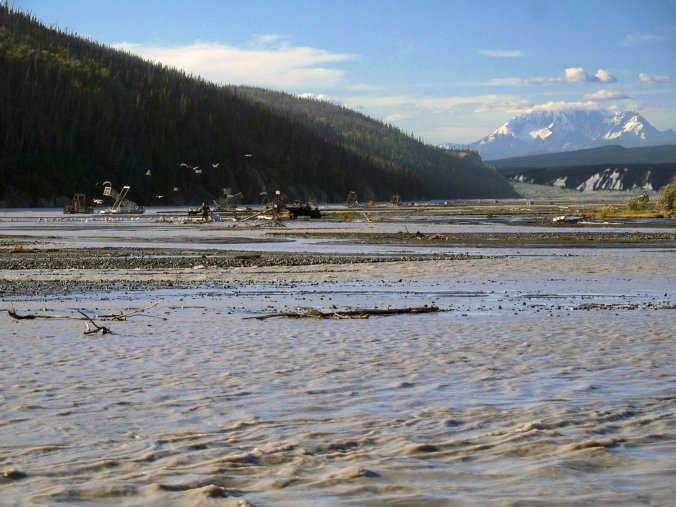
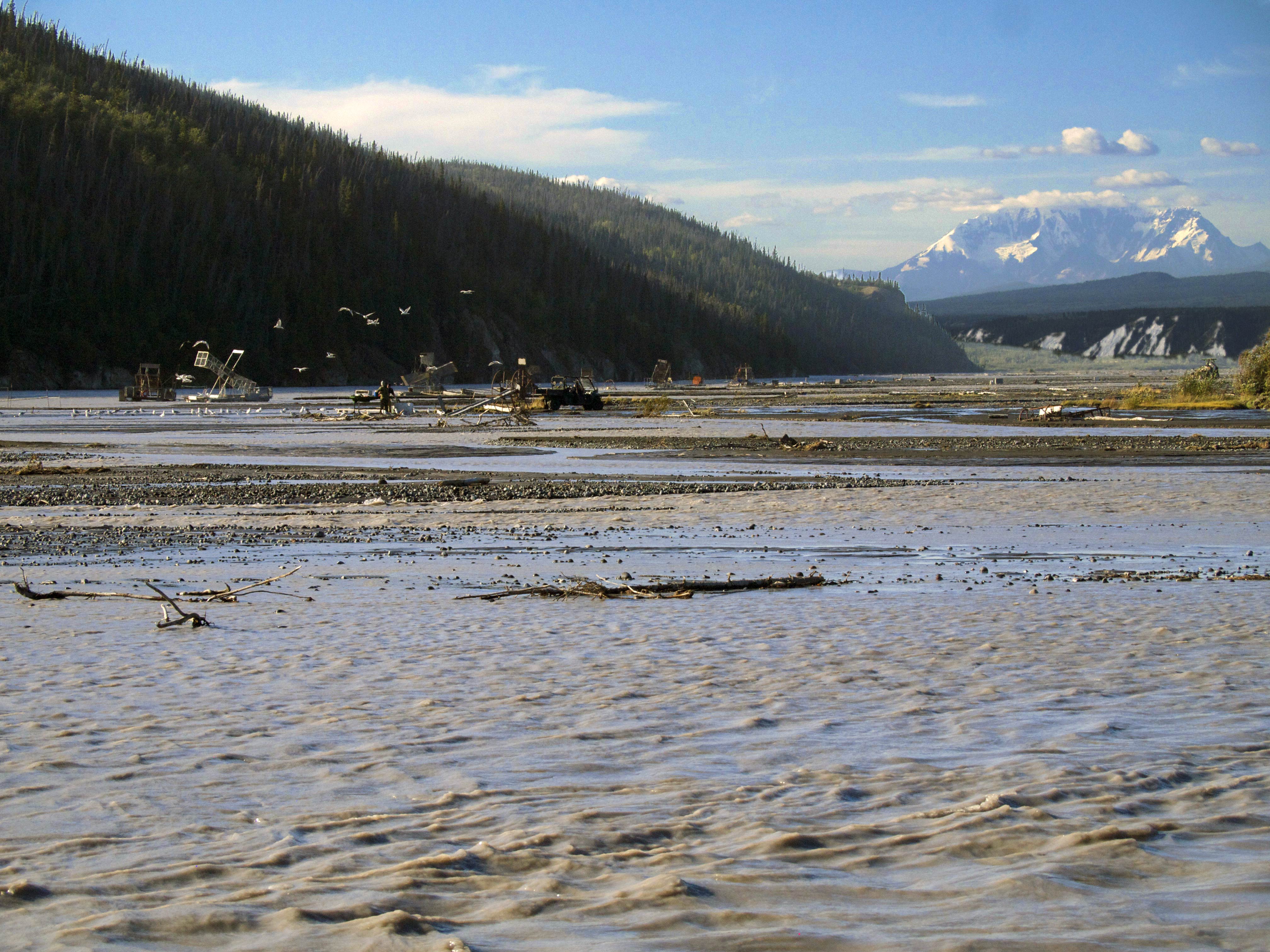
Our road has made a long dramatic hook into the heart of the Wrangell-St. Elias and near the end of the road we’ve come to the confluence of the Chitina and Copper Rivers. Walking out to the edge of a gravel bar, part of the extensive braided watercourses that fill the valley, we watch subsistence fishermen working their fish-wheels gathering Salmon by the basket load while glacier clad peaks rise 14,000 ft beyond. A Dutch traveler approaches us confused about the status of “easement” we are standing on. This is Native Ahtna land within a National Park. We are allowed to visit but activity is rather circumscribed, primarily to protect what is still a productive land that provides for the locals’ needs. Our traveler seems frustrated and disappointed that this wild land is not the free and lawless place of his dreams. With the exception of the first people to enter this place many thousands of years ago, it likely never was.

Fish Wheels and Mt Drum, AK - Photo by Tim GillerFish Wheels and Mt Drum, AK - Photo by Tim Giller

Fish Wheels and Mt Drum, AK – Photo by Tim Giller

Roads North

Lil' Squatch hit the Jackpot near the Alaskan border.

Lil’ Squatch hit the Jackpot near the Alaskan border.

One nice thing about being the slowest little jalopy on the road is that we most often have a long unobstructed view of the landscape ahead. This also means that we sometimes have a long string of less than patient vehicles trailing behind us, but we’re considerate people and we get out of the way when there’s a chance to let folks pass. My hopes are that most people can understand the obvious limitations of our ride and that the ambiguous “Keepin’ it Squatchy” bumper sticker is less aggravating than having one that says, “I may be slow but I’m ahead of you”.

Spending a week on the Alaskan highway or “Al-Can” is giving us plenty of stretches of unobstructed views. This road was built during World War 2 in order to give better supply access to our territory in Alaska when it was otherwise much more accessible to the Japanese. It was built rather quickly by U.S. Army road crews who dealt with mud and muskegs, dense forests thick with bugs and sub- freezing conditions all while improvising the route and inventing building techniques for the tough environment. It was tough to build and tough to drive and when opened to the public after the war it became an adventurous route to the Last Frontier of the North.

Frost Heave on the Al-Can - Photo by Tim Giller

Frost Heave on the Al-Can – Photo by Tim Giller

Today the adventure is steering clear of overloaded logging trucks and oversized rigs carrying massive equipment for the oil and gas fields in remote Alberta and British Columbia. The road has been re-routed in many areas and is almost entirely paved, except in long gravel sections where road crews are busy cramming a years worth of maintenance into a short summer. The log “corduroy” across soggy permafrost and mud grades of 26% are long gone but the land refuses to hold a road in places that freeze and thaw so dramatically. Lil’ Squatch still has to dodge bathtub sized

Squatch's windshield - Photo by Tim Giller

Squatch’s windshield – Photo by Tim Giller

chuckholes and ride long miles of frost-heave rollercoaster and when tractor trailers are barreling down on you flinging gravel it’s not if you’ll get a chip in your windshield but how many.

What remains remarkably wild about this journey though is the land. In these far corners of Canada and where it meets Alaska are some of the best-protected swaths of wilderness anywhere on Earth. The rush to extract from these vast acres is visible along the drive, but there is still a lot land that supports all the wildest things in North America. The Boreal Forest stretches around the northern globe as the largest ecoregion on the planet. A land for Bears, Moose, Caribou, Wolves, innumerable summer birds and all the other creatures hidden in the dense spruce. Where the road cuts through is an opportunity to see many of these animals as they come to edge zone and a 1500 mile drive means it’s almost a guarantee to spot some of them.

Roadside Grizzly, Yukon Territory - Photo by Tim Giller

Roadside Grizzly, Yukon Territory – Photo by Tim Giller

Crossing the Yukon Territory we’ve left the Rocky Mountains but to the south and west rise the biggest region of mountains on the continent. Vast icefields cling to the Kluane range with the St. Elias Mountains beyond stretching into Alaska where they bump into the Wrangells. This bent and folded land is still experiencing the powerful subduction of the Pacific plate and these mountains are still rising, the volcanoes are still smoking and the Earth still quakes with regularity.

It’s hard not to feel ambivalent about roads, especially roads that take you into wild and beautiful places. It is an incredible privilege to have access to places where you experience nature that is untamed and free. But access comes at a cost. I’ve never felt more ambivalent about a road than when I had the chance to share the drive up the Dalton Highway into the farthest north of Alaska and fulfill a long dream of seeing the Brooks Range. It is an incredible land of long tundra horizons and open country where you are free to roam across if you can endure the long miles of unstable and slow squishy ground. There I saw Dall sheep and tiny tree species that didn’t grow above the toe of my boot. I also sat for close to an hour watching a mother grizzly and her cub of the year lolling around together on the soft tussocks between bouts of digging for roots and critters. However the only reason I could be there was this road that was nothing more that an enormous piece of industrial infrastructure servicing the Trans-Alaska oil pipeline and built across the last chance we have to keep a truly immense environment intact.

Roads don’t get built so that naturalists can go visit remote places. One might argue that we have plenty of roads already. Alaska seems to have it’s own ambivalence about the issue. It’s a place that so many dream of coming to, for adventure or to try and live more directly from the land. One look at a road map of Alaska and you see right away that there aren’t many. Access to most of the remote places and to many substantial towns is by plane or by boat or in winter via snowmachine. Even dogsleds are still used. However this big land, and it really is a big land, is not inexhaustible. Roads tend to lead to more roads; access in one place creeps inevitably toward the next and every newcomer wants just one little piece for themselves. It gets played out on a complex tapestry of land use and ownership: federal, state, native, pioneer, visitor vs. local.

A generous gift from an Alaska dipnet fisherman

A generous gift from an Alaska dipnet fisherman

Our road has made a long dramatic hook into the heart of the Wrangell-St. Elias and near the end of the road we’ve come to the confluence of the Chitina and Copper Rivers. Walking out to the edge of a gravel bar, part of the extensive braided watercourses that fill the valley, we watch subsistence fishermen working their fish-wheels gathering Salmon by the basket load while glacier clad peaks rise 14,000 ft beyond. A Dutch traveler approaches us confused about the status of “easement” we are standing on. This is Native Ahtna land within a National Park. We are allowed to visit but activity is rather circumscribed, primarily to protect what is still a productive land that provides for the locals’ needs. Our traveler seems frustrated and disappointed that this wild land is not the free and lawless place of his dreams. With the exception of the first people to enter this place many thousands of years ago, it likely never was.

Fish Wheels and Mt Drum, AK - Photo by Tim Giller

Fish Wheels and Mt Drum, AK – Photo by Tim Giller