The National Monument You’ve Never Heard About

It turns out that south central New Mexico is a lot more dynamic than I had previous understood. I’d been to New Mexico before and did a grand 1100 mile, three day tour from south to north and back again with two girl friends. It was a lot of driving and a whole lot of fun and I loved every inch of New Mexico. Even though my friend had been living in the town of Las Cruces we were only in and out in order to see other places. In my and Tim’s travels we met a couple who mentioned the museum in Deming NM and so we made a point to check it out. They have great displays of early life in Deming and are rightfully famous for their collection of Mogollon pottery. It’s worth a detour if you’re in the area.
We also ended up spending at least one more day than we meant to in Las Cruces. Such a chain of events took place and we had the chance to talk to some wonderful people that we realized if we didn’t just leave we could be there for the rest of the year exploring all it had to offer in nearby outdoor activities. For our second night in town we ditched the over priced rv park and headed for a the nearby national monument to see what it was all about. The Prehistoric Trackways National Monument was founded in 2009 in order to protect what was an incredible discovery some 22 years earlier by amateur paleontologist Jerry MacDonald. He had heard from locals of a spot with good fossils. What he found is a world renowned site of fossilized tracks from the Permian Period (approx 240-280 million years ago). It’s extensive and the best example of tracks from that period ever found. Scientists from all over the world have come to study the area. The “area” is now southern New Mexico but, at the time the tracks were being created the area was mud flats along the coast of Pangea in an inland sea near the equator.
MarineFossilsMarineFossils

MarineFossils

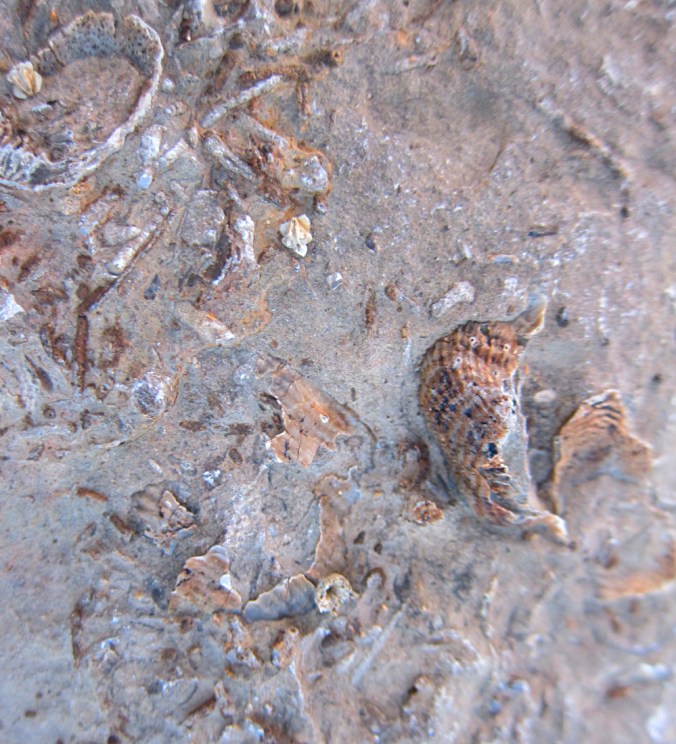
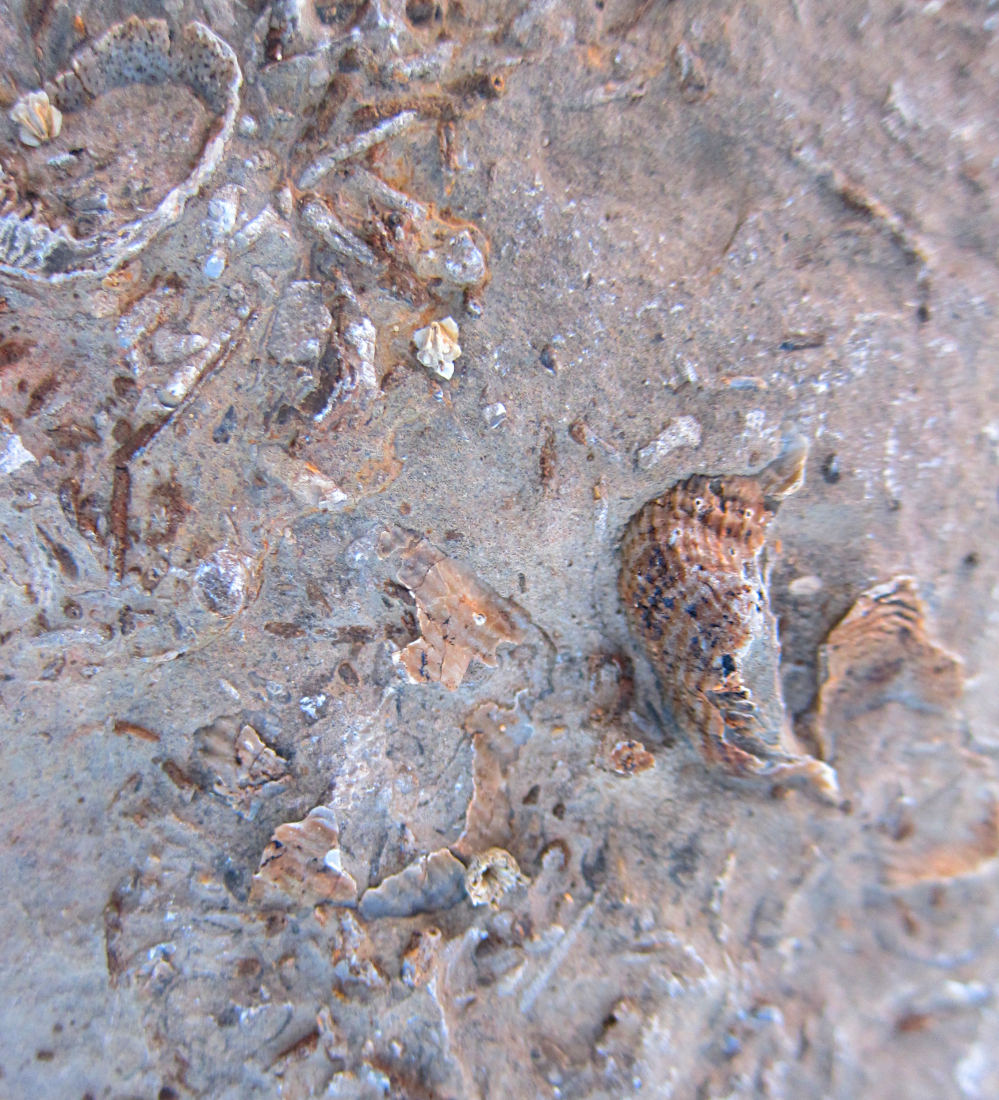
As a tourist it’s a bit of a strange place. There is no infrastructure and much of what it’s famous for has been removed to display and protect. At the trail head there are three signboards with a little bit of the information and the trail is well-marked. At the discovery site there is another sign board but nothing to really tell you where to look. Although there are still fossils, petrified wood and tracks to be found in the red stone we took a detour from the trail signs and ended up finding some marine fossils in the gray mudstone. I don’t go out of my way to research how old the rocks are that I’m seeing when I hike but when you’ve got a signboard and it’s telling you they are roughly 280 million years old it was easy to be excited at just the rocks so finding some really good marine fossils made my day.

The next day was a surprisingly abundant and unusual snow storm in Las Cruces. We had heard rain and wind all night. When it stopped we’d assumed that meant things were clearing up when in reality snow was quietly burying us on a rough dirt road. Sadly we left our camp spot earlier than we would have liked. We were taking in Lil’ Squatch for some tweaking and found ourselves without a home for several hours. I, not understanding what “wet” snow really meant, suggested that we go ahead and pass up the offered ride in favor of a slushy, no sidewalk, one mile jaunt. It turns out that the mechanic just so happened to be located around the corner from the local BLM district office. The power was out and all were leaving but, a man took pity on us and let us in for some maps. They just so happened to have a couple of the slabs from the trackways in the office and he suggested that we check out the local museum of nature and science for even better examples. He also explained that with last years Organ Mountains National Monument acquisition that the Robledo Mountains (where the tracks are found) and the Dona Ana mountains are part of that status. They’re busy trying to figure out the best way for people to gain access to these areas and how best to present the natural history to the public.

PlantfossilPlantfossil

Plantfossil

DimetrodonDimetrodon

Dimetrodon

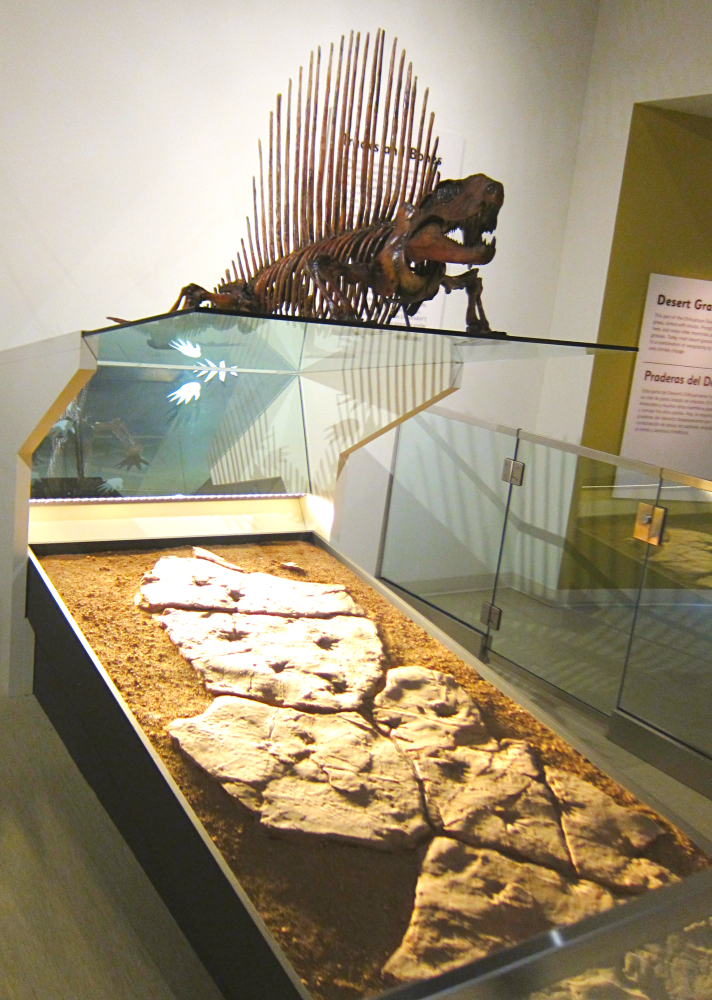
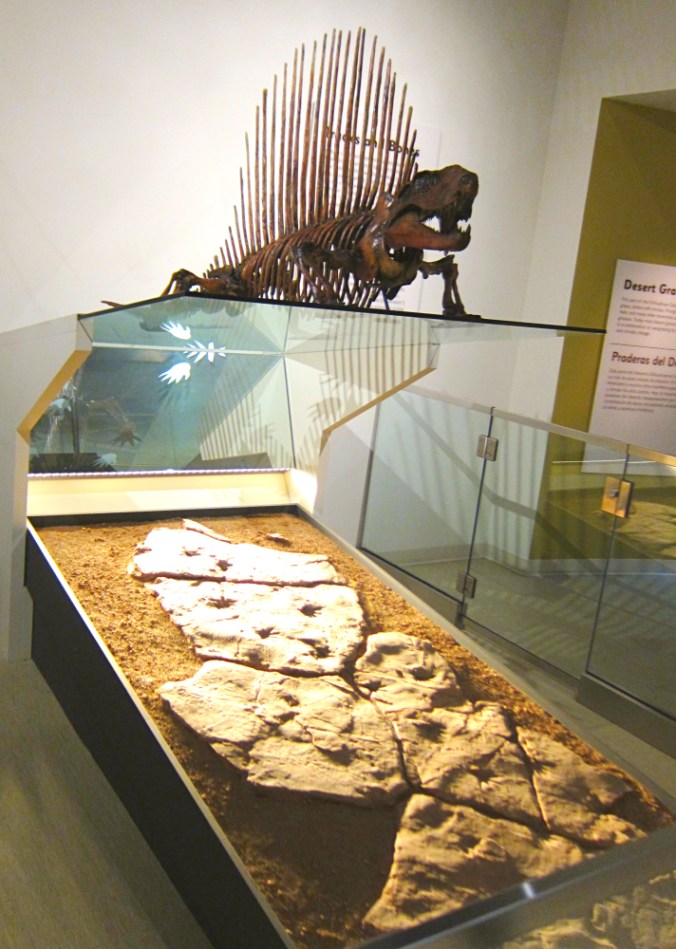
Before we headed out of town we did make a stop at the museum. It’s a new facility and they have two nicely done displays. First was a good example of the Dimetrodon skeleton that had been put together before the tracks were found and below it are the fossil tracks believed to be made by this pelycosaur. The tracks helped them realize that the animal had walked much more upright than previously understood. A long track laid out in the middle of the room also had an interactive screen where you press a list of questions and videos of Jerry MacDonald answering them played. Listening to his well delivered answers and looking at the displays brought it all together for me. With the Pangea map, his descriptions and the painting above that particular track I could begin to think about what is a pretty foreign ecology. (Read more details here:http://www.nature.nps.gov/geology/nationalfossilday/paleozoic_ptnm.cfm)
The National Monument You’ve Never Heard About

It turns out that south central New Mexico is a lot more dynamic than I had previous understood. I’d been to New Mexico before and did a grand 1100 mile, three day tour from south to north and back again with two girl friends. It was a lot of driving and a whole lot of fun and I loved every inch of New Mexico. Even though my friend had been living in the town of Las Cruces we were only in and out in order to see other places. In my and Tim’s travels we met a couple who mentioned the museum in Deming NM and so we made a point to check it out. They have great displays of early life in Deming and are rightfully famous for their collection of Mogollon pottery. It’s worth a detour if you’re in the area.

We also ended up spending at least one more day than we meant to in Las Cruces. Such a chain of events took place and we had the chance to talk to some wonderful people that we realized if we didn’t just leave we could be there for the rest of the year exploring all it had to offer in nearby outdoor activities. For our second night in town we ditched the over priced rv park and headed for a the nearby national monument to see what it was all about. The Prehistoric Trackways National Monument was founded in 2009 in order to protect what was an incredible discovery some 22 years earlier by amateur paleontologist Jerry MacDonald. He had heard from locals of a spot with good fossils. What he found is a world renowned site of fossilized tracks from the Permian Period (approx 240-280 million years ago). It’s extensive and the best example of tracks from that period ever found. Scientists from all over the world have come to study the area. The “area” is now southern New Mexico but, at the time the tracks were being created the area was mud flats along the coast of Pangea in an inland sea near the equator.

As a tourist it’s a bit of a strange place. There is no infrastructure and much of what it’s famMarineFossilsous for has been removed to display and protect. At the trail head there are three signboards with a little bit of the information and the trail is well-marked. At the discovery site there is another sign board but nothing to really tell you where to look. Although there are still fossils, petrified wood and tracks to be found in the red stone we took a detour from the trail signs and ended up finding some marine fossils in the gray mudstone. I don’t go out of my way to research how old the rocks are that I’m seeing when I hike but when you’ve got a signboard and it’s telling you they are roughly 280 million years old it was easy to be excited at just the rocks so finding some really good marine fossils made my day.

The next day was a surprisingly abundant and unusual snow storm in Las Cruces. We had heard rain and wind all night. When it stopped we’d assumed that meant things were clearing up when in reality snow was quietly burying us on a rough dirt road. Sadly we left our camp spot earlier than we would have liked. We were taking in Lil’ Squatch for some tweaking and found ourselves without a home for several hours. I, not understanding what “wet” snow really meant, suggested that we go ahead and pass up the offered ride in favor of a slushy, no sidewalk, one mile jaunt. It turns out that the mechanic just so happened to be located around the corner from the local BLM district office. The power was out and all were leaving but, a man took pity on us and let us in for some maps. They just so happened to have a couple of the slabs from the trackways in the office and he suggested that we check out the local museum of nature and science for even better examples. He also explained that with last years Organ Mountains National Monument acquisition that the Robledo Mountains (where the tracks are found) and the Dona Ana mountains are part of that status. They’re busy trying to figure out the best way for people to gain access to these areas and how best to present the natural history to the public.

PlantfossilBefore we headed out of town we did make a stop at the museum. It’s a new facility and they have two nicely done displays. First was a good example of the Dimetrodon skeleton that had been put together before the tracks were found and below it are the fossil tracks believed to be made by this pelycosaur. The tracks helped them realize that the animal had walked much more upright than previously understood. A long track laid out in the middle of the room also had an interactive screen where you press a list of questions and videos of Jerry MacDonald answering them played. Listening to his well delivered answers and looking at the displays brought it all together for me. With the Pangea map, his descriptions and the painting above that particular track I could begin to think about what is a pretty foreign ecology. (Read more details here:http://www.nature.nps.gov/geology/nationalfossilday/paleozoic_ptnm.cfm)Dimetrodon

Sky Islands

Last year was a mad dash of effort. Time flew by and many things we imagined doing slipped off the list as time slipped out of our hands. It’s as if the accordion bellows of life were at full compression. It’s just a couple of weeks into 2015 and I already feel the accordion expanding out out out. These two weeks of driving around Southern Arizona seem like a month. It’s beautiful down here in ways I did not think to expect. It didn’t take long for me to guess correctly that this area was still part of the basin and range province. Wide valleys are dotted and even corralled by the tell-tell north/south trending mountain ranges. Down here they call these mountains “Sky Islands”. Much like an island the flora and fauna are cut off from the surrounding mountain ranges. While they might have similar climates and life forms many of these plants, birds and animals have no way of connecting with each other because the valleys are too wide and too warm. Others take advantage of the riparian streams and washes, using them like a kind of bird and animal highway. These streams allow for food and protective cover they just can’t get in the high desert valleys that provide not much more than grasses, yucca and cactus.
This wasn’t always the case. Roughly 8,000-4,000 years ago the climate used to be much cooler and wetter down in, what is now, the desert southwest. These valleys were once verdant meadows surrounded by pines and firs. As the climate warmed the plants and animals moved up to cooler elevations that matched their life needs. Trees and plants that have higher water needs tend to only grow on north facing slopes. Further back in time these mountains used to be neighbors. During a period where the west coast experienced subduction the land rippled together. There was volcanic activity and uplift. After the subduction was complete many years of water and wind weathering shaped the mountains to what we see now. The land, much like those accordion bellows, began to spread away from each other. You can actually read a pretty good synopsis on wikipedia about this here: http://en.wikipedia.org/wiki/Basin_and_Range_Province

Alligator JuniperAlligator Juniper

Alligator Juniper

After several nights of enjoying the valleys and canyons of the area we made our way up to explore one of these sky islands, Chiricahua National Monument in eastern Arizona. We got to our campsite at 12:30, made a quick lunch and hit the trail. I’m not sure I meant to sign up for an eight mile hike but, it was worth it either way. Even at camp we are already away from the valley shrubs and grasses and into some real trees. There is juniper, oaks and for the first time in a long while I got to smell some pine. Seeing all these made me feel at home. It’s hard not to compare to my beloved California. As we walked and looked up at the rhyolite formations that the Chiricahua Apache called “standing up rocks” I said how I felt like I was at the crossroads of Yosemite and Bryce. After that I tried to really see the place for it’s own merit. Looking a little closer at some of the juniper trees I noticed their unique bark that gives them their name of alligator juniper since the bark looks much like the skin of an alligator. I also saw the yucca, agave and prickly pear mixed in with the manzanitas and sycamores. What Tim thought was a pinon jay was actually a gray breasted or “Mexican” jay. We’ve yet to see the javalina or elusive coatimundi, we’re not likely to see those in California outside of a zoo (we finally saw a javalina the next day!). The beautiful doe we saw when we started on the trail was an Arizona white-tailed deer and not ubiquitous black-tailed deer. I kept making a point to think this way, even as things felt and smelled familiar. As we crept up higher and started our way on the switchbacks that lead to the Heart of Rocks loop I stopped in my tracks. Even though I’d not only seen pictures but, had also been looking at them over the course of our walk I was struck by just how incredible these rock formations were up close. There is no question of why this is a special place worth protecting (and why the Apache fought so hard to keep it). The rocks are a reddish gray with covering of bright neon green lichen. They’ve weathered in such ways one can’t help seeing familiar shapes within the rocks. Like the pretty aptly named duck on a rock. The CCC (Civilian Conservation Corp) did much work here and it’s easy to tell in the way the trail is built and even the naming of the formations. Small signs are posted near formations with names just as they were in the 1930’s. Thankfully it appears that some of the less than PC names are no longer posted.

As we move into New Mexico I hope to explore more into the strange yet familiar world of mountains that surround deserts. This time with fresh eyes ready to see what is unique and special. And leaving southern Arizona I have a new appreciation for the area I knew so little of. I suppose that’s the whole point of this effort.

ChiricahuaChiricahua

Chiricahua

Sky Islands

Last year was a mad dash of effort. Time flew by and many things we imagined doing slipped off the list as time slipped out of our hands. It’s as if the accordion bellows of life were at full compression. It’s just a couple of weeks into 2015 and I already feel the accordion expanding out out out. These two weeks of driving around Southern Arizona seem like a month. It’s beautiful down here in ways I did not think to expect. It didn’t take long for me to guess correctly that this area was still part of the basin and range province. Wide valleys are dotted and even corralled by the tell-tell north/south trending mountain ranges. Down here they call these mountains “Sky Islands”. Much like an island the flora and fauna are cut off from the surrounding mountain ranges. While they might have similar climates and life forms many of these plants, birds and animals have no way of connecting with each other because the valleys are too wide and too warm. Others take advantage of the riparian streams and washes, using them like a kind of bird and animal highway. These streams allow for food and protective cover they just can’t get in the high desert valleys that provide not much more than grasses, yucca and cactus.

This wasn’t always the case. Roughly 8,000-4,000 years ago the climate used to be much cooler and wetter down in, what is now, the desert southwest. These valleys were once verdant meadows surrounded by pines and firs. As the climate warmed the plants and animals moved up to cooler elevations that matched their life needs. Trees and plants that have higher water needs tend to only grow on north facing slopes. Further back in time these mountains used to be neighbors. During a period where the west coast experienced subduction the land rippled together. There was volcanic activity and uplift. After the subduction was complete many years of water and wind weathering shaped the mountains to what we see now. The land, much like those accordion bellows, began to spread away from each other. You can actually read a pretty good synopsis on wikipedia about this here: http://en.wikipedia.org/wiki/Basin_and_Range_Province

Alligator JuniperAfter several nights of enjoying the valleys and canyons of the area we made our way up to explore one of these sky islands, Chiricahua National Monument in eastern Arizona. We got to our campsite at 12:30, made a quick lunch and hit the trail. I’m not sure I meant to sign up for an eight mile hike but, it was worth it either way. Even at camp we are already away from the valley shrubs and grasses and into some real trees. There is juniper, oaks and for the first time in a long while I got to smell some pine. Seeing all these made me feel at home. It’s hard not to compare to my beloved California. As we walked and looked up at the rhyolite formations that the Chiricahua Apache called “standing up rocks” I said how I felt like I was at the crossroads of Yosemite and Bryce. After that I tried to really see the place for it’s own merit. Looking a little closer at some of the juniper trees I noticed their unique bark that gives them their name of alligator juniper since the bark looks much like the skin of an alligator. I also saw the yucca, agave and prickly pear mixed in with the manzanitas and sycamores. What Tim thought was a pinon jay was actually a gray breasted or “Mexican” jay. We’ve yet to see the javalina or elusive coatimundi, we’re not likely to see those in California outside of a zoo (we finally saw a javalina the next day!). The beautiful doe we saw when we started on the trail was an Arizona white-tailed deer and not ubiquitous black-tailed deer. I kept making a point to think this way, even as things felt and smelled familiar. As we crept up higher and started our way on the switchbacks that lead to the Heart of Rocks loop I stopped in my tracks. Even though I’d not only seen pictures but, had also been looking at them over the course of our walk I was struck by just how incredible these rock formations were up close. There is no question of why this is a special place worth protecting (and why the Apache fought so hard to keep it). The rocks are a reddish gray with covering of bright neon green lichen. They’ve weathered in such ways one can’t help seeing familiar shapes within the rocks. Like the pretty aptly named duck on a rock. The CCC (Civilian Conservation Corp) did much work here and it’s easy to tell in the way the trail is built and even the naming of the formations. Small signs are posted near formations with names just as they were in the 1930’s. Thankfully it appears that some of the less than PC names are no longer posted.

As we move into New Mexico I hope to explore more into the strange yet familiar world of mountains that surround deserts. This time with fresh eyes ready to see what is unique and special. And leaving southern Arizona I have a new appreciation for the area I knew so little of. I suppose that’s the whole point of this effort.

Chiricahua

Whiskey & Cranes

If we hadn’t stopped at a bar in Tombstone we probably would have gotten to Whitewater Draw in time to see the massive flocks of cranes coming in for the evening. It was worth it though because where else are you going to find yourself sitting next to a real life gunslinger (reenactor) drinking whiskey? As he left to go to rehearsal we left to camp next to the Sandhill cranes. Even though in was getting dark and most of the birds had settled in, as soon as we shut off Lil’ Squatch’s engine you could hear them. The conversation at the bar was fun but these creatures speak an ancient tongue that is beyond description. It was so compelling that both Rachael and I, without speaking, began walking towards the sound. The cranes rest for the night standing in shallow water as protection from predators and the sound of thousands of their trilling voices carrying across the wetland penetrates you and reaches some primal part of your brain. It’s as if you can feel the thousands of years that this chorus has been raised nightly and it connects you to prehistoric ancestors who surely knew this sound well.
Whitewater Draw is a wildlife management area and one of several seasonal wetlands in the center of Sulphur Springs Valley an expansive example of basin and range country in the southeast corner of Arizona. With prairie and agricultural fields to feed in by day it is the perfect winter home for the cranes. It is also an excellent place to camp and we stayed here two nights, the all night conversations of the birds infiltrating my dreams. With some of the least light polluted skies in the US it is also an amazing place to see the stars, though with a bitter chill it was hard to bundle up enough to enjoy for very long. I was picturing the cranes huddled in together for warmth and gossip.

As dawn approaches the chattering trills begin to escalate. The sound grows to a crescendo as the sun is rising and with the sun the birds rise in groups of 20 or 30, then groups in the hundreds. The horizon fills with long lines of cranes flocked up to go to their chosen feeding sites in the valley. For some hours you can spot the now scattered groups rising and dispersing across the sky. As I said the sound of these magnificent birds is indescribable so even though this recording is also a poor substitution for hearing and feeling it in person, I’ll let the Sandhill cranes speak for themselves in this video I made: https://www.youtube.com/watch?v=WdQETjnDYik&feature=youtu.be


Whiskey & Cranes

If we hadn’t stopped at a bar in Tombstone we probably would have gotten to Whitewater Draw in time to see the massive flocks of cranes coming in for the evening. It was worth it though because where else are you going to find yourself sitting next to a real life gunslinger (reenactor) drinking whiskey? As he left to go to rehearsal we left to camp next to the Sandhill cranes. Even though in was getting dark and most of the birds had settled in, as soon as we shut off Lil’ Squatch’s engine you could hear them. The conversation at the bar was fun but these creatures speak an ancient tongue that is beyond description. It was so compelling that both Rachael and I, without speaking, began walking towards the sound. The cranes rest for the night standing in shallow water as protection from predators and the sound of thousands of their trilling voices carrying across the wetland penetrates you and reaches some primal part of your brain. It’s as if you can feel the thousands of years that this chorus has been raised nightly and it connects you to prehistoric ancestors who surely knew this sound well.

Whitewater Draw is a wildlife management area and one of several seasonal wetlands in the center of Sulphur Springs Valley an expansive example of basin and range country in the southeast corner of Arizona. With prairie and agricultural fields to feed in by day it is the perfect winter home for the cranes. It is also an excellent place to camp and we stayed here two nights, the all night conversations of the birds infiltrating my dreams. With some of the least light polluted skies in the US it is also an amazing place to see the stars, though with a bitter chill it was hard to bundle up enough to enjoy for very long. I was picturing the cranes huddled in together for warmth and gossip.

As dawn approaches the chattering trills begin to escalate. The sound grows to a crescendo as the sun is rising and with the sun the birds rise in groups of 20 or 30, then groups in the hundreds. The horizon fills with long lines of cranes flocked up to go to their chosen feeding sites in the valley. For some hours you can spot the now scattered groups rising and dispersing across the sky. As I said the sound of these magnificent birds is indescribable so even though this recording is also a poor substitution for hearing and feeling it in person, I’ll let the Sandhill cranes speak for themselves in this video I made: https://www.youtube.com/watch?v=WdQETjnDYik&feature=youtu.be