To Seek

It’s cold again. I don’t have to get out from under the covers to know this. I can see our breath as we yawn and stretch and begin to talk of coffee. I just wasn’t as mentally prepared as I told myself I was when we were leaving the summer like conditions of Florida. It all feels very familiar, the leafless and seemingly lifeless trees, the hands so cold it hurts. We drove from summer back into winter since ten days into it spring has yet to show. But there it is again, the pop of red from out of the woods. We started seeing this tree all the way back in Louisiana, up into middle Mississippi and along the Florida panhandle. Try as we might to get an up close look we couldn’t seem to find a spot where the trees red leaves were close enough to the ground to really see. We just looked in vain at the red fluttering above our heads. A tree that hasn’t let go of it’s red autumn leaves. Are they leaves?
Last December on a trip to Yosemite Tim and I managed to get every passerby curious as to what we were looking at in the grass along the path. We had to sheepishly tell them it was fungus that had grown off a piece of feces. It looked like a giant caterpillar. This is how we “generalists” work. From watching a common gray squirrel to going out on a rainy day hike to see California newts, we find it all pretty interesting and we’re willing to seek it out.

We’ve become visitor center connoisseurs. If you go to a National Park and they have more than one I recommend hitting them all up if possible. Each has their own personality and often unique information about that particular locale of the park. The Sugarlands visitor and park headquarters of the Great Smokey National Park has wonderful displays from A Naturalists Notebook written by Robert G. Johnsson and illustrated by John D. Dawson complimented by taxidermy displays and believable fake versions of some plants and flowers. We liked it so much we went back to try and take in as much as possible. We found out there that Great Smokies National Park is the salamander capital of the world. There are over 30 different species of salamander within the park and several are endemic. Turns out the Smokies are a temperate rain forest. The higher elevations get up to 85 inches of rain a year and the lower around 55. With the astounding amount of rhododendrons, hemlocks and firs parts of the park felt more like the Pacific Northwest. Salamanders are amphibians so moisture is a necessity. Many salamanders are lungless and breathe through their skin. They need good clean water and air which is becoming more compromised with all the nearby coal power plants. For now though the estimated numbers are impressive.

SalamanderHuntSalamanderHunt

SalamanderHunt

SalamanderSalamander

Salamander

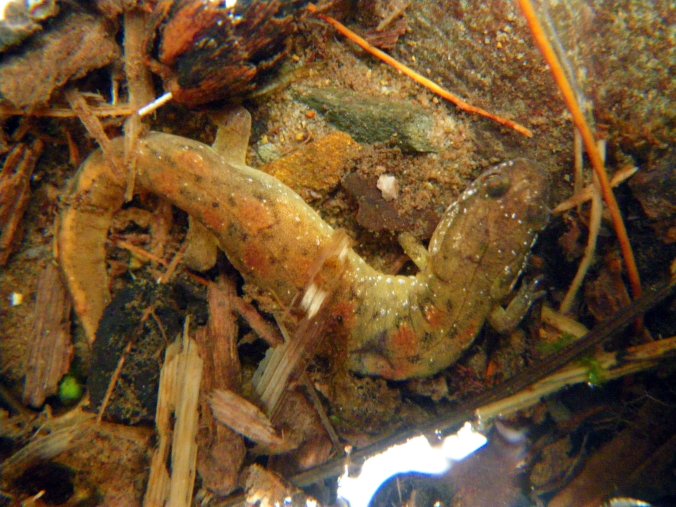
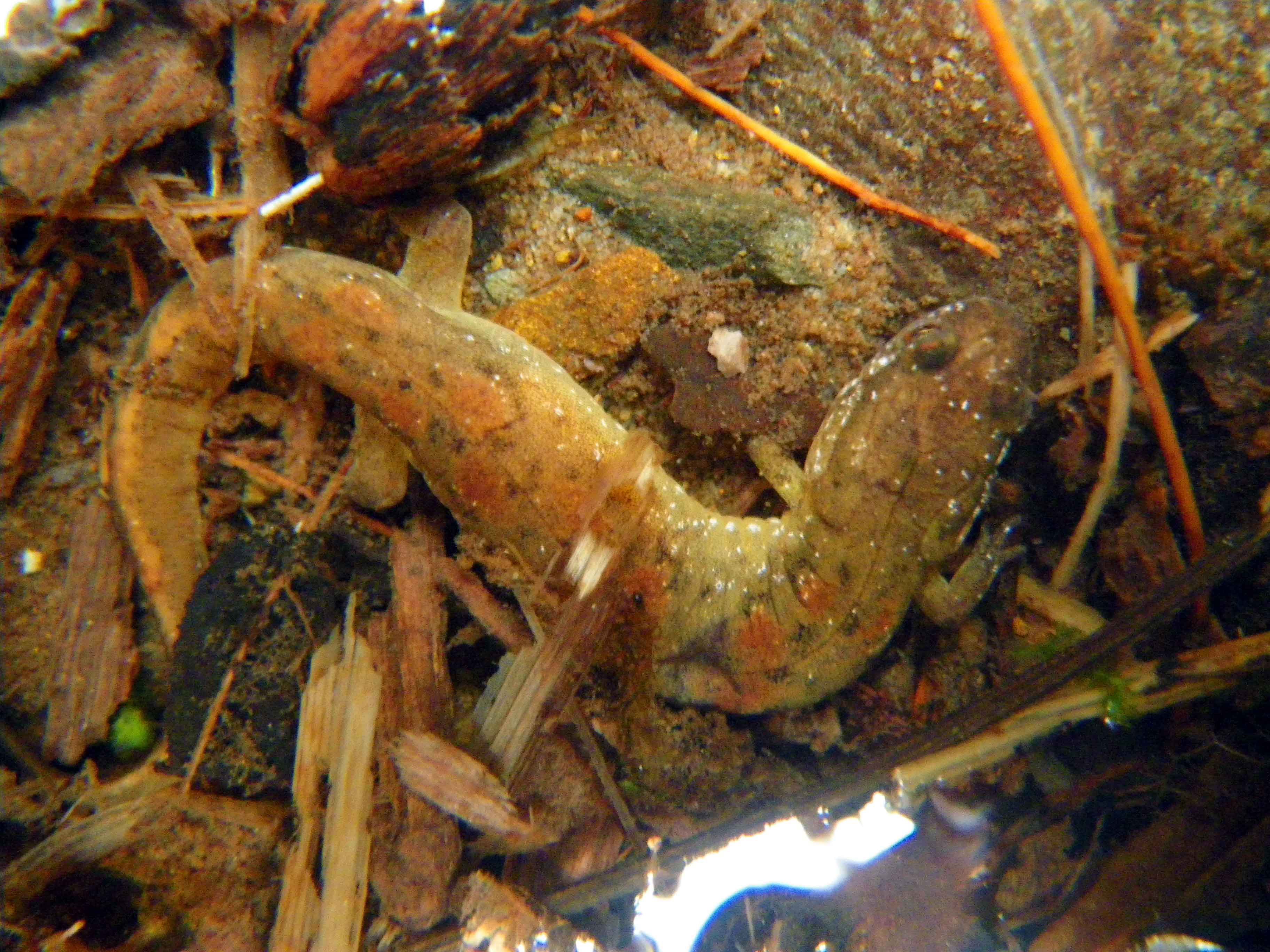
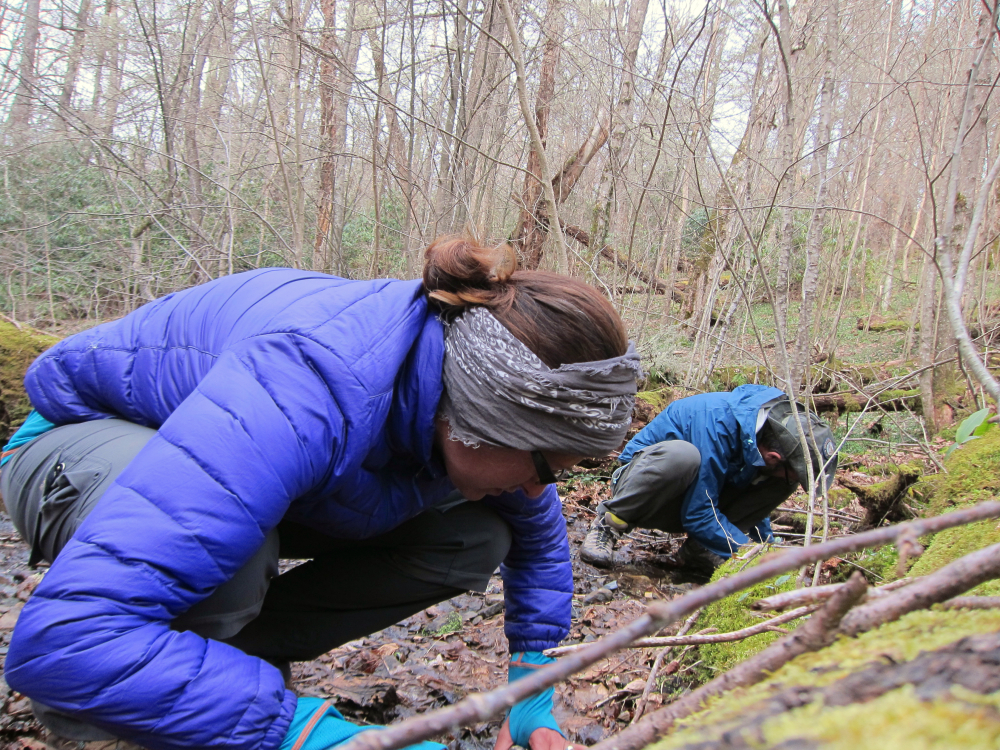
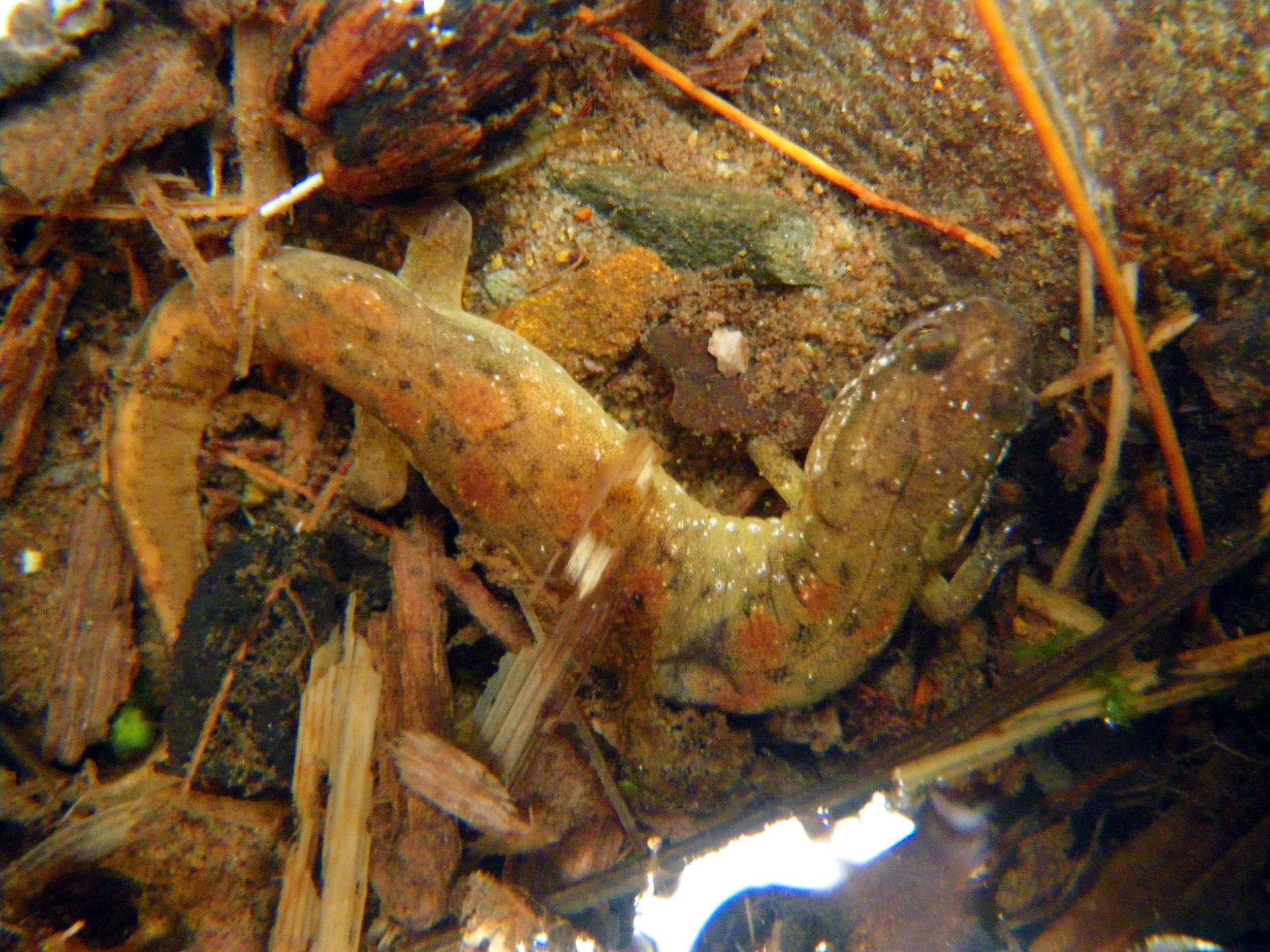
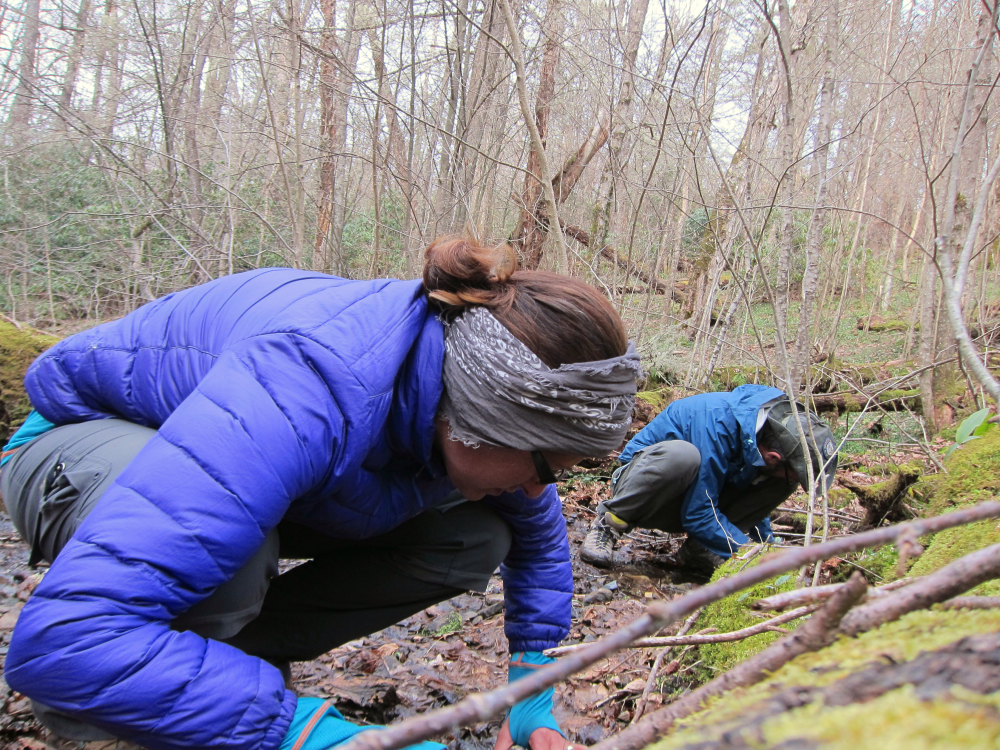
The hunt was on! I figured with our successful California Newt experiences this should be cake. We looked under rocks and logs along streams and found many different caddisfly larvae tubes. We looked in a swamp where we found thousands of tad poles and a few millipedes. Tim began pawing at punky wood much like a bear clawing for grubs. We even saw some grubs. After a few days of this I began to think that we’d not see one after all. Then I thought about how my friend’s daughter Juniper had looked under rocks along the rocky shore back in San Diego and in doing so found a brittle star. I looked back at the stream we had just crossed and found a calmer run where a rock was just so that there was a little cave under it. When I pulled it up some silt spun around in the depression and it took a second to realize what I was looking at. I called Tim over and there it was our first of many found salamander! It was tiny, no bigger than my pinky, dark with white gills. It was all very exciting and each subsequent find no less so.

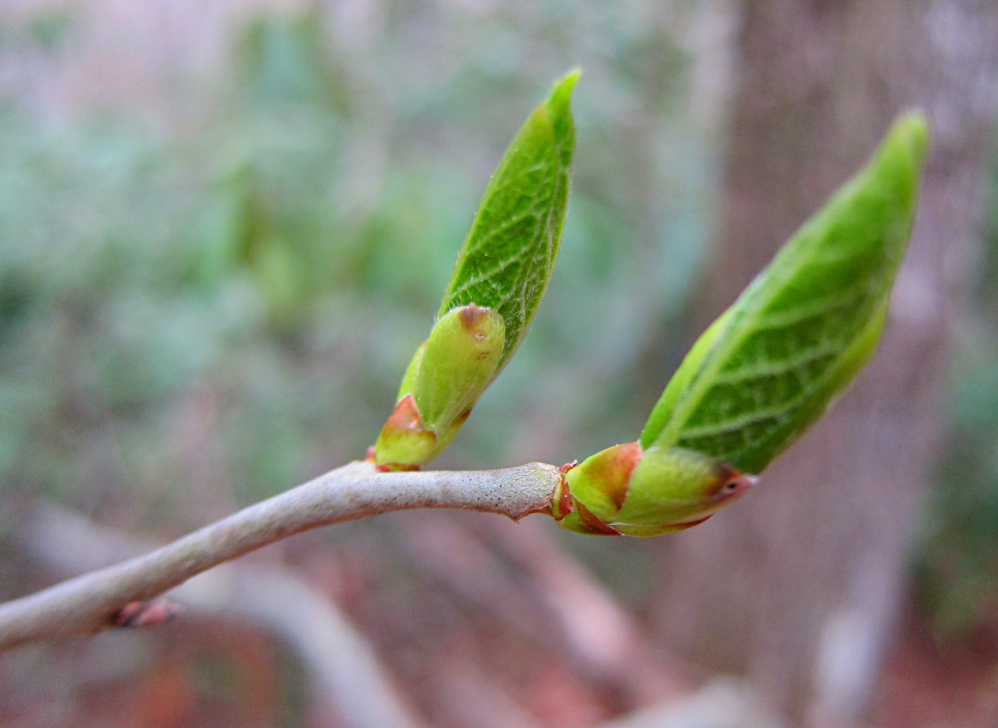
As for the trees with the stubborn red leaves, we got up close to that too. Turns out it’s the red maple and what we had been seeing was the fruit, or samara, that develop first before leaves or flowers in an effort to be ready to drop into nearby water ways when they are their highest in late spring. The red maple is actually quite common in the eastern states and has become more so with the loss of oaks and pines.

I may not always get to see the neat creatures and plants I seek but I get great joy out of the act of looking. Much like playing a game. As long as the game is fun it doesn’t matter if I win or lose. Sure I’ll gloat like the best of them and high five my teammates just like I high fived Tim, my ultimate teammate, on our successful Great Smokey Mountain salamander hunt.

Look who decided to come out to play!Look who decided to come out to play!

Look who decided to come out to play!

To Seek

It’s cold again. I don’t have to get out from under the covers to know this. I can see our breath as we yawn and stretch and begin to talk of coffee. I just wasn’t as mentally prepared as I told myself I was when we were leaving the summer like conditions of Florida. It all feels very familiar, the leafless and seemingly lifeless trees, the hands so cold it hurts. We drove from summer back into winter since ten days into it spring has yet to show. But there it is again, the pop of red from out of the woods. We started seeing this tree all the way back in Louisiana, up into middle Mississippi and along the Florida panhandle. Try as we might to get an up close look we couldn’t seem to find a spot where the trees red leaves were close enough to the ground to really see. We just looked in vain at the red fluttering above our heads. A tree that hasn’t let go of it’s red autumn leaves. Are they leaves?

Last December on a trip to Yosemite Tim and I managed to get every passerby curious as to what we were looking at in the grass along the path. We had to sheepishly tell them it was fungus that had grown off a piece of feces. It looked like a giant caterpillar. This is how we “generalists” work. From watching a common gray squirrel to going out on a rainy day hike to see California newts, we find it all pretty interesting and we’re willing to seek it out.

We’ve become visitor center connoisseurs. If you go to a National Park and they have more than one I recommend hitting them all up if possible. Each has their own personality and often unique information about that particular locale of the park. The Sugarlands visitor and park headquarters of the Great Smokey National Park has wonderful displays from A Naturalists Notebook written by Robert G. Johnsson and illustrated by John D. Dawson complimented by taxidermy displays and believable fake versions of some plants and flowers. We liked it so much we went back to try and take in as much as possible. We found out there that Great Smokies National Park is the salamander capital of the world. There are over 30 different species of salamander within the park and several are endemic. Turns out the Smokies are a temperate rain forest. The higher elevations get up to 85 inches of rain a year and the lower around 55. With the astounding amount of rhododendrons, hemlocks and firs parts of the park felt more like the Pacific Northwest. Salamanders are amphibians so moisture is a necessity. Many salamanders are lungless and breathe through their skin. They need good clean water and air which is becoming more compromised with all the nearby coal power plants. For now though the estimated numbers are impressive.

SalamanderHuntThe hunt was on! I figured with our successful California Newt experiences this should be cake. We looked under rocks and logs along streams and found many different caddisfly larvae tubes. We looked in a swamp where we found thousands of tad poles and a few millipedes. Tim began pawing at punky wood much like a bear clawing for grubs. We even saw some grubs. After a few days of this I began to think that we’d not see one after all. Then I thought about how my friend’s daughter Juniper had looked under rocks along the rocky shore back in San Diego and in doing so found a brittle star. I looked back at the stream we had just crossed and found a calmer run where a rock was just so that there was a little cave under it. When I pulled it up some silt spun around in the depression and it took a second to realize what I was looking at. I called Tim over and there it was our first of many found salamander! It was tiny, no bigger than my pinky, dark with white gills. It was all very exciting and each subsequent find no less so.Salamander

As for the trees with the stubborn red leaves, we got up close to that too. Turns out it’s the red maple and what we had been seeing was the fruit, or samara, that develop first before leaves or flowers in an effort to be ready to drop into nearby water ways when they are their highest in late spring. The red maple is actually quite common in the eastern states and has become more so with the loss of oaks and pines.

I may not always get to see the neat creatures and plants I seek but I get great joy out of the act of looking. Much like playing a game. As long as the game is fun it doesn’t matter if I win or lose. Sure I’ll gloat like the best of them and high five my teammates just like I high fived Tim, my ultimate teammate, on our successful Great Smokey Mountain salamander hunt.
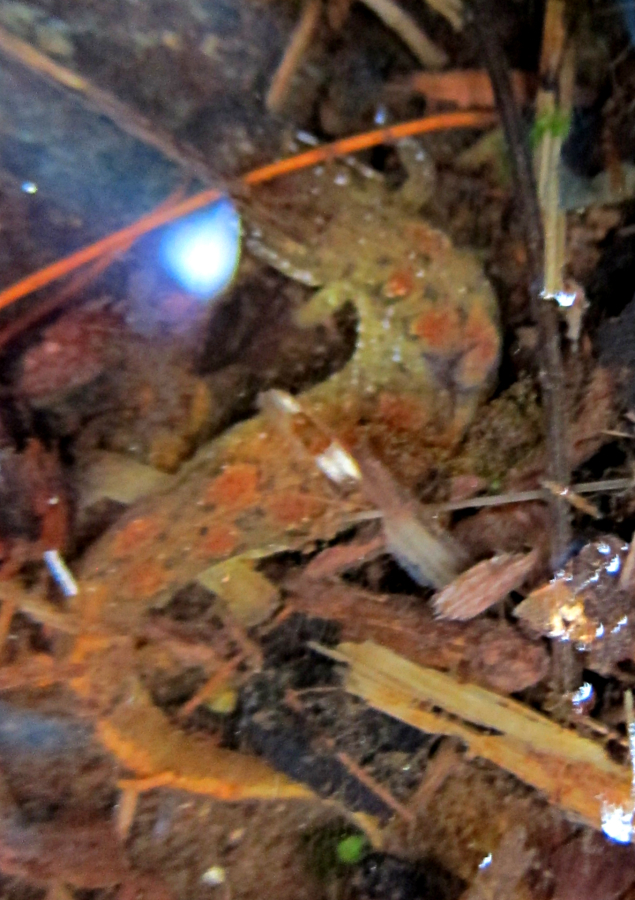
Look who decided to come out to play!

Look who decided to come out to play!

Mountain Folks

James was a fountain of knowledge, an unsolicited fountain but fascinating just the same. And maybe more like an oscillating lawn sprinkler with no obvious shut off valve, a new topic beginning before the previous thought had been finished. I caught him sizing us up as we were walking into the small town thrift store where he was apparently employed, although he spent the better part of 45 minutes talking to us once we were cornered between the over-starched linens, thumb-worn romance novels and water damaged gospel albums. We discovered that James is a true naturalist in his own right. He originally took us to be Appalachian thru-hikers. Months of living in Lil’ Squatch must give us an outdoorsy look. What followed was a staccato primer on the natural history of Southern Appalachia around this corner of Tennessee, Georgia and North Carolina beginning with a quick karate chop description of the river drainages around where we had camped the two previous nights and ending with his interpretations of local Cherokee legends. We were finally able to leave once his exasperated co-workers pulled him away, but not before his very pregnant girlfriend showed up and a was able to show us an indecipherable photo from her flip-phone of what we were told was an amazing waterfall. Though the conversation was decidedly one sided I really appreciated his knowledge and enthusiasm. I think he was relishing the opportunity to share because he was working off a one year ban from the National Forest, though we couldn’t understand if it was for poaching fish, harvesting ginseng out season or for threatening a fellow camper with a bucket containing two live and very venomous copperhead snakes.
People have deep connection with these mountains and rivers. We had another opportunity to learn this the next day when by chance we were able to join a volunteer river clean up along the Hiawassee. Organized in part by Trout Unlimited, we found a group of folks who knew the local waters thoroughly. We learned which rivers had good populations of native fish, and which ones were favored by non-native stocked fish that can thrive in the colder waters below the many dams in the watershed. Kayaking is also incredibly popular in Eastern Tennessee and a few of our cohorts told us of how several dammed rivers have become such popular whitewater destinations that compromises have been made in flow timing in order to benefit these users. The Tennessee Valley Authority (TVA) was also a sponsor of the volunteer event. This agency is the builder of these dams, beginning in the 1930s, to bring electricity and flood control to an impoverished region. A side effect was the substantial alteration of a large amount of river habitat. Over the years some efforts have been successful to mitigate the damage but the fact is most of the dams remain, though many are nearing the end of the functional lifetime as silt builds up behind them.

Settler Home - Photo by Tim GillerSettler Home - Photo by Tim Giller

Settler Home – Photo by Tim Giller

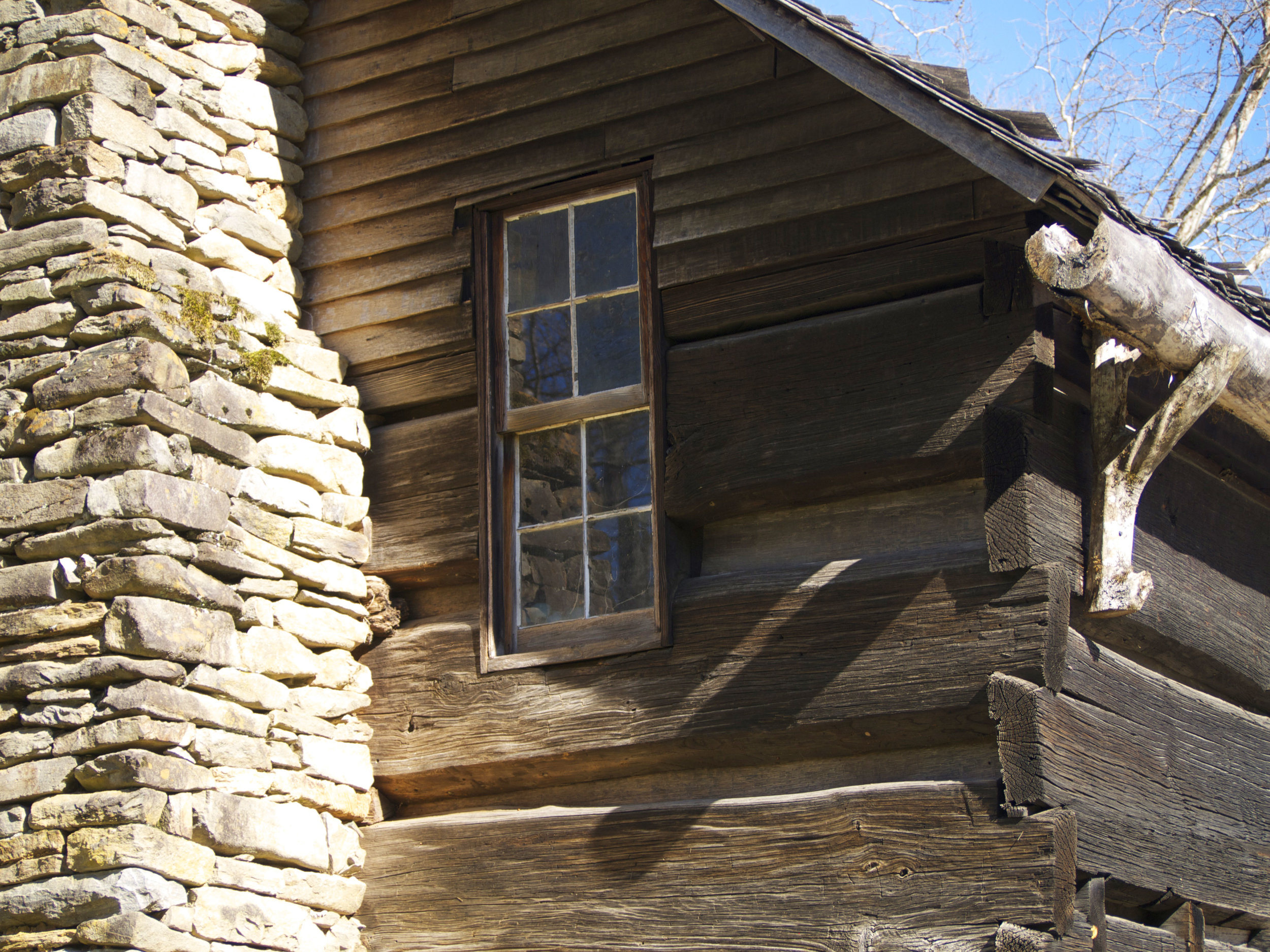
Eager to have our own first hand experience of this place we made our way to Great Smokey Mountain National Park. As the biggest chunk of preserved Appalachia it also preserves much of the human story of the region. The Eastern band of Cherokee still maintains a presence here despite their bitter and unfair removal along the Trail of Tears. Homesteaders also made a home here and were also compelled to leave as the park was formed; many of their historical homes and other structures have been preserved as visitor attractions. Today the human story appears to be throngs of automobiles. The Smokies are the most visited National Park in the country and the vast majority of those visitors see it from only a car window after working their way through a dense gauntlet of tourist trap attractions just outside the boundaries. Clearly this was no way to find some connection to this landscape so we planned out a 4-day backcountry hike into the heart of the mountains.

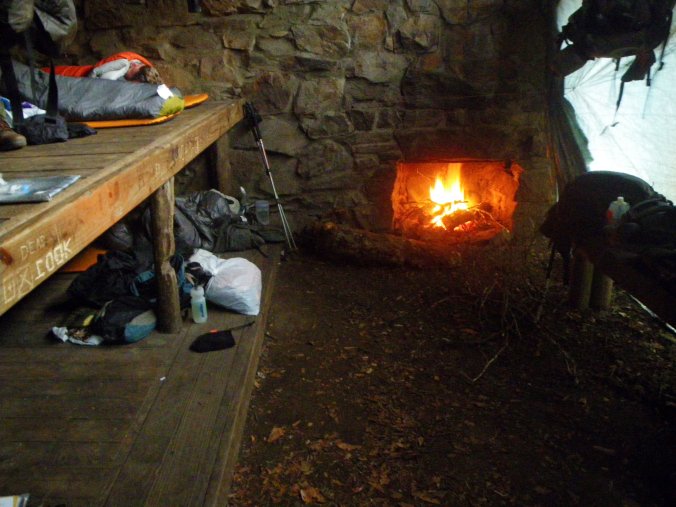
Silers Bald AT Shelter - Photo by Tim GillerSilers Bald AT Shelter - Photo by Tim Giller

Silers Bald AT Shelter – Photo by Tim Giller

Up there we encountered a whole new culture that has staked a claim on these mountains. We found ourselves in the middle of the peak season of Appalachian Trail thru-hikers and had the pleasure of spending a windy and frosty night in one of the highest trail shelters on the route. The 2200 mile trail from Georgia to Maine reaches it’s highest point just up the trail from where we walked and each year more and more people attempt to hike the entire trail in one go. Along the route volunteers have built and maintain a series of wooden and stone shelters for hikers to sleep in with ten or more people squeezing into them each night during the high season. These become nightly social gathering spots where stories and information are exchanged and new hiking partners and friendships are made, folks only going by their trail names such as “Black and Blue”, “Bean-Counter” or “Proudfoot”. When we realized we’d be staying along the trail on Easter morning we ducked into town to get candy before heading out. As Rachael passed out treats to grateful thru-hikers I decided her trail name would be “Easter Bummy”.

Salamander - Photo by Tim GillerSalamander - Photo by Tim Giller

Salamander – Photo by Tim Giller

Most of our time though was spent away from the crowd of this busy trail. I was extremely grateful to have the time to get back into the valleys and ridges of the backcountry because my desire for taking this hike was to get a closer look at the nature of these mountains. This wasn’t as easy as I had expected. My first point of entry in a new landscape is generally to get a lay of the land, to see the shape of its contours and get my bearings. Even in early spring with few leaves in the forest to obscure my view it is rare to have the open vistas of my western ranges. I found myself craning my neck, struggling to make out peaks, looking for rocky outcrops to use as landmarks, but it was all indistinct hills covered with a thick and indistinguishable uniformity of trees. What I learned was that to see this landscape you need to look into it, to look more closely and see the incredible diversity of trees, fungus, lichens, mosses, and insects, to flip over a few rocks looking for salamanders, to open my ears to the variety of birdsong emanating from hidden spots back in the endless tangle of branches, to immerse myself in the remarkably clear and cold waters of the countless streams. It has been these little creatures and processes that have kept this landscape humming, despite all the comings and goings of humans over the millennia, indifferent to our foibles though unfortunately not immune to them.

Mountain Folks

James was a fountain of knowledge, an unsolicited fountain but fascinating just the same. And maybe more like an oscillating lawn sprinkler with no obvious shut off valve, a new topic beginning before the previous thought had been finished. I caught him sizing us up as we were walking into the small town thrift store where he was apparently employed, although he spent the better part of 45 minutes talking to us once we were cornered between the over-starched linens, thumb-worn romance novels and water damaged gospel albums. We discovered that James is a true naturalist in his own right. He originally took us to be Appalachian thru-hikers. Months of living in Lil’ Squatch must give us an outdoorsy look. What followed was a staccato primer on the natural history of Southern Appalachia around this corner of Tennessee, Georgia and North Carolina beginning with a quick karate chop description of the river drainages around where we had camped the two previous nights and ending with his interpretations of local Cherokee legends. We were finally able to leave once his exasperated co-workers pulled him away, but not before his very pregnant girlfriend showed up and a was able to show us an indecipherable photo from her flip-phone of what we were told was an amazing waterfall. Though the conversation was decidedly one sided I really appreciated his knowledge and enthusiasm. I think he was relishing the opportunity to share because he was working off a one year ban from the National Forest, though we couldn’t understand if it was for poaching fish, harvesting ginseng out season or for threatening a fellow camper with a bucket containing two live and very venomous copperhead snakes.

People have deep connection with these mountains and rivers. We had another opportunity to learn this the next day when by chance we were able to join a volunteer river clean up along the Hiawassee. Organized in part by Trout Unlimited, we found a group of folks who knew the local waters thoroughly. We learned which rivers had good populations of native fish, and which ones were favored by non-native stocked fish that can thrive in the colder waters below the many dams in the watershed. Kayaking is also incredibly popular in Eastern Tennessee and a few of our cohorts told us of how several dammed rivers have become such popular whitewater destinations that compromises have been made in flow timing in order to benefit these users. The Tennessee Valley Authority (TVA) was also a sponsor of the volunteer event. This agency is the builder of these dams, beginning in the 1930s, to bring electricity and flood control to an impoverished region. A side effect was the substantial alteration of a large amount of river habitat. Over the years some efforts have been successful to mitigate the damage but the fact is most of the dams remain, though many are nearing the end of the functional lifetime as silt builds up behind them.

Settler Home - Photo by Tim Giller

Settler Home – Photo by Tim Giller

Eager to have our own first hand experience of this place we made our way to Great Smokey Mountain National Park. As the biggest chunk of preserved Appalachia it also preserves much of the human story of the region. The Eastern band of Cherokee still maintains a presence here despite their bitter and unfair removal along the Trail of Tears. Homesteaders also made a home here and were also compelled to leave as the park was formed; many of their historical homes and other structures have been preserved as visitor attractions. Today the human story appears to be throngs of automobiles. The Smokies are the most visited National Park in the country and the vast majority of those visitors see it from only a car window after working their way through a dense gauntlet of tourist trap attractions just outside the boundaries. Clearly this was no way to find some connection to this landscape so we planned out a 4-day backcountry hike into the heart of the mountains.

Silers Bald AT Shelter - Photo by Tim Giller

Silers Bald AT Shelter – Photo by Tim Giller

Up there we encountered a whole new culture that has staked a claim on these mountains. We found ourselves in the middle of the peak season of Appalachian Trail thru-hikers and had the pleasure of spending a windy and frosty night in one of the highest trail shelters on the route. The 2200 mile trail from Georgia to Maine reaches it’s highest point just up the trail from where we walked and each year more and more people attempt to hike the entire trail in one go. Along the route volunteers have built and maintain a series of wooden and stone shelters for hikers to sleep in with ten or more people squeezing into them each night during the high season. These become nightly social gathering spots where stories and information are exchanged and new hiking partners and friendships are made, folks only going by their trail names such as “Black and Blue”, “Bean-Counter” or “Proudfoot”. When we realized we’d be staying along the trail on Easter morning we ducked into town to get candy before heading out. As Rachael passed out treats to grateful thru-hikers I decided her trail name would be “Easter Bummy”.

Salamander - Photo by Tim Giller

Salamander – Photo by Tim Giller

Most of our time though was spent away from the crowd of this busy trail. I was extremely grateful to have the time to get back into the valleys and ridges of the backcountry because my desire for taking this hike was to get a closer look at the nature of these mountains. This wasn’t as easy as I had expected. My first point of entry in a new landscape is generally to get a lay of the land, to see the shape of its contours and get my bearings. Even in early spring with few leaves in the forest to obscure my view it is rare to have the open vistas of my western ranges. I found myself craning my neck, struggling to make out peaks, looking for rocky outcrops to use as landmarks, but it was all indistinct hills covered with a thick and indistinguishable uniformity of trees. What I learned was that to see this landscape you need to look into it, to look more closely and see the incredible diversity of trees, fungus, lichens, mosses, and insects, to flip over a few rocks looking for salamanders, to open my ears to the variety of birdsong emanating from hidden spots back in the endless tangle of branches, to immerse myself in the remarkably clear and cold waters of the countless streams. It has been these little creatures and processes that have kept this landscape humming, despite all the comings and goings of humans over the millennia, indifferent to our foibles though unfortunately not immune to them.

Creature Encounters

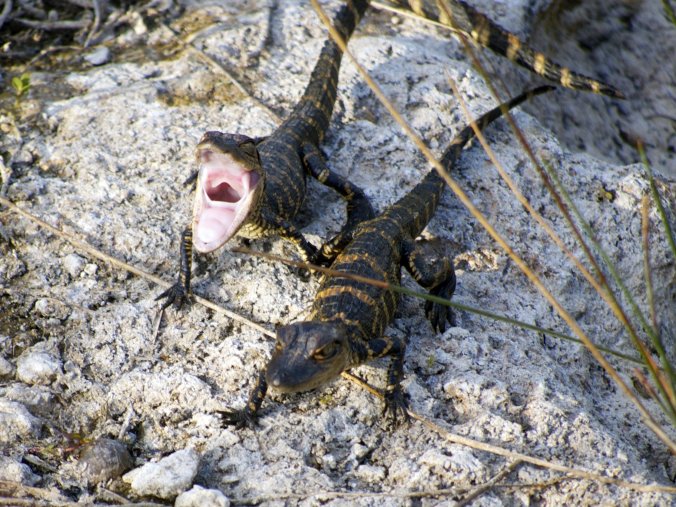
Baby Gators - Photo by Tim GillerBaby Gators - Photo by Tim Giller

Baby Gators – Photo by Tim Giller

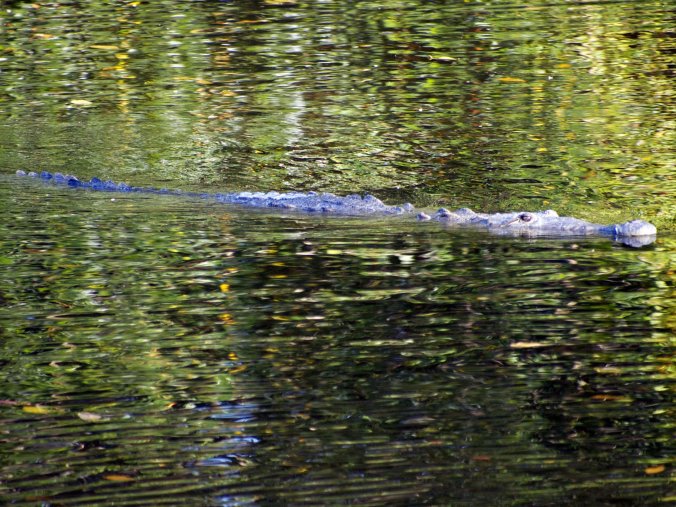
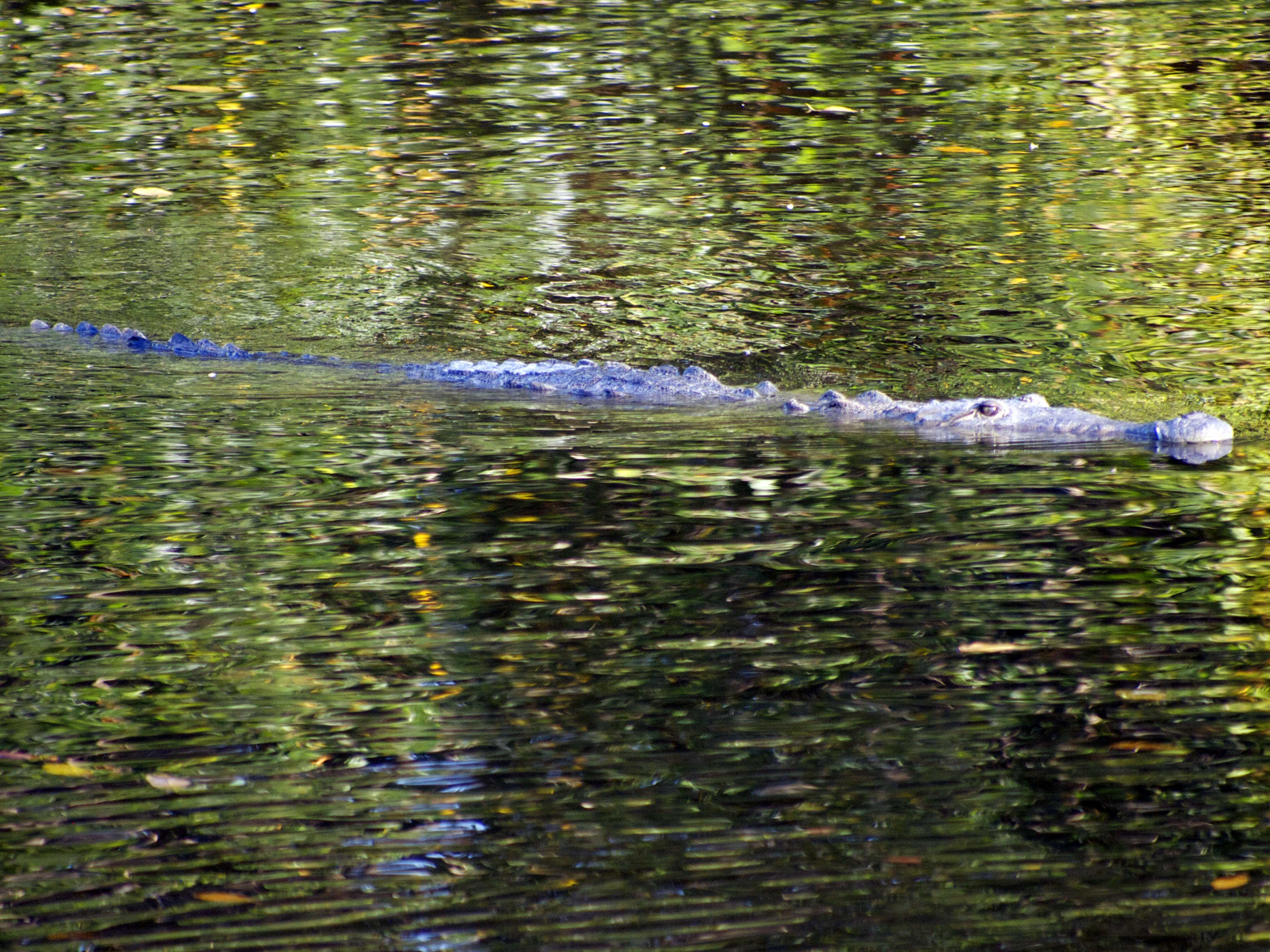
I can’t help myself, I love a good swimming hole. It was a bad joke though, the splashing around and pretending that something was pulling me under. I knew that even before I followed Rachael’s stare to an alligator, its powerful tail propelling it across the pond in my direction, just the eyes and snout protruding from the surface, clearly attracted to my movements. I was about to get out anyway, so I just did it a bit more quickly. I suppose there is a reason I wasn’t seeing people swimming in the backwaters. I could stick to the seawater areas of Everglades National Park but then again we did see a monstrous crocodile while kayaking earlier and they prefer the saltier waters.

American Crocodile - Photo by Tim GillerAmerican Crocodile - Photo by Tim Giller

American Crocodile – Photo by Tim Giller

These prehistoric creatures aren’t at all interested in attacking people and there is no need to pretend you’re the late Steve Erwin to get a wildlife experience in the Everglades. The animals are abundant, as are wet places to visit them. The water table is generally somewhere above your ankles in this place. You may think you’re standing on dry land but cut any hole in the ground and it soon becomes a pond. This is exactly what the alligators do in the dry winter months to give themselves some watery space.

With water and land so intertwined and sometimes hard to differentiate the best way to explore is by boat and the quiet paddling of a kayak or canoe keeps the wildlife from scattering. It’s also more reliable than larger boats with less worry about getting caught on a sandbar at low tide or finding yourself hung up in a mangrove thicket. Occasionally however, especially in these dry winter months, the river of grass is more grass than river and you might find your butt dragging

Mangroves - Photo by Tim GillerMangroves - Photo by Tim Giller

Mangroves – Photo by Tim Giller

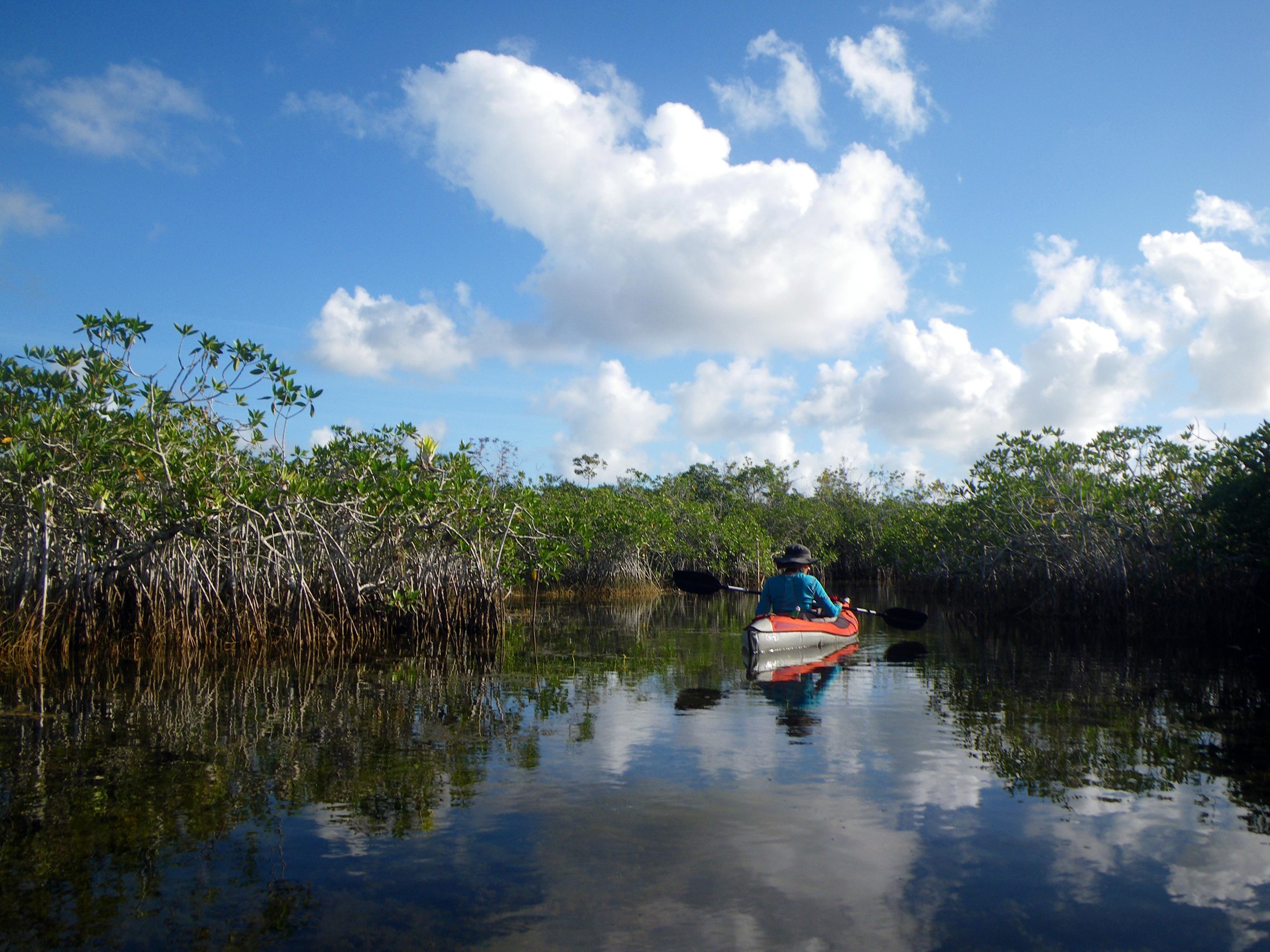
Rachael and I took the opportunity to spend several days paddling here. Inland we found a tightly winding water trail through red mangrove tunnels, tree limbs drooping with bromeliads and scattered with the sounds of mysterious birds. This area is the only place where the American alligator and the American crocodile coexist. Squeezing through a gap in the foliage Rachael inadvertently whacked a hidden alligator with her paddle who then unhappily hissed at me as I hurried by. In the next pond was a locally famous 14-foot croc smiling at us mischievously from the bank. Our route opened onto the freshwater marl prairie. With less than a foot of water and sawgrass at eye level it had the surreal feeling of kayaking across a Kansas wheat field accompanied by dragonflies and a marshy fragrance.

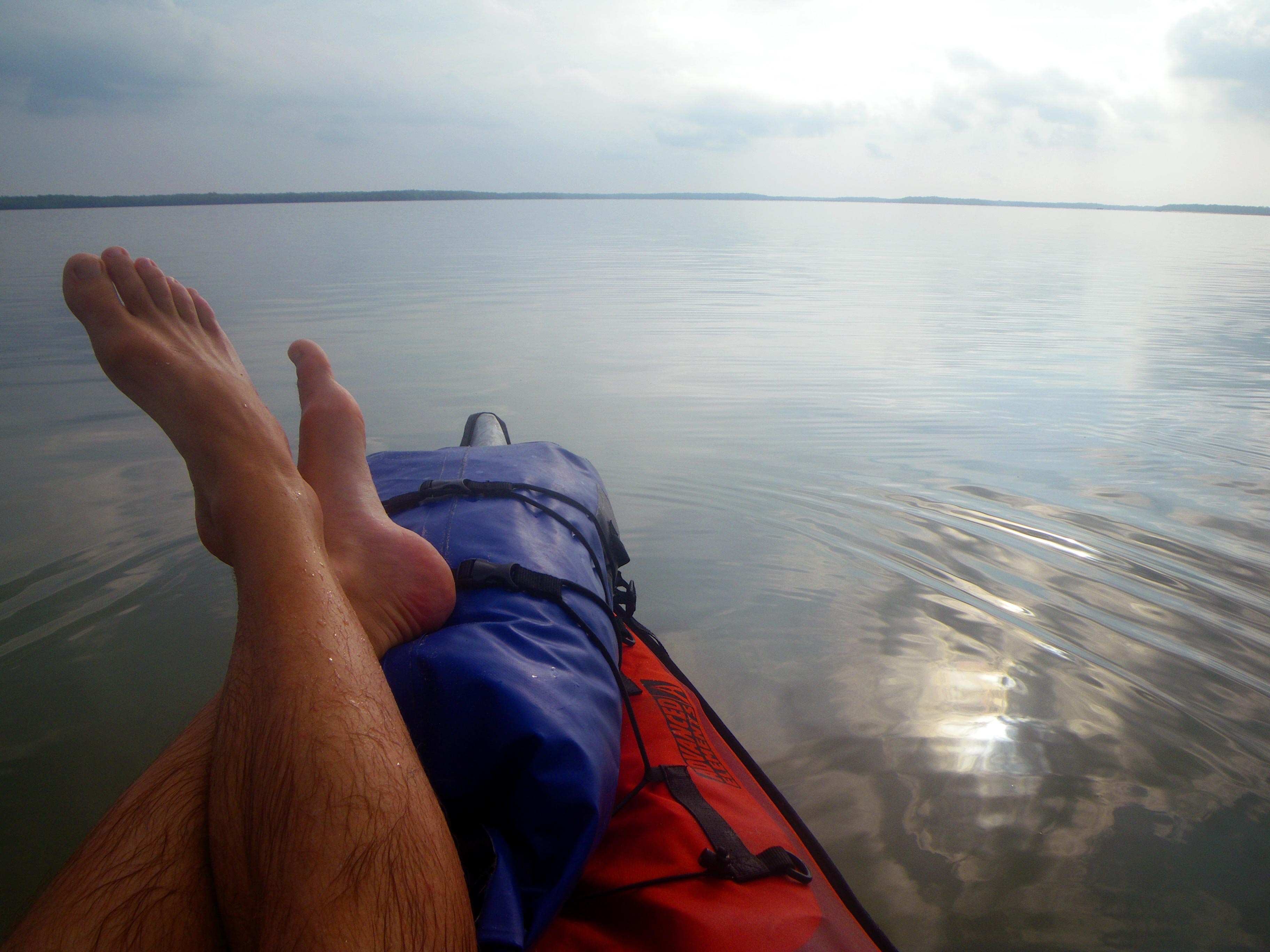
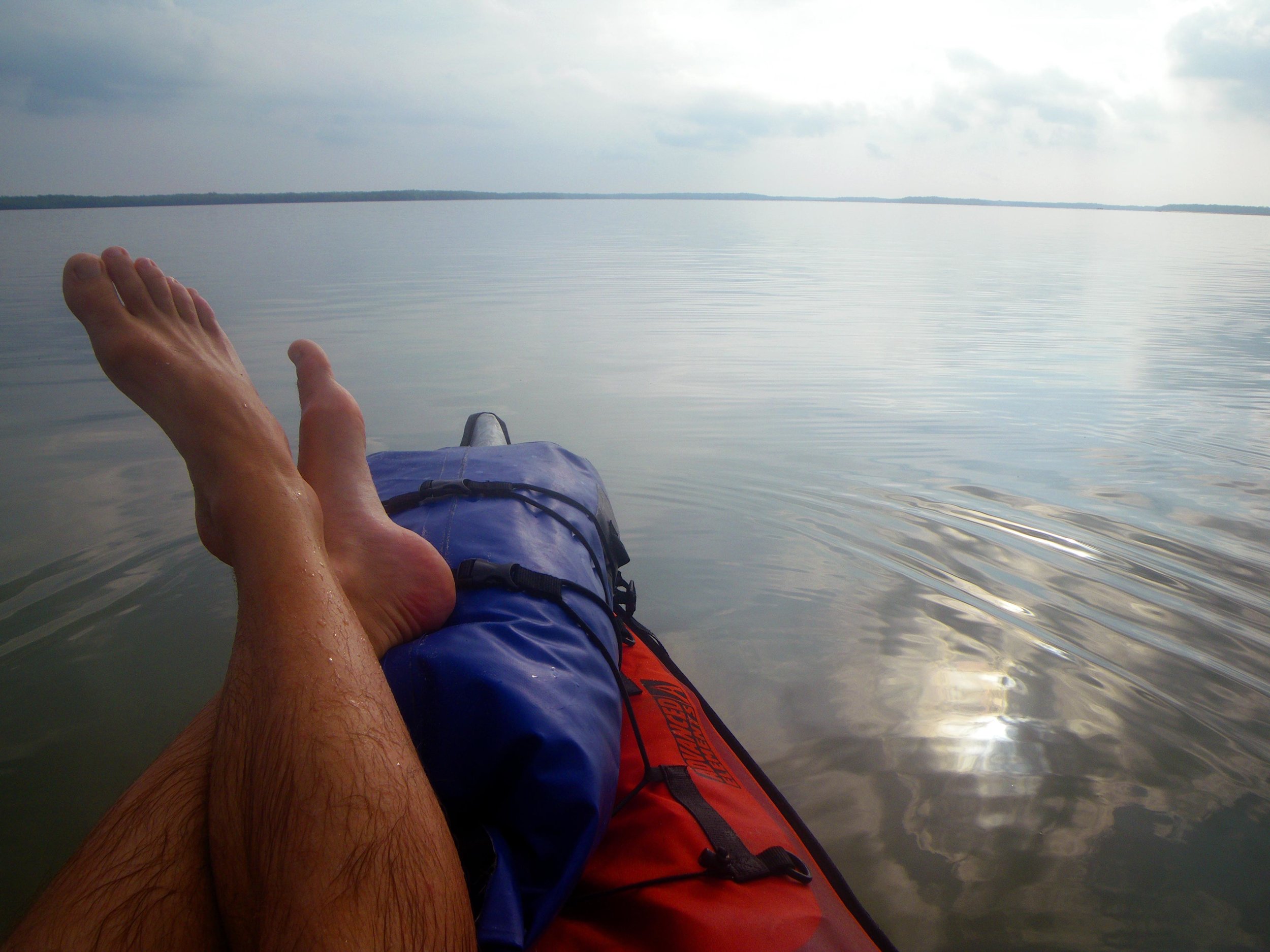
Our bigger adventure was kayaking for a few days into the Ten Thousand Island Wilderness and camping out on a couple keys next to the Gulf of Mexico. I was reminded of the rewards of putting in a little human powered effort toward getting oneself into a wild place. We saw dolphins by the dozen circling and feeding in the channels between islands. At one point, startled by a snort just off the stern of my boat, I turned to see the whiskery snout of a large and gentle manatee bobbing behind me for a few moments. Our eyes scanning the water we learned to distinguish the flotsam from the critters and a few times caught sight of furtive sea turtles, their heads periscoping above the calm waters showing a beaked overbite then discreetly sinking away at the sight of us humans.

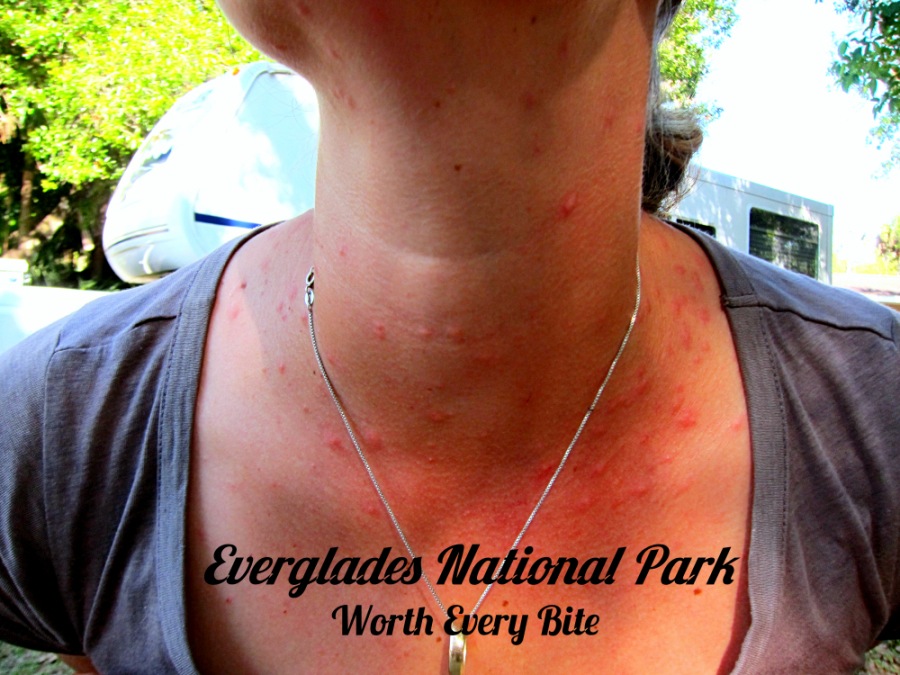
Out in these mangrove islands are other creatures including sharks and stingrays scanning the shallows near our campsites and a small breed of raccoon that has managed to swim it’s way out here and make a go of it in the overlapping roots, oyster shells and scattered sand bars than make up what little ground there is. They’ve also learned that paddlers can be a source of snacks and fresh water which are tough to come by, so we were awakened by them examining our gear in the dark and also caught them munching on the horseshoe crabs that wash up with the tides. Probably the most abundant animal out here is the sandfly or no-see-um. Kept at bay most of the time by the steady sea breeze we awoke one morning to still air and were reminded that we don’t need to taunt alligators to become part of the food chain. Simply stepping outside to the acid sting of a thousand tiny bites puts one’s flesh directly into the ecosystem. Thankfully we had that breeze most of the time and the quick relief of plunging into the Gulf for a soothing saltwater rinse.

Not all the tiny organisms were horrifying pests. Late one night, awoken by our raccoon visitors and attracted from our tent by a rich, star-filled sky, a blue glow at the waterline caught my eye. I’ve seen fireflies and I’ve heard of bioluminescent water creatures but this was unexpected and something easily missed with the intrusion of a flashlight or lantern. Innumerable tiny and barely tangible organisms were glowing in the gentle ripples of the rising tide, lighting briefly with each jostle. Mesmerized I went to take a closer look and as I ran my fingers through the warm waters, a sparkling trail of spots traced out my movements. I gently scooped up handfuls of water tossing them outward into the bay instigating dazzling flashes of blue-green light across the surface. The mysterious chemistry of these creatures was a powerful magic to me.

Ten Thousand Islands, Everglades N.P. - Photo by Tim GillerTen Thousand Islands, Everglades N.P. - Photo by Tim Giller

Ten Thousand Islands, Everglades N.P. – Photo by Tim Giller

Creature Encounters


Baby Gators - Photo by Tim Giller

Baby Gators – Photo by Tim Giller

I can’t help myself, I love a good swimming hole. It was a bad joke though, the splashing around and pretending that something was pulling me under. I knew that even before I followed Rachael’s stare to an alligator, its powerful tail propelling it across the pond in my direction, just the eyes and snout protruding from the surface, clearly attracted to my movements. I was about to get out anyway, so I just did it a bit more quickly. I suppose there is a reason I wasn’t seeing people swimming in the backwaters. I could stick to the seawater areas of Everglades National Park but then again we did see a monstrous crocodile while kayaking earlier and they prefer the saltier waters.

American Crocodile - Photo by Tim Giller

American Crocodile – Photo by Tim Giller

These prehistoric creatures aren’t at all interested in attacking people and there is no need to pretend you’re the late Steve Erwin to get a wildlife experience in the Everglades. The animals are abundant, as are wet places to visit them. The water table is generally somewhere above your ankles in this place. You may think you’re standing on dry land but cut any hole in the ground and it soon becomes a pond. This is exactly what the alligators do in the dry winter months to give themselves some watery space.

With water and land so intertwined and sometimes hard to differentiate the best way to explore is by boat and the quiet paddling of a kayak or canoe keeps the wildlife from scattering. It’s also more reliable than larger boats with less worry about getting caught on a sandbar at low tide or finding yourself hung up in a mangrove thicket. Occasionally however, especially in these dry winter months, the river of grass is more grass than river and you might find your butt dragging

Mangroves - Photo by Tim Giller

Mangroves – Photo by Tim Giller

Rachael and I took the opportunity to spend several days paddling here. Inland we found a tightly winding water trail through red mangrove tunnels, tree limbs drooping with bromeliads and scattered with the sounds of mysterious birds. This area is the only place where the American alligator and the American crocodile coexist. Squeezing through a gap in the foliage Rachael inadvertently whacked a hidden alligator with her paddle who then unhappily hissed at me as I hurried by. In the next pond was a locally famous 14-foot croc smiling at us mischievously from the bank. Our route opened onto the freshwater marl prairie. With less than a foot of water and sawgrass at eye level it had the surreal feeling of kayaking across a Kansas wheat field accompanied by dragonflies and a marshy fragrance.

Our bigger adventure was kayaking for a few days into the Ten Thousand Island Wilderness and camping out on a couple keys next to the Gulf of Mexico. I was reminded of the rewards of putting in a little human powered effort toward getting oneself into a wild place. We saw dolphins by the dozen circling and feeding in the channels between islands. At one point, startled by a snort just off the stern of my boat, I turned to see the whiskery snout of a large and gentle manatee bobbing behind me for a few moments. Our eyes scanning the water we learned to distinguish the flotsam from the critters and a few times caught sight of furtive sea turtles, their heads periscoping above the calm waters showing a beaked overbite then discreetly sinking away at the sight of us humans.

Out in these mangrove islands are other creatures including sharks and stingrays scanning the shallows near our campsites and a small breed of raccoon that has managed to swim it’s way out here and make a go of it in the overlapping roots, oyster shells and scattered sand bars than make up what little ground there is. They’ve also learned that paddlers can be a source of snacks and fresh water which are tough to come by, so we were awakened by them examining our gear in the dark and also caught them munching on the horseshoe crabs that wash up with the tides. Probably the most abundant animal out here is the sandfly or no-see-um. Kept at bay most of the time by the steady sea breeze we awoke one morning to still air and were reminded that we don’t need to taunt alligators to become part of the food chain. Simply stepping outside to the acid sting of a thousand tiny bites puts one’s flesh directly into the ecosystem. Thankfully we had that breeze most of the time and the quick relief of plunging into the Gulf for a soothing saltwater rinse.

Not all the tiny organisms were horrifying pests. Late one night, awoken by our raccoon visitors and attracted from our tent by a rich, star-filled sky, a blue glow at the waterline caught my eye. I’ve seen fireflies and I’ve heard of bioluminescent water creatures but this was unexpected and something easily missed with the intrusion of a flashlight or lantern. Innumerable tiny and barely tangible organisms were glowing in the gentle ripples of the rising tide, lighting briefly with each jostle. Mesmerized I went to take a closer look and as I ran my fingers through the warm waters, a sparkling trail of spots traced out my movements. I gently scooped up handfuls of water tossing them outward into the bay instigating dazzling flashes of blue-green light across the surface. The mysterious chemistry of these creatures was a powerful magic to me.

Ten Thousand Islands, Everglades N.P. - Photo by Tim Giller

Ten Thousand Islands, Everglades N.P. – Photo by Tim Giller

An open space of light

River of GrassRiver of Grass

River of Grass

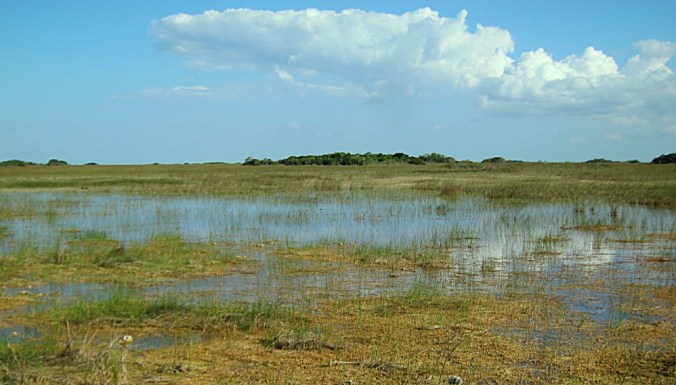
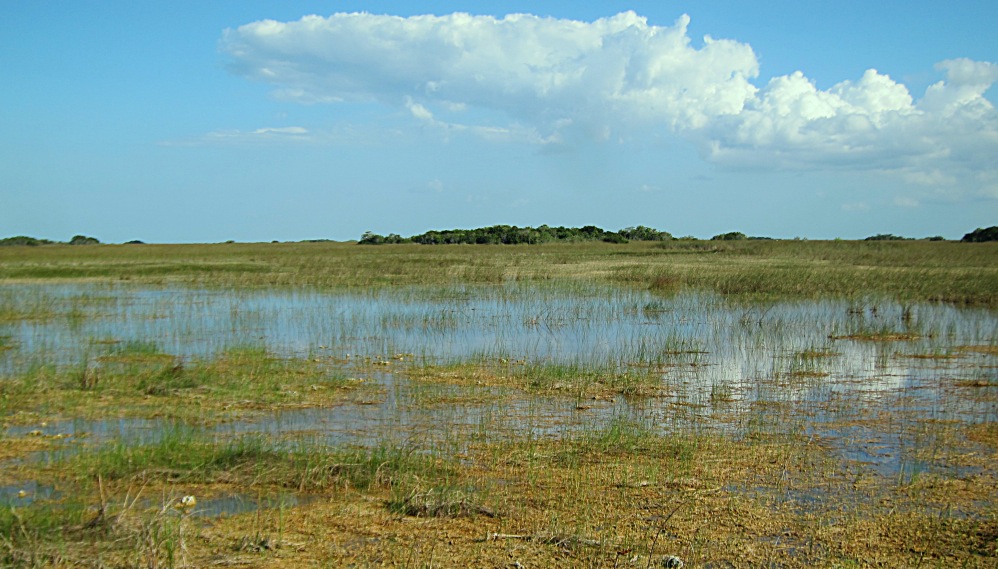
I’m not sure that I can do justice to either my experience in or the place of the Everglades in just a thousand word blog post. I spent one of the best weeks of my life in one of the most unique places in the world exploring all that I could soak up in our time there. Without too much prior knowledge I naively expected Everglades National Park to be the iconic 1000 Island Mangrove forests. In fact Everglades National Park inland is mostly the 50 mile wide “River of Grass”. A sawgrass prairie dotted by tree islands that sprout up in portions of the park that are mere inches higher in relief than the surrounding prairies. These islands range in size but are mostly teardrop in shape due to the way the water runs from Lake Okeechobee in the northeast towards the southwest out into the gulf. Or should I say used to?

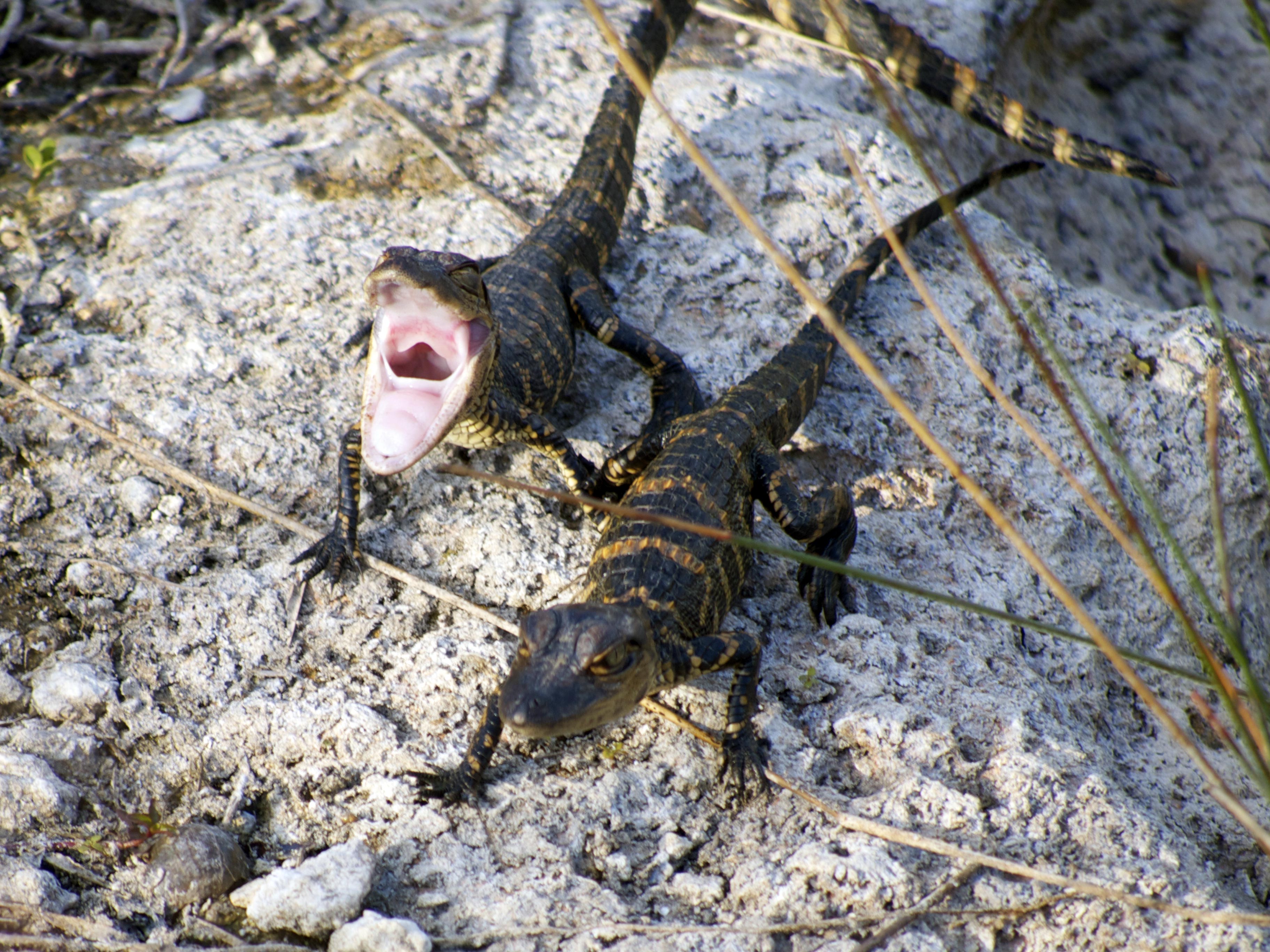
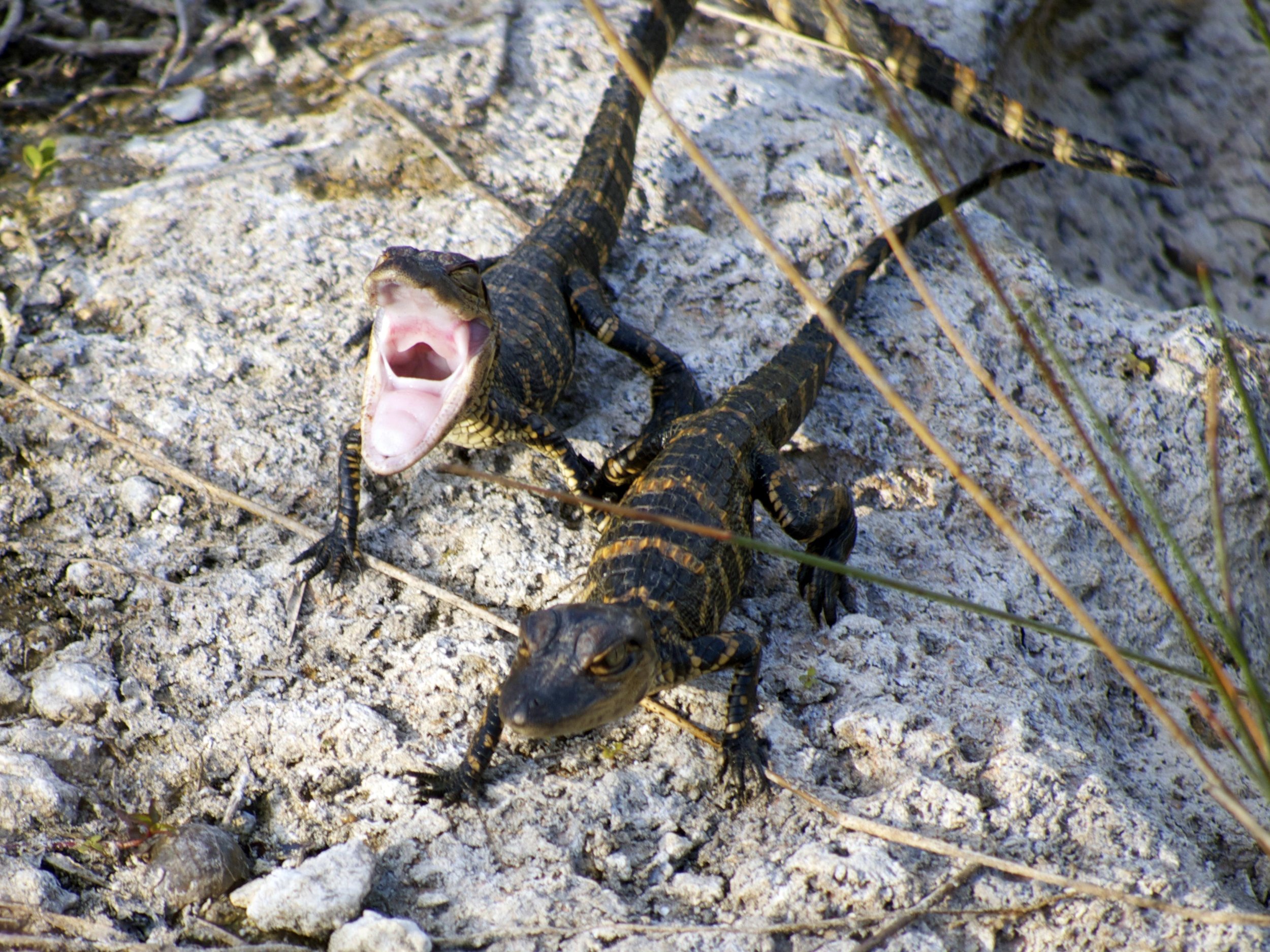
South Florida is a very wet place where everything is sticky and hot. Our clothes and sheets cling to our bodies making us feel claustrophobic. The damp air collects in the fold of my neck and the backs of my knees. In the morning the condensation drips off everything we left outside to dry. When it has rained that water came down in buckets. The fattest juiciest drops of rain that I’ve only experienced in the Southeast of America. This is south Florida’s “dry” season and it’s winter. We’re definitely not in California anymore. The Everglades average about 4 inches a month during the winter. This is the same average for San Francisco’s wettest month of January. Needless to say there is still water to be seen in the Everglades during their winter drought. Other parks close parts during the winter but in the Everglades parts of the park close down because it’s too hot and way too buggy to be comfortable to visit much in the summer. Because of the very low relief of the area all the fish get concentrated into burrow ponds throughout the park. Historically, these burrow ponds were dug out only by alligators. They dig out a hole in the sawgrass so they don’t dry out. This has the added benefit of collecting the fish in the area as they move into deeper waters. This concentration of fish gives predator birds a place for a feeding frenzy. And in turn supplies the alligators with all the food they need for the winter. There are so many alligators in the Everglades that we jokingly mentioned getting sick of them. As it turns out these dinosaur like creatures who can take your hand off in a matter of seconds are quite gentle in matters of life. Mating consists of gentle stroking and nuzzling and alligator mothers protect their young for a year or even two. We got lucky at a little pond looking for tadpoles and instead found a very young clutch of alligators with what looked like their older sibling and mom nearby. The babies would walk up to each other to “cuddle” and made noises not unlike puppies. The they would open for a big yawn before settling down. (See Tim’s photo on the just photos page)

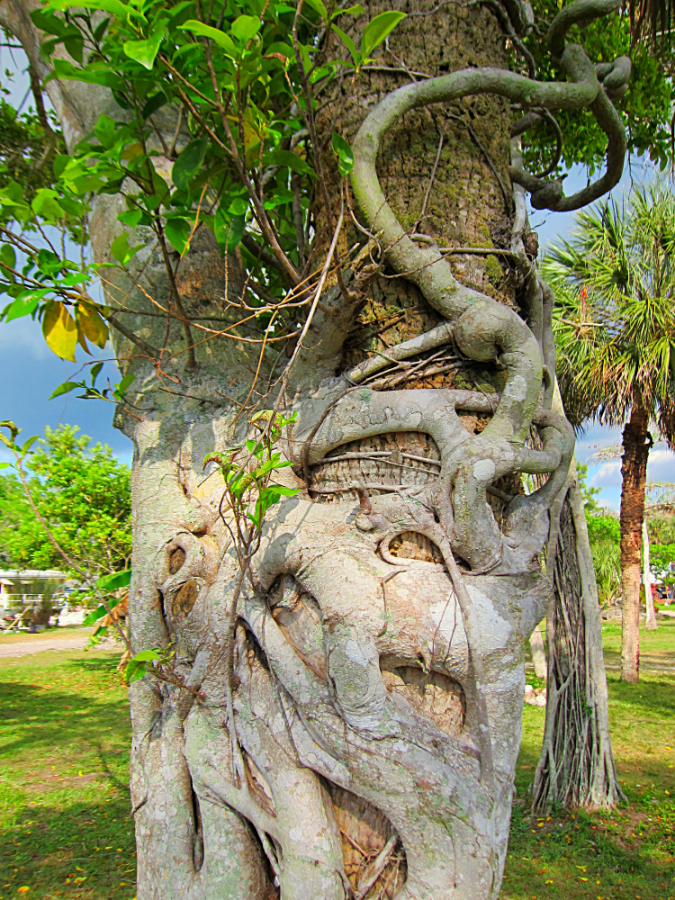
Strangler FigStrangler Fig

Strangler Fig

In order to develop south Florida the run off from lake Okeechobee has been channelized and now water that isn’t used for urban centers or agriculture spills out into the ocean. While there is a massive, 30 year, restoration plan in play currently 80% of the water in the Everglades now only comes from rain. A big portion of the restoration plan includes restoring more historic water flow conditions that puts the right amount of water into the river at the right time of the year. Of course clean water is of the essence. The Everglades are a low phosphorous environment and the plants are uniquely adapted to growing in those conditions. Too much phosphorous will kill off the sawgrass. With the surrounding agriculture it’s not hard to see where the excess phosphorous is coming from. Another issue is mercury in the water from an unknown origin.

No doubt the glue of the Everglades is the base of the food chain, something called Periphyton. Periphyton is a mixture of algae, bacteria and microbes. It looks much like over soggy catails and smells a bit like rotting foods. We had the pleasure of kayaking in very shallow water thick with the stuff. This made for a long stinky slog it what was otherwise an amazing kayak outing. Periphyton holds and traps in moisture so that the Everglades don’t dry out in the winter months. Periphyton also helps keep the water clean by absorbing contaminants. However, it’s sensitive to too much pollution and reacts very quickly under stress.

On top of too little clean fresh water the park is battling some formidable invasive species, most notably the Burmese python. The Everglades is the most unique biological region in North America. It’s not just a National Park but is also listed as an International Biosphere Reserve, World Heritage Site and a Wetland of International Importance. It’s at once temperate and tropical. A place where the pine and the palm intermingle, the last known place for the American Crocodile and a refuge for the Kempler’s Sea turtle. Saved by the Passionate Marjory Stoneman Douglas it was made a park in 1947. Many people since then have continued the fight to protect and restore the park to the best of their abilities. The park makes no bones about the dire situation the Everglades are in. The park brochure spells it out the best with this line “The Everglades is currently on life support, alive but diminished”. Knowing this I feel very grateful for the abundance of wildlife we saw while we were there, even if the bugs are also abundant.

Everglades PostcardEverglades Postcard

Everglades Postcard

An open space of light

River of Grass

River of Grass

I’m not sure that I can do justice to either my experience in or the place of the Everglades in just a thousand word blog post. I spent one of the best weeks of my life in one of the most unique places in the world exploring all that I could soak up in our time there. Without too much prior knowledge I naively expected Everglades National Park to be the iconic 1000 Island Mangrove forests. In fact Everglades National Park inland is mostly the 50 mile wide “River of Grass”. A sawgrass prairie dotted by tree islands that sprout up in portions of the park that are mere inches higher in relief than the surrounding prairies. These islands range in size but are mostly teardrop in shape due to the way the water runs from Lake Okeechobee in the northeast towards the southwest out into the gulf. Or should I say used to?

South Florida is a very wet place where everything is sticky and hot. Our clothes and sheets cling to our bodies making us feel claustrophobic. The damp air collects in the fold of my neck and the backs of my knees. In the morning the condensation drips off everything we left outside to dry. When it has rained that water came down in buckets. The fattest juiciest drops of rain that I’ve only experienced in the Southeast of America. This is south Florida’s “dry” season and it’s winter. We’re definitely not in California anymore. The Everglades average about 4 inches a month during the winter. This is the same average for San Francisco’s wettest month of January. Needless to say there is still water to be seen in the Everglades during their winter drought. Other parks close parts during the winter but in the Everglades parts of the park close down because it’s too hot and way too buggy to be comfortable to visit much in the summer. Because of the very low relief of the area all the fish get concentrated into burrow ponds throughout the park. Historically, these burrow ponds were dug out only by alligators. They dig out a hole in the sawgrass so they don’t dry out. This has the added benefit of collecting the fish in the area as they move into deeper waters. This concentration of fish gives predator birds a place for a feeding frenzy. And in turn supplies the alligators with all the food they need for the winter. There are so many alligators in the Everglades that we jokingly mentioned getting sick of them. As it turns out these dinosaur like creatures who can take your hand off in a matter of seconds are quite gentle in matters of life. Mating consists of gentle stroking and nuzzling and alligator mothers protect their young for a year or even two. We got lucky at a little pond looking for tadpoles and instead found a very young clutch of alligators with what looked like their older sibling and mom nearby. The babies would walk up to each other to “cuddle” and made noises not unlike puppies. The they would open for a big yawn before settling down. (See Tim’s photo on the just photos page)

Strangler Fig

Strangler Fig on Palm

In order to develop south Florida the run off from lake Okeechobee has been channelized and now water that isn’t used for urban centers or agriculture spills out into the ocean. While there is a massive, 30 year, restoration plan in play currently 80% of the water in the Everglades now only comes from rain. A big portion of the restoration plan includes restoring more historic water flow conditions that puts the right amount of water into the river at the right time of the year. Of course clean water is of the essence. The Everglades are a low phosphorous environment and the plants are uniquely adapted to growing in those conditions. Too much phosphorous will kill off the sawgrass. With the surrounding agriculture it’s not hard to see where the excess phosphorous is coming from. Another issue is mercury in the water from an unknown origin.

No doubt the glue of the Everglades is the base of the food chain, something called Periphyton. Periphyton is a mixture of algae, bacteria and microbes. It looks much like over soggy catails and smells a bit like rotting foods. We had the pleasure of kayaking in very shallow water thick with the stuff. This made for a long stinky slog it what was otherwise an amazing kayak outing. Periphyton holds and traps in moisture so that the Everglades don’t dry out in the winter months. Periphyton also helps keep the water clean by absorbing contaminants. However, it’s sensitive to too much pollution and reacts very quickly under stress.

On top of too little clean fresh water the park is battling some formidable invasive species, most notably the Burmese python. The Everglades is the most unique biological region in North America. It’s not just a National Park but is also listed as an International Biosphere Reserve, World Heritage Site and a Wetland of International Importance. It’s at once temperate and tropical. A place where the pine and the palm intermingle, the last known place for the American Crocodile and a refuge for the Kempler’s Sea turtle. Saved by the Passionate Marjory Stoneman Douglas it was made a park in 1947. Many people since then have continued the fight to protect and restore the park to the best of their abilities. The park makes no bones about the dire situation the Everglades are in. The park brochure spells it out the best with this line “The Everglades is currently on life support, alive but diminished”. Knowing this I feel very grateful for the abundance of wildlife we saw while we were there, even if the bugs are also abundant.

Everglades Postcard

Roads End

CauswayCausway

Causway

The constant flow of vehicles was clear evidence that I’m not the only one who finds the end of the road compelling. When that road ends at a Caribbean Island with a romantic history of pirates, rumrunners, Cuban exiles and Ernest Hemingway the 100-mile conga line of RVs, convertibles and a heavy preponderance of Harleys is not surprising. What I found hard to imagine was where all those vehicles were going to end up given that the island of Key West is no more than 4 miles long and maybe 2 miles at it’s widest. I was wondering if drivers dazzled by the sun dappled, turquoise waters, foreheads sticky from the humid air just kept driving off the southernmost point of the continental U.S. into the Florida Straights. Given the identical character of the returning traffic it’s clear that March is a massive game of musical chairs, all those Massachusetts and Minnesota license plates taking turns at escaping the northern winters, the dockside thatch bars filled by Bermuda short clad refugees scoffing at the silent loop of the Weather Channel showing the latest snow-pocalypse back home.
With Rachael’s gracious assistance I was able to ditch my gear and hop on my bike for the long arcing ride from Key Largo to Key West. Formed over 100,000 years ago the Keys are a chain of coral reef outcrops linked by a series of bridges and causeways built on the skeleton of Henry Flagler’s hurricane wrecked Overseas Railway. With a small bit of effort it would be a world-class bike route, the paths and wide shoulders not very contiguous yet. As it stands it’s a pretty great ride if you’re comfortable having a steady flow of cars just off your hip. Being on a bike allowed me to see the mangroves and tropical waters close up. It also meant that in the steamy sun my forehead and everything else was sticky and hot when I reached roads end, so I went ahead and dove off the southernmost point into the reviving waters of the Florida Straights.

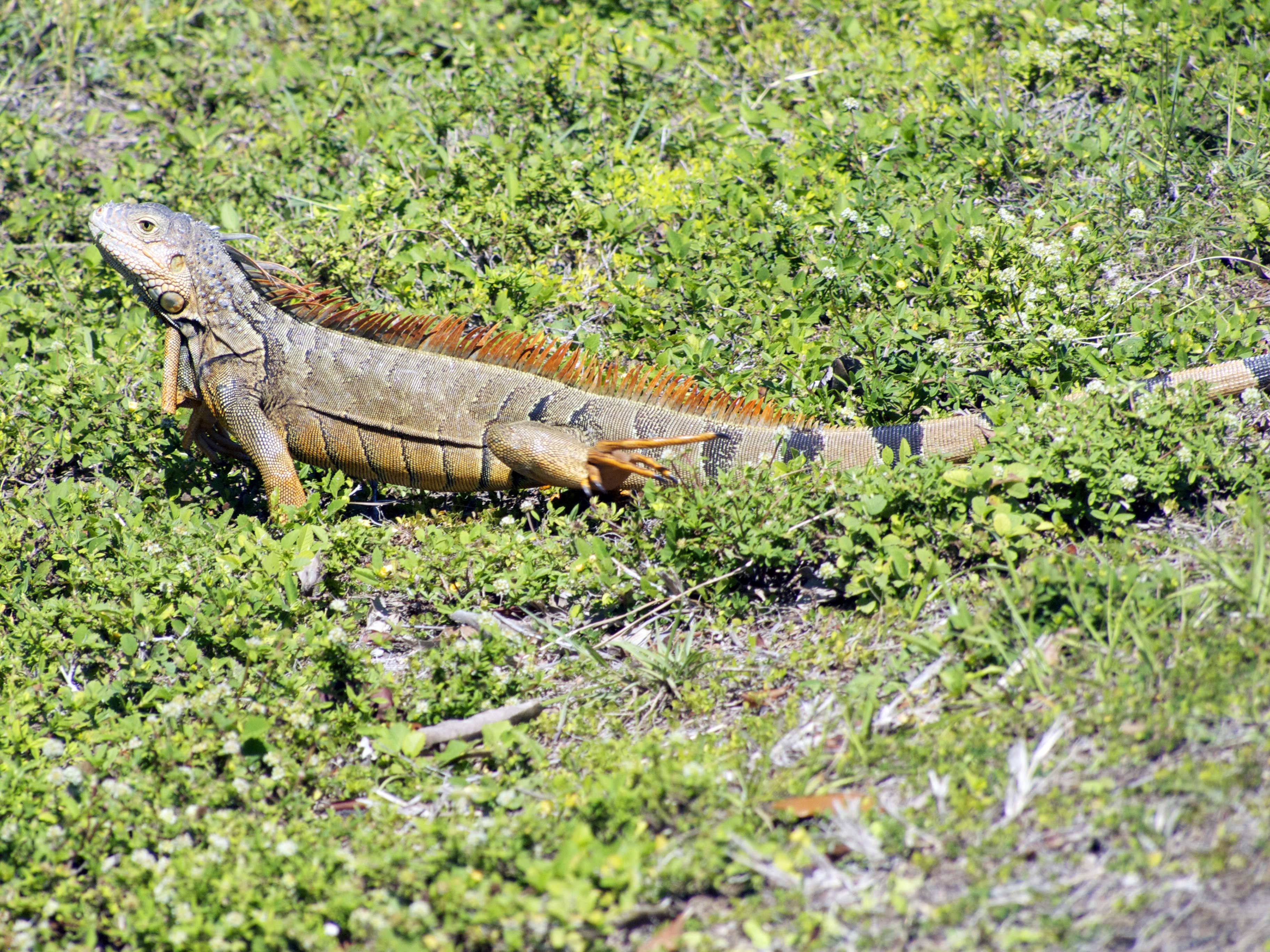
IgunaIguna

Iguna

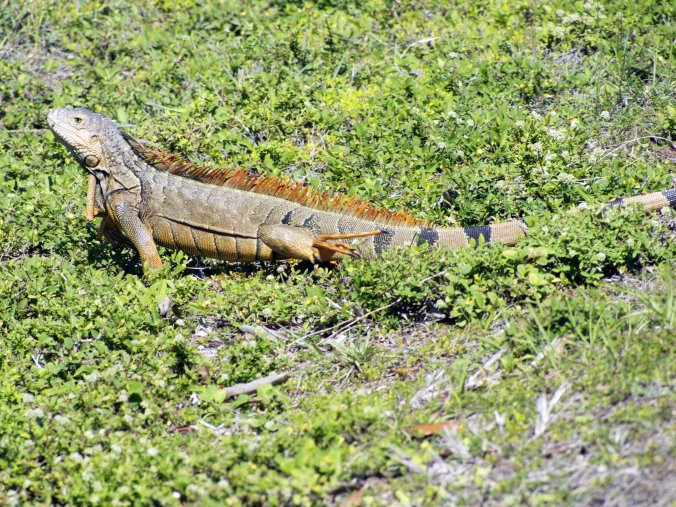
The Keys have island ecology issues. Islands, by their physical separation, have a high rate on endemism – plants and animals unique to that place. By attaching these islands to each other and to the mainland with a road, aggressive, non-native species start to show up. Being this far south everything was exotic to me so it’s difficult without prior study to know what is native. The hundreds of big Green Iguanas scampering into the mangroves as I rode by, not native. The attractive, grey-green palm trees, also not native. In fact the warm frost-free climate that has attracted folks for all these years also means it’s a place where exotics can thrive and some of those folks brought exotics with them with that in mind. On many islands essentially all life is invasive. On a brand new volcanic rock rising from the sea there is going to be that first coconut that floats in and takes root or that first colorful songbird that gets blown way off course and makes a home. Over generations these creatures adapting to local conditions can become new and unique species. Our modern dilemma is the much-accelerated rate that a highly mobile and somewhat careless humanity brings to these changes. The biodiversity that is essential to a healthy and adaptable ecosystem is diminished each time a Norway Rat jumps ship or a oversized pet Python gets dumped in the Florida swamp. Some newcomers can wipe out whole classes of native life.

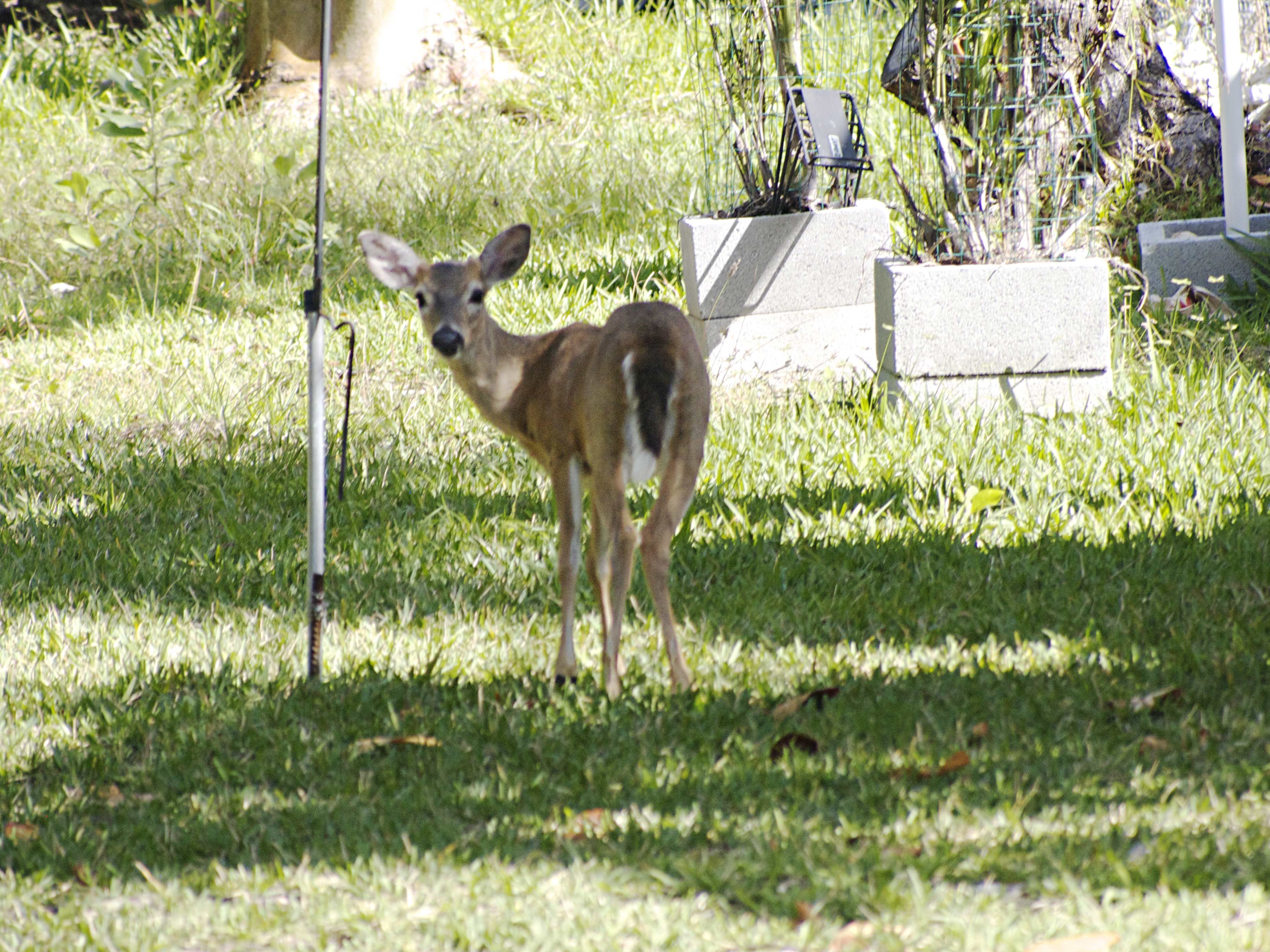
Key DeerKey Deer

Key Deer

7mile7mile

7mile

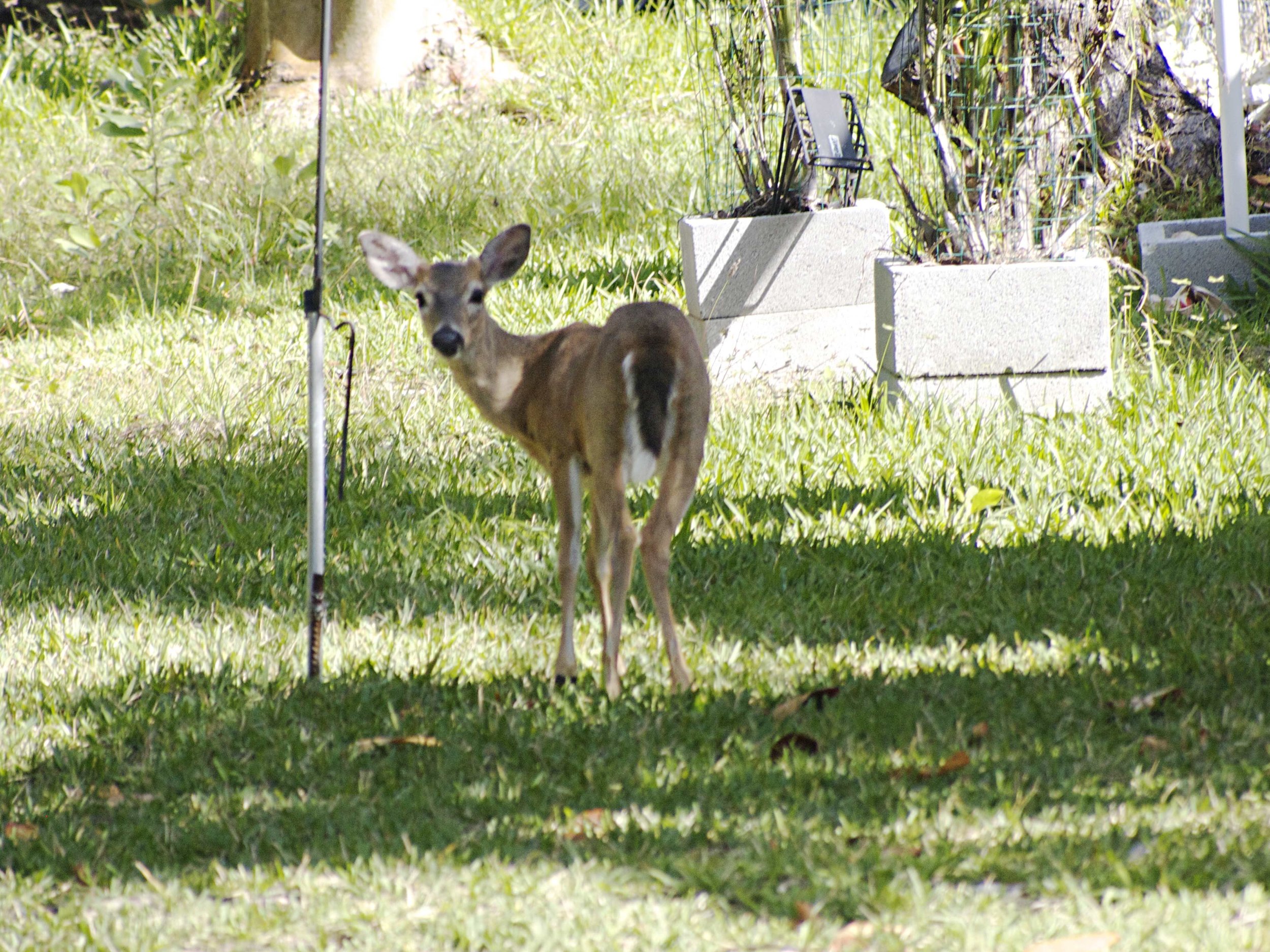
Nature is well at hand in the Keys once you find your way off the main drag. There are mangroves filled with unique birds you can’t see elsewhere in America and those alluring waters are rich with fish. I suppose that to the vast majority of travelers, on that narrow strip of congested pavement, nature is the tarpon they hope to hook on their half day fishing charter or the conch fritters they wash down with a rum punch. If they were lucky like I was they might have spotted the diminutive Key Deer that was grazing behind some secluded mobile homes. Like a lot of island mammals it is much smaller than it’s mainland cousin the white tailed deer and is found only on a few Keys towards the end of the line. Endangered and protected with a special reserve on Big Pine Key it’s hoped that they can coexist within the laid back Keys lifestyle. Unfortunately, with over 30 deer killed so far on the busy highway it looks like this year might be worse than the last. Paradise can be irresistible and with so many crowding in to get a taste, both the lifestyle and the deer can suffer. With our feet up on a chunk of coral and an improvised rum cocktail in our hands while watching the sun set into Florida Bay I guess I was grateful for a chance to get our little piece of this paradise.

Roads End

The constant flow of vehicles was clear evidence that I’m not the only one who finds the end of the road compelling. When that road ends at a Caribbean Island with a romantic history of pirates, rumrunners, Cuban exiles and Ernest Hemingway the 100-mile conga line of RVs, convertibles and a heavy preponderance of Harleys is not surprising. What I found hard to imagine was where all those vehicles were going to end up given that the island of Key West is no more than 4 miles long and maybe 2 miles at it’s widest. I was wondering if drivers dazzled by the sun dappled, turquoise waters, foreheads sticky from the humid air just kept driving off the southernmost point of the continental U.S. into the Florida Straights. Given the identical character of the returning traffic it’s clear that March is a massive game of musical chairs, all those Massachusetts and Minnesota license plates taking turns at escaping the northern winters, the dockside thatch bars filled by Bermuda short clad refugees scoffing at the silent loop of the Weather Channel showing the latest snow-pocalypse back home.

With Rachael’s gracious assistance I was able to ditch my gear and hop on my bike for the long arcing ride from Key Largo to Key West. Formed over 100,000 years ago thCauswaye Keys are a chain of coral reef outcrops linked by a series of bridges and causeways built on the skeleton of Henry Flagler’s hurricane wrecked Overseas Railway. With a small bit of effort it would be a world-class bike route, the paths and wide shoulders not very contiguous yet. As it stands it’s a pretty great ride if you’re comfortable having a steady flow of cars just off your hip. Being on a bike allowed me to see the mangroves and tropical waters close up. It also meant that in the steamy sun my forehead and everything else was sticky and hot when I reached roads end, so I went ahead and dove off the southernmost point into the reviving waters of the Florida Straights.

The Keys have island ecology issues. Islands, by their physical separation, have a high rate on endemism – plants and animals unique to that place. By attaching these islands to each other and to the mainland with a road, aggressive, non-native species start to show up. Being this far south everything was exotic to me so it’s difficult without prior study to know what is native. The hundreds of big Green Iguanas scampering into the mangroves as I rode by, nIgunaot native. The attractive, grey-green palm trees, also not native. In fact the warm frost-free climate that has attracted folks for all these years also means it’s a place where exotics can thrive and some of those folks brought exotics with them with that in mind. On many islands essentially all life is invasive. On a brand new volcanic rock rising from the sea there is going to be that first coconut that floats in and takes root or that first colorful songbird that gets blown way off course and makes a home. Over generations these creatures adapting to local conditions can become new and unique species. Our modern dilemma is the much-accelerated rate that a highly mobile and somewhat careless humanity brings to these changes. The biodiversity that is essential to a healthy and adaptable ecosystem is diminished each time a Norway Rat jumps ship or a oversized pet Python gets dumped in the Florida swamp. Some newcomers can wipe out whole classes of native life.


Key Deer

Key Deer

Nature is well at hand in the Keys once you find your way off the main drag. There are mangroves filled with unique birds you can’t see elsewhere in America and those alluring waters are rich with fish. I suppose that to the vast majority of travelers, on that narrow strip of congested pavement, nature is the tarpon they hope to hook on their half day fishing charter or the conch fritters they wash down with a rum punch. If they were lucky like I was they might have spotted the diminutive Key Deer that was grazing behind some secluded mobile homes. Like a lot of island mammals it is much smaller than it’s mainland cousin the white tailed deer and is found only on a few Keys towards the end of the line. Endangered and protected with a special reserve on Big Pine Key it’s hoped that they can coexist within the laid back Keys lifestyle. Unfortunately, with over 30 deer killed so far on the busy highway it looks like this year might be worse than the last. Paradise can be irresistible and with so many crowding in to get a taste, both the lifestyle and the deer can suffer. With our feet up on a chunk of coral and an improvised rum cocktail in our hands while watching the sun set into Florida Bay I guess I was grateful for a chance to get our little piece of this paradise.7mile