Mountain Folks

James was a fountain of knowledge, an unsolicited fountain but fascinating just the same. And maybe more like an oscillating lawn sprinkler with no obvious shut off valve, a new topic beginning before the previous thought had been finished. I caught him sizing us up as we were walking into the small town thrift store where he was apparently employed, although he spent the better part of 45 minutes talking to us once we were cornered between the over-starched linens, thumb-worn romance novels and water damaged gospel albums. We discovered that James is a true naturalist in his own right. He originally took us to be Appalachian thru-hikers. Months of living in Lil’ Squatch must give us an outdoorsy look. What followed was a staccato primer on the natural history of Southern Appalachia around this corner of Tennessee, Georgia and North Carolina beginning with a quick karate chop description of the river drainages around where we had camped the two previous nights and ending with his interpretations of local Cherokee legends. We were finally able to leave once his exasperated co-workers pulled him away, but not before his very pregnant girlfriend showed up and a was able to show us an indecipherable photo from her flip-phone of what we were told was an amazing waterfall. Though the conversation was decidedly one sided I really appreciated his knowledge and enthusiasm. I think he was relishing the opportunity to share because he was working off a one year ban from the National Forest, though we couldn’t understand if it was for poaching fish, harvesting ginseng out season or for threatening a fellow camper with a bucket containing two live and very venomous copperhead snakes.

People have deep connection with these mountains and rivers. We had another opportunity to learn this the next day when by chance we were able to join a volunteer river clean up along the Hiawassee. Organized in part by Trout Unlimited, we found a group of folks who knew the local waters thoroughly. We learned which rivers had good populations of native fish, and which ones were favored by non-native stocked fish that can thrive in the colder waters below the many dams in the watershed. Kayaking is also incredibly popular in Eastern Tennessee and a few of our cohorts told us of how several dammed rivers have become such popular whitewater destinations that compromises have been made in flow timing in order to benefit these users. The Tennessee Valley Authority (TVA) was also a sponsor of the volunteer event. This agency is the builder of these dams, beginning in the 1930s, to bring electricity and flood control to an impoverished region. A side effect was the substantial alteration of a large amount of river habitat. Over the years some efforts have been successful to mitigate the damage but the fact is most of the dams remain, though many are nearing the end of the functional lifetime as silt builds up behind them.

Settler Home - Photo by Tim Giller

Settler Home – Photo by Tim Giller

Eager to have our own first hand experience of this place we made our way to Great Smokey Mountain National Park. As the biggest chunk of preserved Appalachia it also preserves much of the human story of the region. The Eastern band of Cherokee still maintains a presence here despite their bitter and unfair removal along the Trail of Tears. Homesteaders also made a home here and were also compelled to leave as the park was formed; many of their historical homes and other structures have been preserved as visitor attractions. Today the human story appears to be throngs of automobiles. The Smokies are the most visited National Park in the country and the vast majority of those visitors see it from only a car window after working their way through a dense gauntlet of tourist trap attractions just outside the boundaries. Clearly this was no way to find some connection to this landscape so we planned out a 4-day backcountry hike into the heart of the mountains.

Silers Bald AT Shelter - Photo by Tim Giller

Silers Bald AT Shelter – Photo by Tim Giller

Up there we encountered a whole new culture that has staked a claim on these mountains. We found ourselves in the middle of the peak season of Appalachian Trail thru-hikers and had the pleasure of spending a windy and frosty night in one of the highest trail shelters on the route. The 2200 mile trail from Georgia to Maine reaches it’s highest point just up the trail from where we walked and each year more and more people attempt to hike the entire trail in one go. Along the route volunteers have built and maintain a series of wooden and stone shelters for hikers to sleep in with ten or more people squeezing into them each night during the high season. These become nightly social gathering spots where stories and information are exchanged and new hiking partners and friendships are made, folks only going by their trail names such as “Black and Blue”, “Bean-Counter” or “Proudfoot”. When we realized we’d be staying along the trail on Easter morning we ducked into town to get candy before heading out. As Rachael passed out treats to grateful thru-hikers I decided her trail name would be “Easter Bummy”.
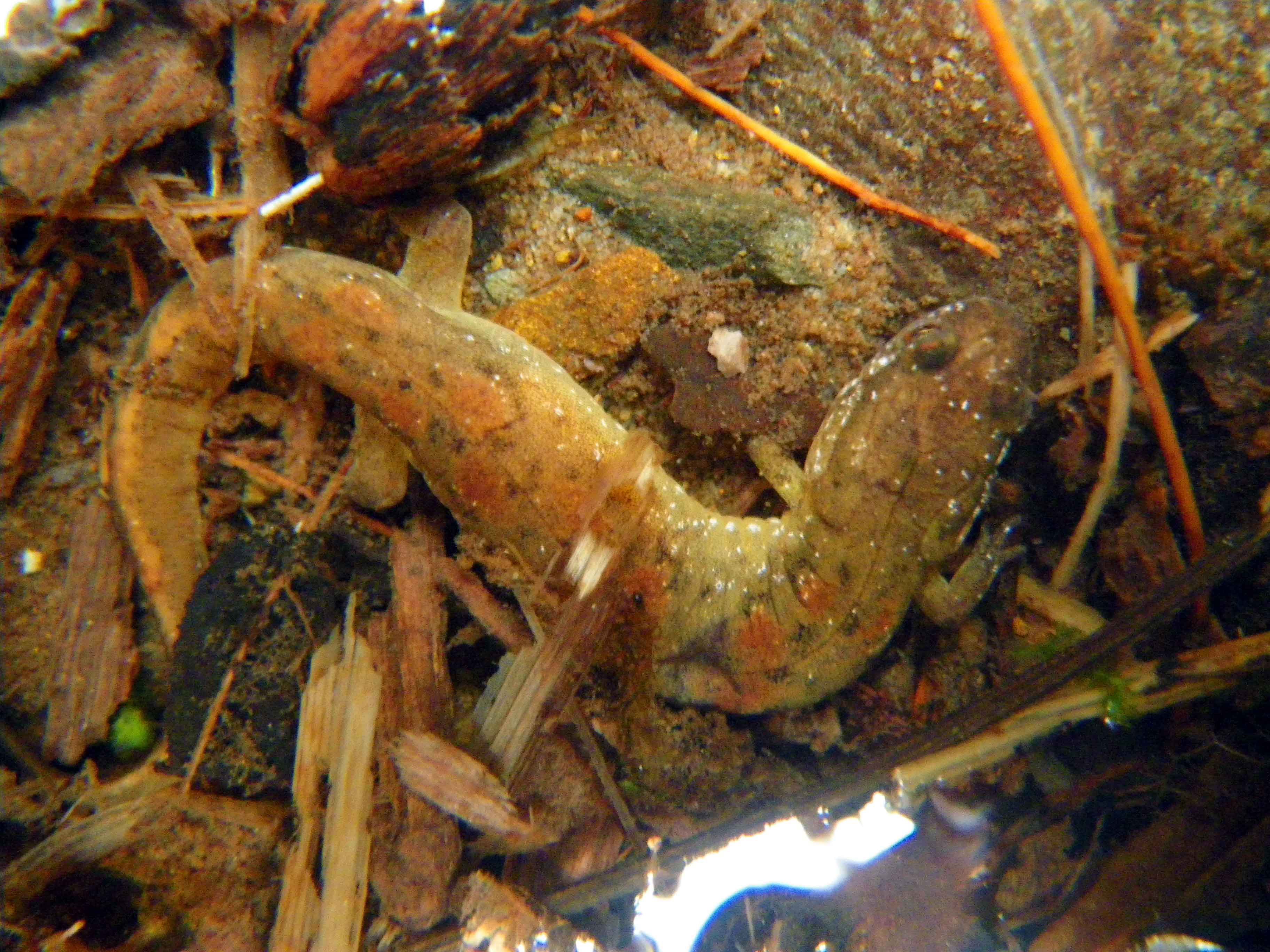
Salamander - Photo by Tim Giller

Salamander – Photo by Tim Giller

Most of our time though was spent away from the crowd of this busy trail. I was extremely grateful to have the time to get back into the valleys and ridges of the backcountry because my desire for taking this hike was to get a closer look at the nature of these mountains. This wasn’t as easy as I had expected. My first point of entry in a new landscape is generally to get a lay of the land, to see the shape of its contours and get my bearings. Even in early spring with few leaves in the forest to obscure my view it is rare to have the open vistas of my western ranges. I found myself craning my neck, struggling to make out peaks, looking for rocky outcrops to use as landmarks, but it was all indistinct hills covered with a thick and indistinguishable uniformity of trees. What I learned was that to see this landscape you need to look into it, to look more closely and see the incredible diversity of trees, fungus, lichens, mosses, and insects, to flip over a few rocks looking for salamanders, to open my ears to the variety of birdsong emanating from hidden spots back in the endless tangle of branches, to immerse myself in the remarkably clear and cold waters of the countless streams. It has been these little creatures and processes that have kept this landscape humming, despite all the comings and goings of humans over the millennia, indifferent to our foibles though unfortunately not immune to them.
Creature Encounters

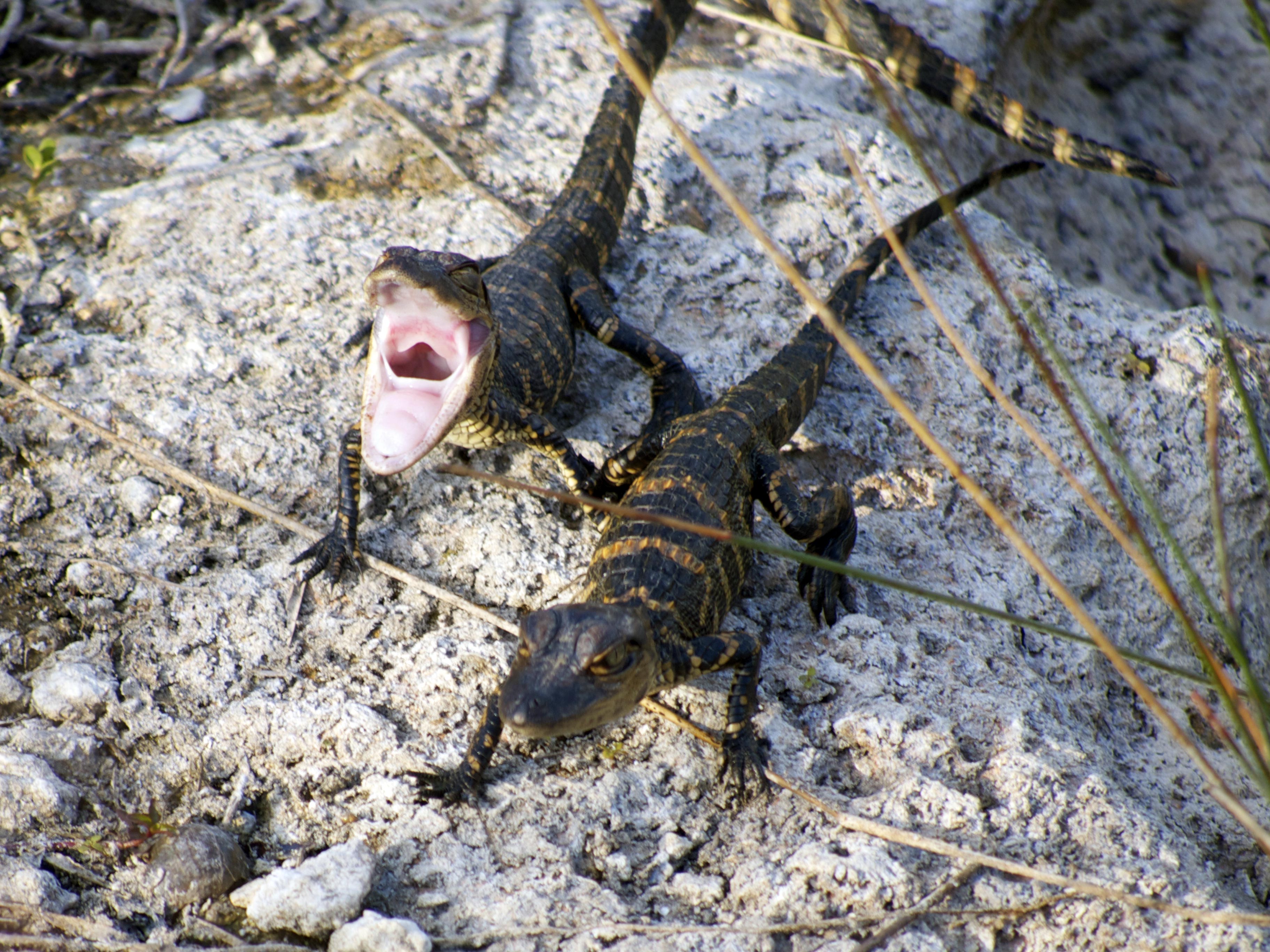
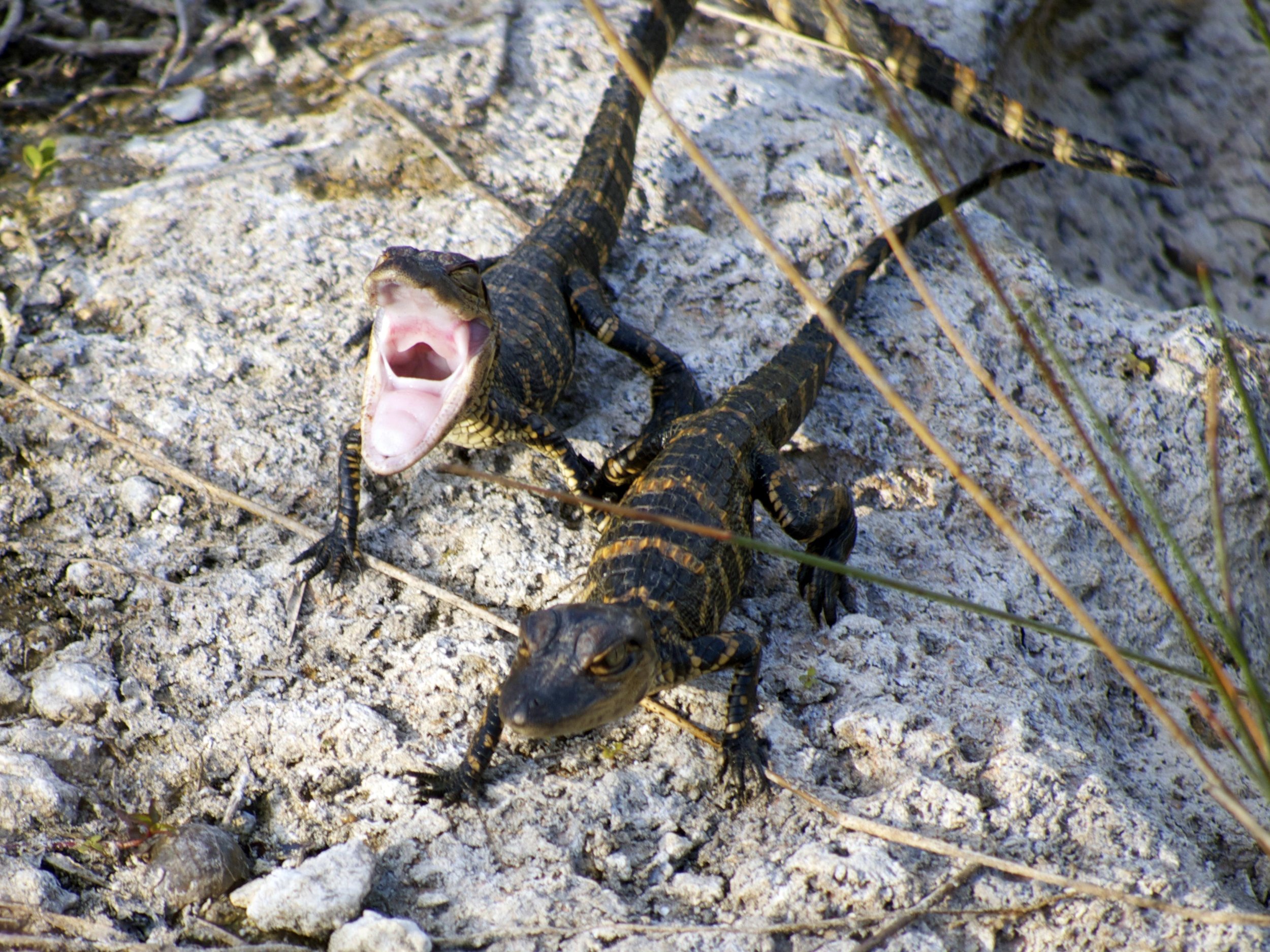
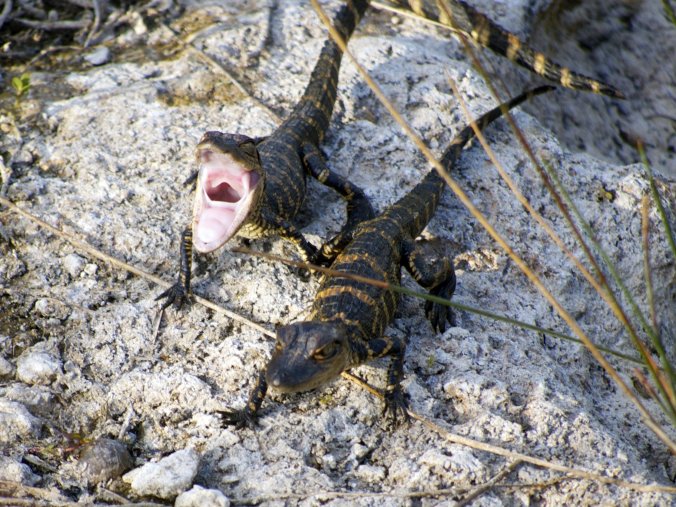
Baby Gators - Photo by Tim GillerBaby Gators - Photo by Tim Giller

Baby Gators – Photo by Tim Giller

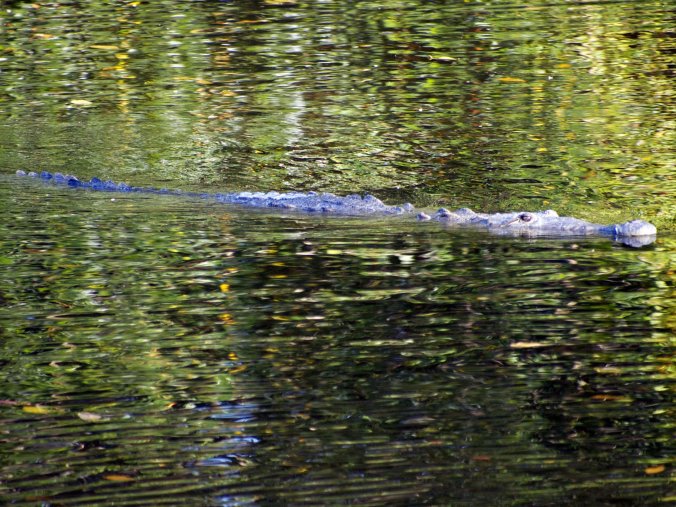
I can’t help myself, I love a good swimming hole. It was a bad joke though, the splashing around and pretending that something was pulling me under. I knew that even before I followed Rachael’s stare to an alligator, its powerful tail propelling it across the pond in my direction, just the eyes and snout protruding from the surface, clearly attracted to my movements. I was about to get out anyway, so I just did it a bit more quickly. I suppose there is a reason I wasn’t seeing people swimming in the backwaters. I could stick to the seawater areas of Everglades National Park but then again we did see a monstrous crocodile while kayaking earlier and they prefer the saltier waters.

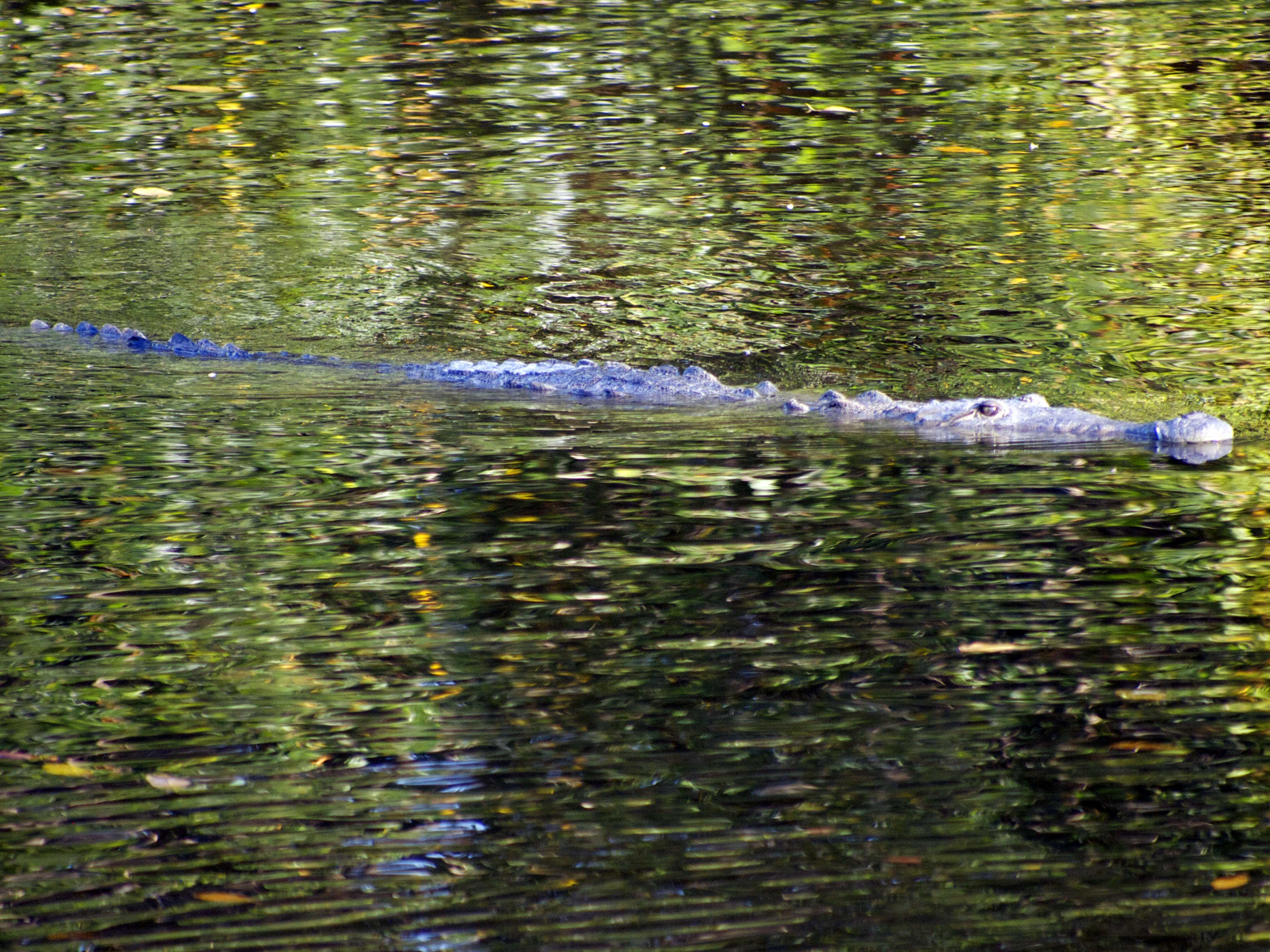
American Crocodile - Photo by Tim GillerAmerican Crocodile - Photo by Tim Giller

American Crocodile – Photo by Tim Giller

These prehistoric creatures aren’t at all interested in attacking people and there is no need to pretend you’re the late Steve Erwin to get a wildlife experience in the Everglades. The animals are abundant, as are wet places to visit them. The water table is generally somewhere above your ankles in this place. You may think you’re standing on dry land but cut any hole in the ground and it soon becomes a pond. This is exactly what the alligators do in the dry winter months to give themselves some watery space.

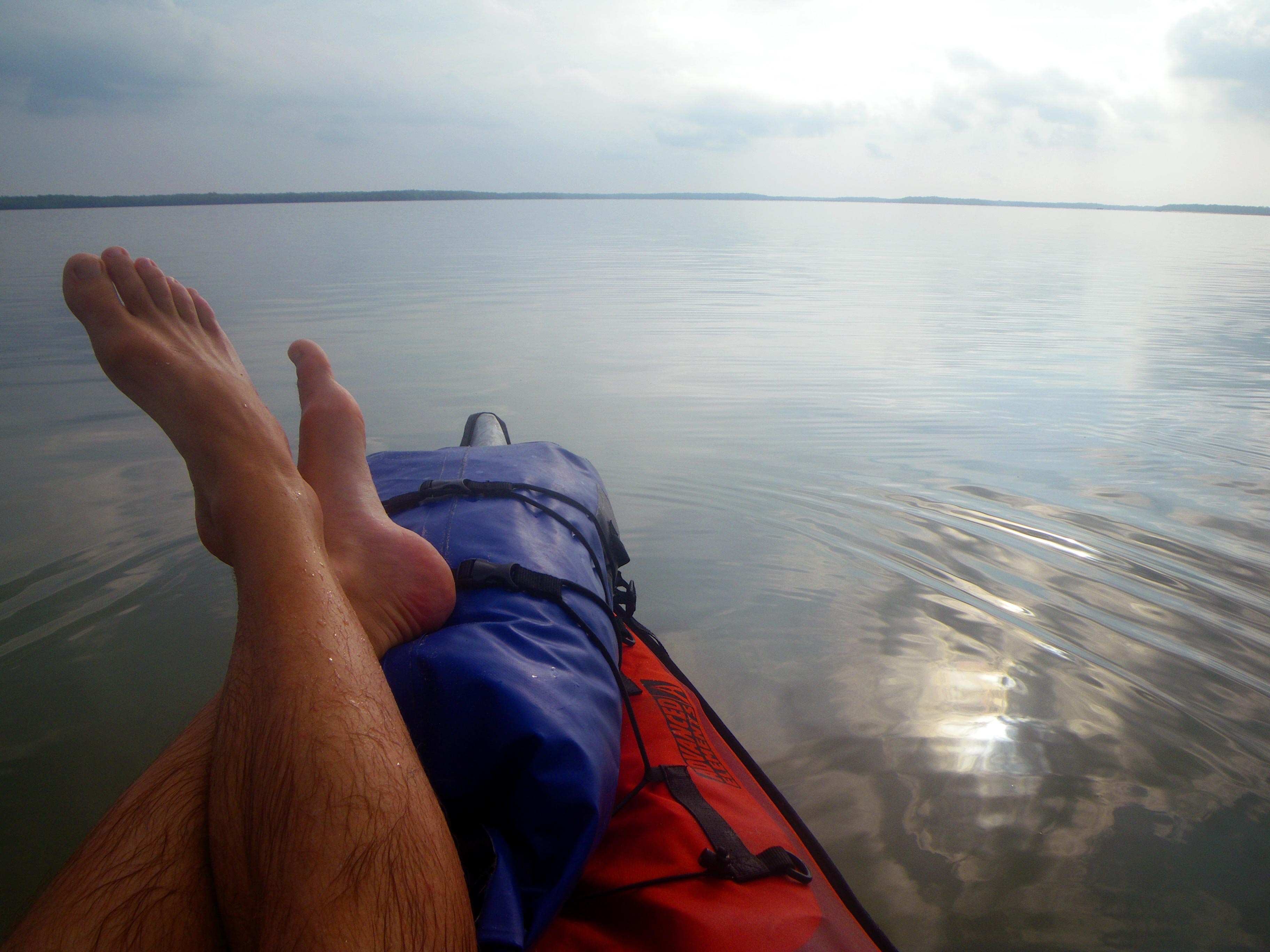
With water and land so intertwined and sometimes hard to differentiate the best way to explore is by boat and the quiet paddling of a kayak or canoe keeps the wildlife from scattering. It’s also more reliable than larger boats with less worry about getting caught on a sandbar at low tide or finding yourself hung up in a mangrove thicket. Occasionally however, especially in these dry winter months, the river of grass is more grass than river and you might find your butt dragging

Mangroves - Photo by Tim GillerMangroves - Photo by Tim Giller

Mangroves – Photo by Tim Giller

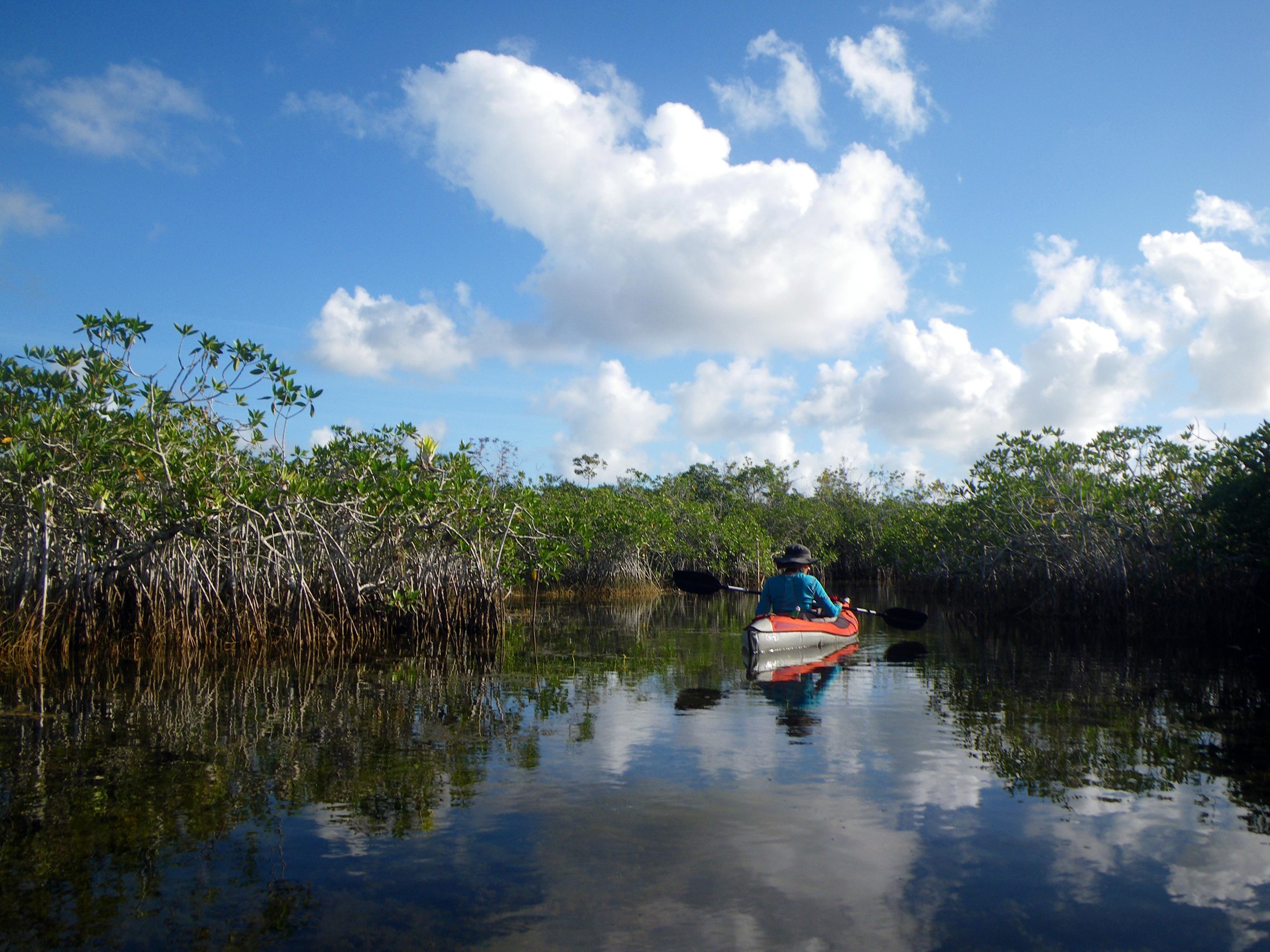
Rachael and I took the opportunity to spend several days paddling here. Inland we found a tightly winding water trail through red mangrove tunnels, tree limbs drooping with bromeliads and scattered with the sounds of mysterious birds. This area is the only place where the American alligator and the American crocodile coexist. Squeezing through a gap in the foliage Rachael inadvertently whacked a hidden alligator with her paddle who then unhappily hissed at me as I hurried by. In the next pond was a locally famous 14-foot croc smiling at us mischievously from the bank. Our route opened onto the freshwater marl prairie. With less than a foot of water and sawgrass at eye level it had the surreal feeling of kayaking across a Kansas wheat field accompanied by dragonflies and a marshy fragrance.

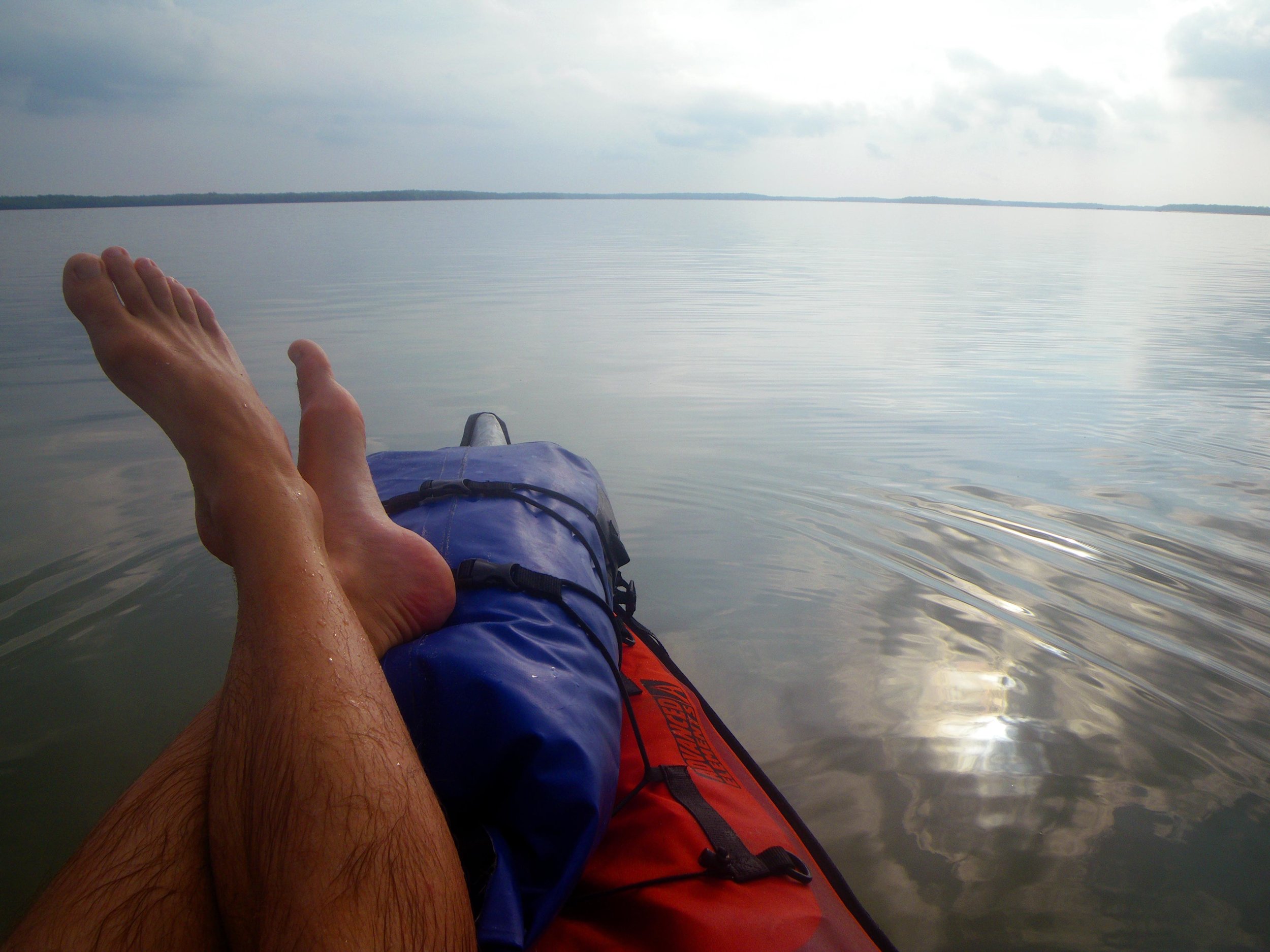
Our bigger adventure was kayaking for a few days into the Ten Thousand Island Wilderness and camping out on a couple keys next to the Gulf of Mexico. I was reminded of the rewards of putting in a little human powered effort toward getting oneself into a wild place. We saw dolphins by the dozen circling and feeding in the channels between islands. At one point, startled by a snort just off the stern of my boat, I turned to see the whiskery snout of a large and gentle manatee bobbing behind me for a few moments. Our eyes scanning the water we learned to distinguish the flotsam from the critters and a few times caught sight of furtive sea turtles, their heads periscoping above the calm waters showing a beaked overbite then discreetly sinking away at the sight of us humans.

Out in these mangrove islands are other creatures including sharks and stingrays scanning the shallows near our campsites and a small breed of raccoon that has managed to swim it’s way out here and make a go of it in the overlapping roots, oyster shells and scattered sand bars than make up what little ground there is. They’ve also learned that paddlers can be a source of snacks and fresh water which are tough to come by, so we were awakened by them examining our gear in the dark and also caught them munching on the horseshoe crabs that wash up with the tides. Probably the most abundant animal out here is the sandfly or no-see-um. Kept at bay most of the time by the steady sea breeze we awoke one morning to still air and were reminded that we don’t need to taunt alligators to become part of the food chain. Simply stepping outside to the acid sting of a thousand tiny bites puts one’s flesh directly into the ecosystem. Thankfully we had that breeze most of the time and the quick relief of plunging into the Gulf for a soothing saltwater rinse.

Not all the tiny organisms were horrifying pests. Late one night, awoken by our raccoon visitors and attracted from our tent by a rich, star-filled sky, a blue glow at the waterline caught my eye. I’ve seen fireflies and I’ve heard of bioluminescent water creatures but this was unexpected and something easily missed with the intrusion of a flashlight or lantern. Innumerable tiny and barely tangible organisms were glowing in the gentle ripples of the rising tide, lighting briefly with each jostle. Mesmerized I went to take a closer look and as I ran my fingers through the warm waters, a sparkling trail of spots traced out my movements. I gently scooped up handfuls of water tossing them outward into the bay instigating dazzling flashes of blue-green light across the surface. The mysterious chemistry of these creatures was a powerful magic to me.

Ten Thousand Islands, Everglades N.P. - Photo by Tim GillerTen Thousand Islands, Everglades N.P. - Photo by Tim Giller

Ten Thousand Islands, Everglades N.P. – Photo by Tim Giller

Creature Encounters


Baby Gators - Photo by Tim Giller

Baby Gators – Photo by Tim Giller

I can’t help myself, I love a good swimming hole. It was a bad joke though, the splashing around and pretending that something was pulling me under. I knew that even before I followed Rachael’s stare to an alligator, its powerful tail propelling it across the pond in my direction, just the eyes and snout protruding from the surface, clearly attracted to my movements. I was about to get out anyway, so I just did it a bit more quickly. I suppose there is a reason I wasn’t seeing people swimming in the backwaters. I could stick to the seawater areas of Everglades National Park but then again we did see a monstrous crocodile while kayaking earlier and they prefer the saltier waters.

American Crocodile - Photo by Tim Giller

American Crocodile – Photo by Tim Giller

These prehistoric creatures aren’t at all interested in attacking people and there is no need to pretend you’re the late Steve Erwin to get a wildlife experience in the Everglades. The animals are abundant, as are wet places to visit them. The water table is generally somewhere above your ankles in this place. You may think you’re standing on dry land but cut any hole in the ground and it soon becomes a pond. This is exactly what the alligators do in the dry winter months to give themselves some watery space.

With water and land so intertwined and sometimes hard to differentiate the best way to explore is by boat and the quiet paddling of a kayak or canoe keeps the wildlife from scattering. It’s also more reliable than larger boats with less worry about getting caught on a sandbar at low tide or finding yourself hung up in a mangrove thicket. Occasionally however, especially in these dry winter months, the river of grass is more grass than river and you might find your butt dragging

Mangroves - Photo by Tim Giller

Mangroves – Photo by Tim Giller

Rachael and I took the opportunity to spend several days paddling here. Inland we found a tightly winding water trail through red mangrove tunnels, tree limbs drooping with bromeliads and scattered with the sounds of mysterious birds. This area is the only place where the American alligator and the American crocodile coexist. Squeezing through a gap in the foliage Rachael inadvertently whacked a hidden alligator with her paddle who then unhappily hissed at me as I hurried by. In the next pond was a locally famous 14-foot croc smiling at us mischievously from the bank. Our route opened onto the freshwater marl prairie. With less than a foot of water and sawgrass at eye level it had the surreal feeling of kayaking across a Kansas wheat field accompanied by dragonflies and a marshy fragrance.

Our bigger adventure was kayaking for a few days into the Ten Thousand Island Wilderness and camping out on a couple keys next to the Gulf of Mexico. I was reminded of the rewards of putting in a little human powered effort toward getting oneself into a wild place. We saw dolphins by the dozen circling and feeding in the channels between islands. At one point, startled by a snort just off the stern of my boat, I turned to see the whiskery snout of a large and gentle manatee bobbing behind me for a few moments. Our eyes scanning the water we learned to distinguish the flotsam from the critters and a few times caught sight of furtive sea turtles, their heads periscoping above the calm waters showing a beaked overbite then discreetly sinking away at the sight of us humans.

Out in these mangrove islands are other creatures including sharks and stingrays scanning the shallows near our campsites and a small breed of raccoon that has managed to swim it’s way out here and make a go of it in the overlapping roots, oyster shells and scattered sand bars than make up what little ground there is. They’ve also learned that paddlers can be a source of snacks and fresh water which are tough to come by, so we were awakened by them examining our gear in the dark and also caught them munching on the horseshoe crabs that wash up with the tides. Probably the most abundant animal out here is the sandfly or no-see-um. Kept at bay most of the time by the steady sea breeze we awoke one morning to still air and were reminded that we don’t need to taunt alligators to become part of the food chain. Simply stepping outside to the acid sting of a thousand tiny bites puts one’s flesh directly into the ecosystem. Thankfully we had that breeze most of the time and the quick relief of plunging into the Gulf for a soothing saltwater rinse.

Not all the tiny organisms were horrifying pests. Late one night, awoken by our raccoon visitors and attracted from our tent by a rich, star-filled sky, a blue glow at the waterline caught my eye. I’ve seen fireflies and I’ve heard of bioluminescent water creatures but this was unexpected and something easily missed with the intrusion of a flashlight or lantern. Innumerable tiny and barely tangible organisms were glowing in the gentle ripples of the rising tide, lighting briefly with each jostle. Mesmerized I went to take a closer look and as I ran my fingers through the warm waters, a sparkling trail of spots traced out my movements. I gently scooped up handfuls of water tossing them outward into the bay instigating dazzling flashes of blue-green light across the surface. The mysterious chemistry of these creatures was a powerful magic to me.

Ten Thousand Islands, Everglades N.P. - Photo by Tim Giller

Ten Thousand Islands, Everglades N.P. – Photo by Tim Giller

Roads End

CauswayCausway

Causway

The constant flow of vehicles was clear evidence that I’m not the only one who finds the end of the road compelling. When that road ends at a Caribbean Island with a romantic history of pirates, rumrunners, Cuban exiles and Ernest Hemingway the 100-mile conga line of RVs, convertibles and a heavy preponderance of Harleys is not surprising. What I found hard to imagine was where all those vehicles were going to end up given that the island of Key West is no more than 4 miles long and maybe 2 miles at it’s widest. I was wondering if drivers dazzled by the sun dappled, turquoise waters, foreheads sticky from the humid air just kept driving off the southernmost point of the continental U.S. into the Florida Straights. Given the identical character of the returning traffic it’s clear that March is a massive game of musical chairs, all those Massachusetts and Minnesota license plates taking turns at escaping the northern winters, the dockside thatch bars filled by Bermuda short clad refugees scoffing at the silent loop of the Weather Channel showing the latest snow-pocalypse back home.
With Rachael’s gracious assistance I was able to ditch my gear and hop on my bike for the long arcing ride from Key Largo to Key West. Formed over 100,000 years ago the Keys are a chain of coral reef outcrops linked by a series of bridges and causeways built on the skeleton of Henry Flagler’s hurricane wrecked Overseas Railway. With a small bit of effort it would be a world-class bike route, the paths and wide shoulders not very contiguous yet. As it stands it’s a pretty great ride if you’re comfortable having a steady flow of cars just off your hip. Being on a bike allowed me to see the mangroves and tropical waters close up. It also meant that in the steamy sun my forehead and everything else was sticky and hot when I reached roads end, so I went ahead and dove off the southernmost point into the reviving waters of the Florida Straights.

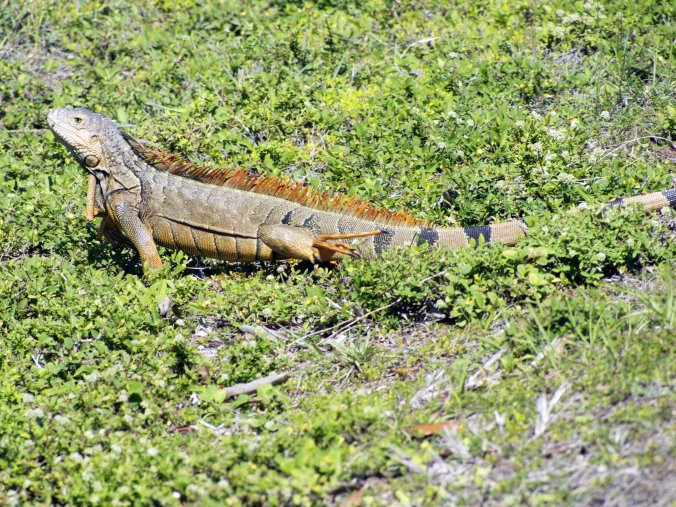
IgunaIguna

Iguna

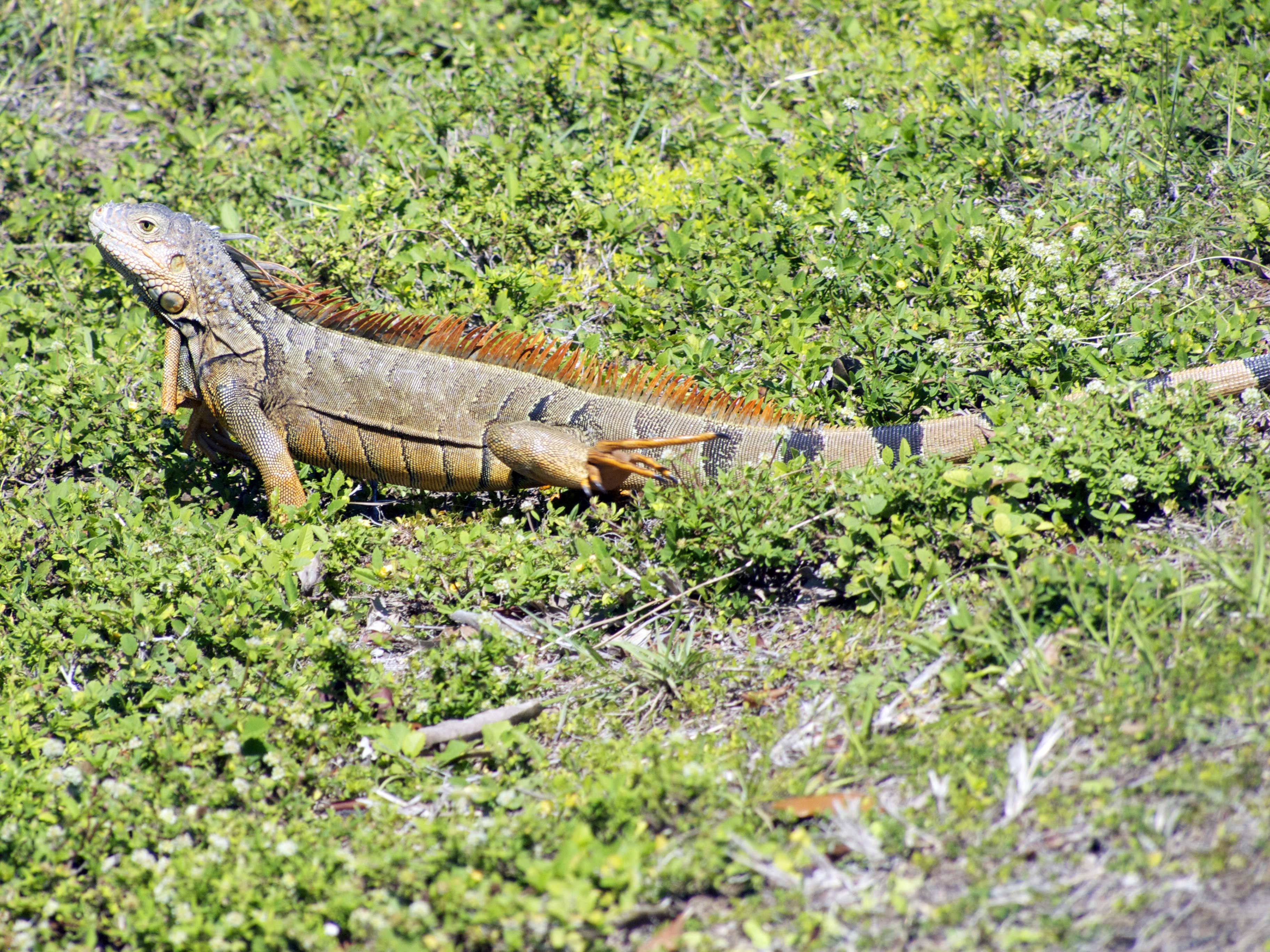
The Keys have island ecology issues. Islands, by their physical separation, have a high rate on endemism – plants and animals unique to that place. By attaching these islands to each other and to the mainland with a road, aggressive, non-native species start to show up. Being this far south everything was exotic to me so it’s difficult without prior study to know what is native. The hundreds of big Green Iguanas scampering into the mangroves as I rode by, not native. The attractive, grey-green palm trees, also not native. In fact the warm frost-free climate that has attracted folks for all these years also means it’s a place where exotics can thrive and some of those folks brought exotics with them with that in mind. On many islands essentially all life is invasive. On a brand new volcanic rock rising from the sea there is going to be that first coconut that floats in and takes root or that first colorful songbird that gets blown way off course and makes a home. Over generations these creatures adapting to local conditions can become new and unique species. Our modern dilemma is the much-accelerated rate that a highly mobile and somewhat careless humanity brings to these changes. The biodiversity that is essential to a healthy and adaptable ecosystem is diminished each time a Norway Rat jumps ship or a oversized pet Python gets dumped in the Florida swamp. Some newcomers can wipe out whole classes of native life.

Key DeerKey Deer

Key Deer

7mile7mile

7mile

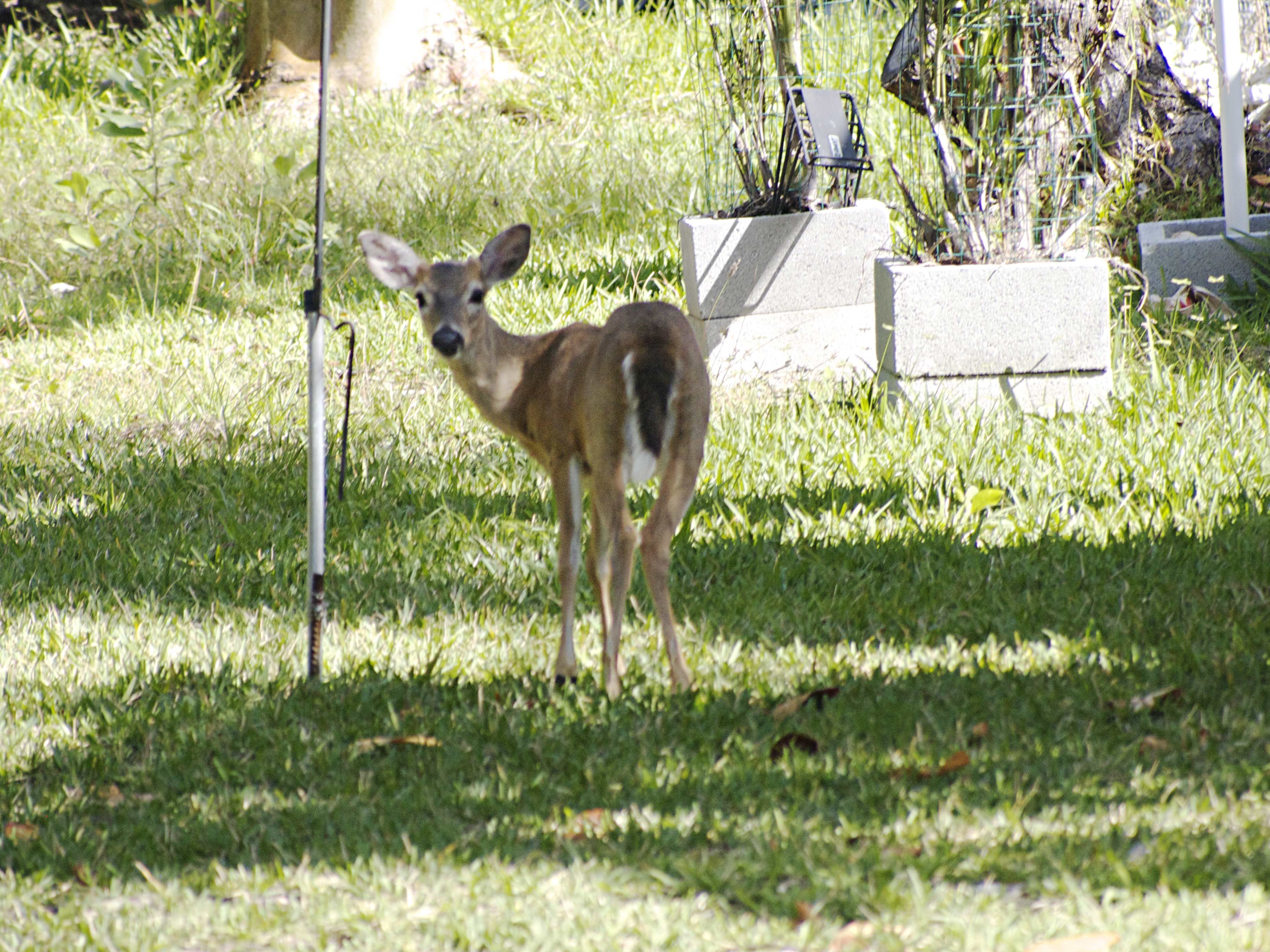
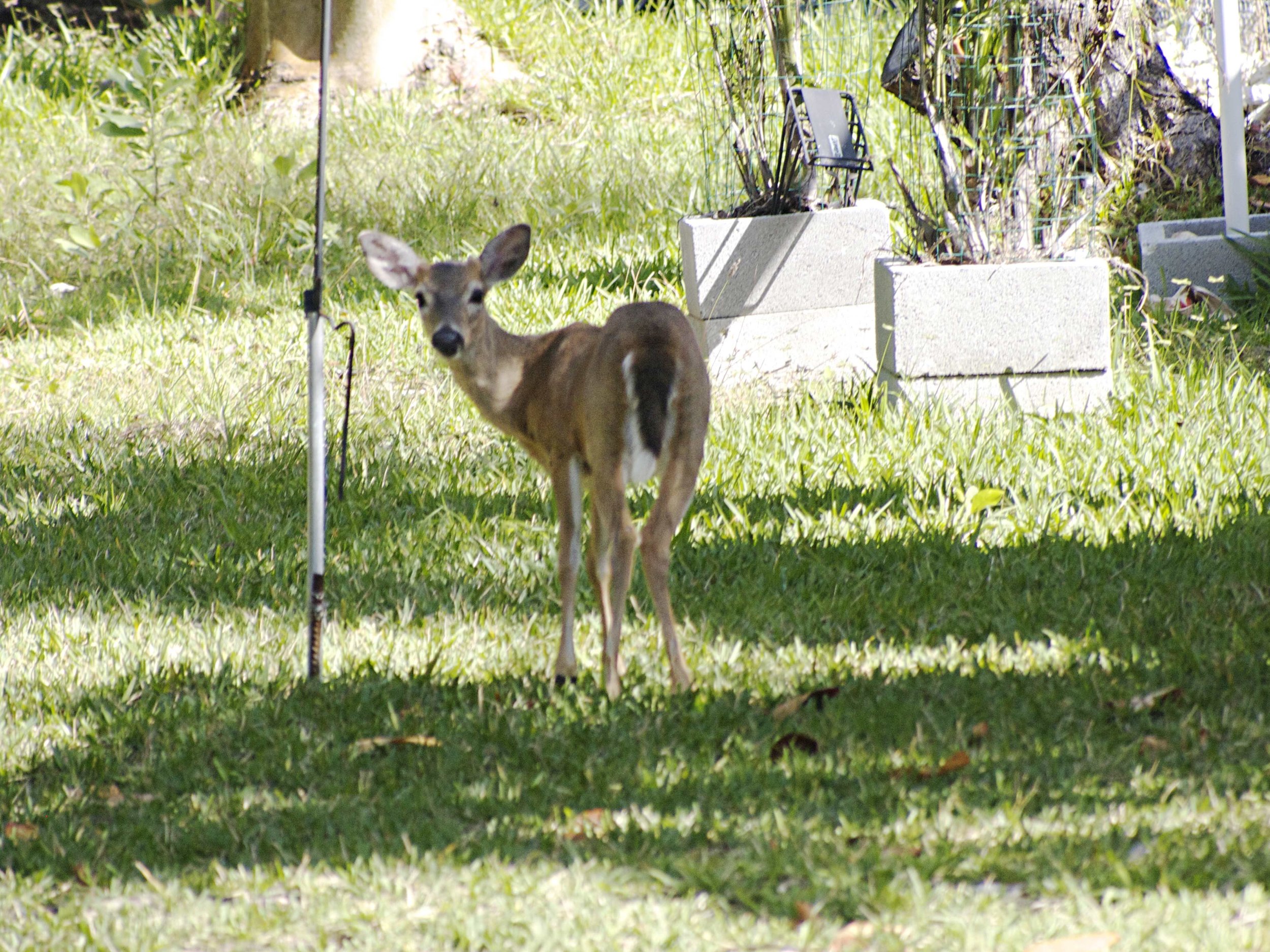
Nature is well at hand in the Keys once you find your way off the main drag. There are mangroves filled with unique birds you can’t see elsewhere in America and those alluring waters are rich with fish. I suppose that to the vast majority of travelers, on that narrow strip of congested pavement, nature is the tarpon they hope to hook on their half day fishing charter or the conch fritters they wash down with a rum punch. If they were lucky like I was they might have spotted the diminutive Key Deer that was grazing behind some secluded mobile homes. Like a lot of island mammals it is much smaller than it’s mainland cousin the white tailed deer and is found only on a few Keys towards the end of the line. Endangered and protected with a special reserve on Big Pine Key it’s hoped that they can coexist within the laid back Keys lifestyle. Unfortunately, with over 30 deer killed so far on the busy highway it looks like this year might be worse than the last. Paradise can be irresistible and with so many crowding in to get a taste, both the lifestyle and the deer can suffer. With our feet up on a chunk of coral and an improvised rum cocktail in our hands while watching the sun set into Florida Bay I guess I was grateful for a chance to get our little piece of this paradise.

Roads End

The constant flow of vehicles was clear evidence that I’m not the only one who finds the end of the road compelling. When that road ends at a Caribbean Island with a romantic history of pirates, rumrunners, Cuban exiles and Ernest Hemingway the 100-mile conga line of RVs, convertibles and a heavy preponderance of Harleys is not surprising. What I found hard to imagine was where all those vehicles were going to end up given that the island of Key West is no more than 4 miles long and maybe 2 miles at it’s widest. I was wondering if drivers dazzled by the sun dappled, turquoise waters, foreheads sticky from the humid air just kept driving off the southernmost point of the continental U.S. into the Florida Straights. Given the identical character of the returning traffic it’s clear that March is a massive game of musical chairs, all those Massachusetts and Minnesota license plates taking turns at escaping the northern winters, the dockside thatch bars filled by Bermuda short clad refugees scoffing at the silent loop of the Weather Channel showing the latest snow-pocalypse back home.

With Rachael’s gracious assistance I was able to ditch my gear and hop on my bike for the long arcing ride from Key Largo to Key West. Formed over 100,000 years ago thCauswaye Keys are a chain of coral reef outcrops linked by a series of bridges and causeways built on the skeleton of Henry Flagler’s hurricane wrecked Overseas Railway. With a small bit of effort it would be a world-class bike route, the paths and wide shoulders not very contiguous yet. As it stands it’s a pretty great ride if you’re comfortable having a steady flow of cars just off your hip. Being on a bike allowed me to see the mangroves and tropical waters close up. It also meant that in the steamy sun my forehead and everything else was sticky and hot when I reached roads end, so I went ahead and dove off the southernmost point into the reviving waters of the Florida Straights.

The Keys have island ecology issues. Islands, by their physical separation, have a high rate on endemism – plants and animals unique to that place. By attaching these islands to each other and to the mainland with a road, aggressive, non-native species start to show up. Being this far south everything was exotic to me so it’s difficult without prior study to know what is native. The hundreds of big Green Iguanas scampering into the mangroves as I rode by, nIgunaot native. The attractive, grey-green palm trees, also not native. In fact the warm frost-free climate that has attracted folks for all these years also means it’s a place where exotics can thrive and some of those folks brought exotics with them with that in mind. On many islands essentially all life is invasive. On a brand new volcanic rock rising from the sea there is going to be that first coconut that floats in and takes root or that first colorful songbird that gets blown way off course and makes a home. Over generations these creatures adapting to local conditions can become new and unique species. Our modern dilemma is the much-accelerated rate that a highly mobile and somewhat careless humanity brings to these changes. The biodiversity that is essential to a healthy and adaptable ecosystem is diminished each time a Norway Rat jumps ship or a oversized pet Python gets dumped in the Florida swamp. Some newcomers can wipe out whole classes of native life.


Key Deer

Key Deer

Nature is well at hand in the Keys once you find your way off the main drag. There are mangroves filled with unique birds you can’t see elsewhere in America and those alluring waters are rich with fish. I suppose that to the vast majority of travelers, on that narrow strip of congested pavement, nature is the tarpon they hope to hook on their half day fishing charter or the conch fritters they wash down with a rum punch. If they were lucky like I was they might have spotted the diminutive Key Deer that was grazing behind some secluded mobile homes. Like a lot of island mammals it is much smaller than it’s mainland cousin the white tailed deer and is found only on a few Keys towards the end of the line. Endangered and protected with a special reserve on Big Pine Key it’s hoped that they can coexist within the laid back Keys lifestyle. Unfortunately, with over 30 deer killed so far on the busy highway it looks like this year might be worse than the last. Paradise can be irresistible and with so many crowding in to get a taste, both the lifestyle and the deer can suffer. With our feet up on a chunk of coral and an improvised rum cocktail in our hands while watching the sun set into Florida Bay I guess I was grateful for a chance to get our little piece of this paradise.7mile


Mud Moving

TruckTruck

Truck

Poverty Point - Photo by Tim GillerPoverty Point - Photo by Tim Giller

Poverty Point – Photo by Tim Giller

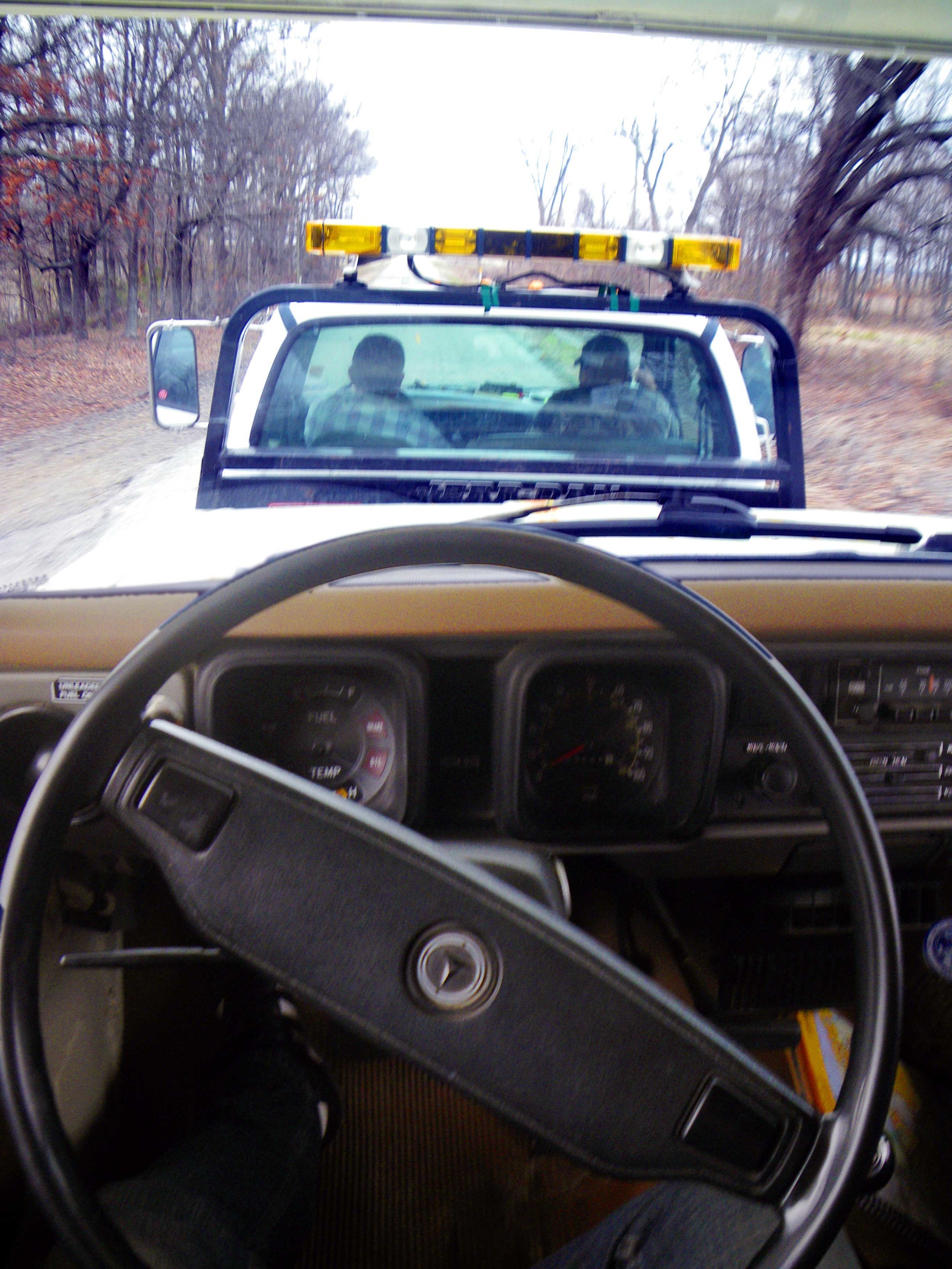
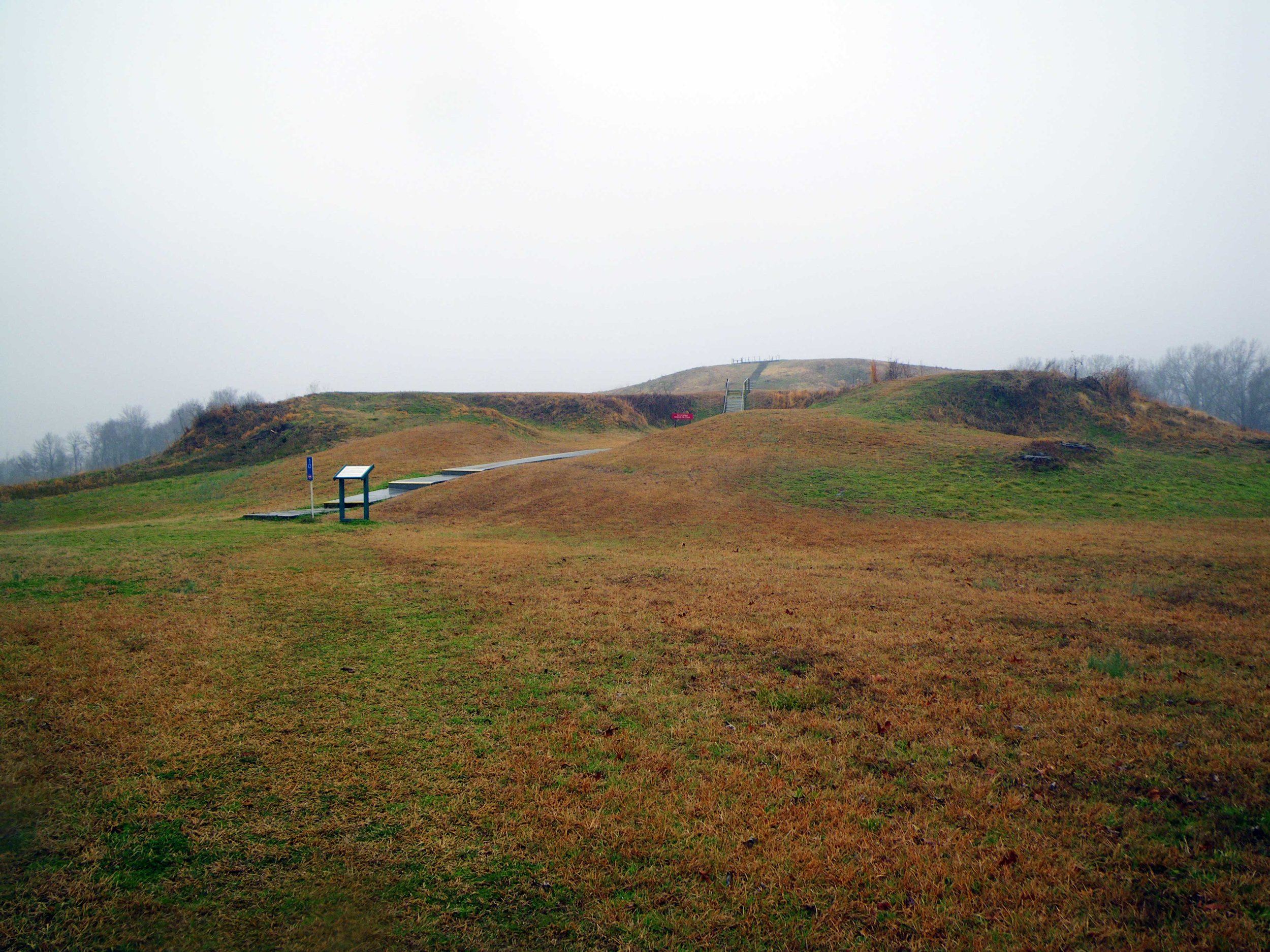
“Do you think Lloyd has ever accidentally dumped a vehicle into one of these farm ditches?” I asked Rachael.   I reached for the steering wheel and my foot was searching for the brake pedal even though I knew it was pointless. We had put our faith in the fact that Lloyd and his assistant Darren knew what they were doing out on these patched and potholed backcountry Louisiana farm roads, however my equilibrium had taken a lot of hours getting used to the suspension on Lil’ Squatch and being an extra five feet off the ground made going into an bumpy, off-camber turn feel more dangerous than a county fair rollercoaster that was missing a few cotter pins. And almost as fun. “I don’t think this is legal in California” said Rachael. “Uh-uh. Bet it ain’t legal here either, but here we are.” I had to admit that not only was it kind of pleasant to be sitting back and letting someone else cart us along but also the view was pretty great being this high off the ground. Unfortunately we were up on the back of Lloyd’s truck because Squatch’s water pump had seized about 3 miles from the Poverty Point archaeological site (a name that caused the truck dispatcher to chuckle unsympathetically) and we were being taken into his small town shop to fix it.

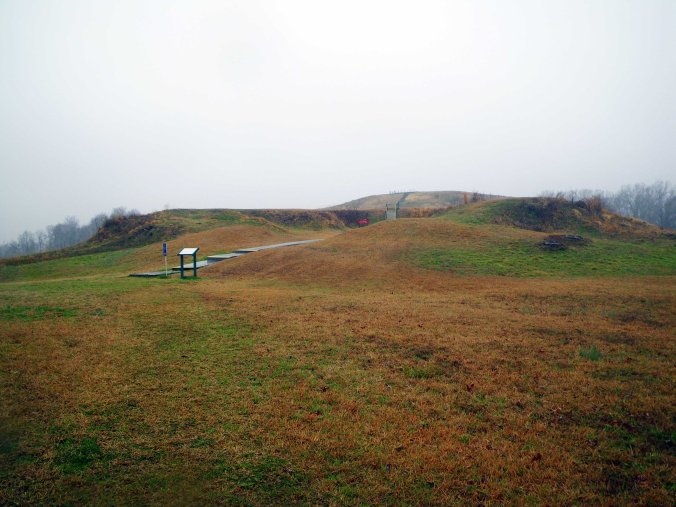
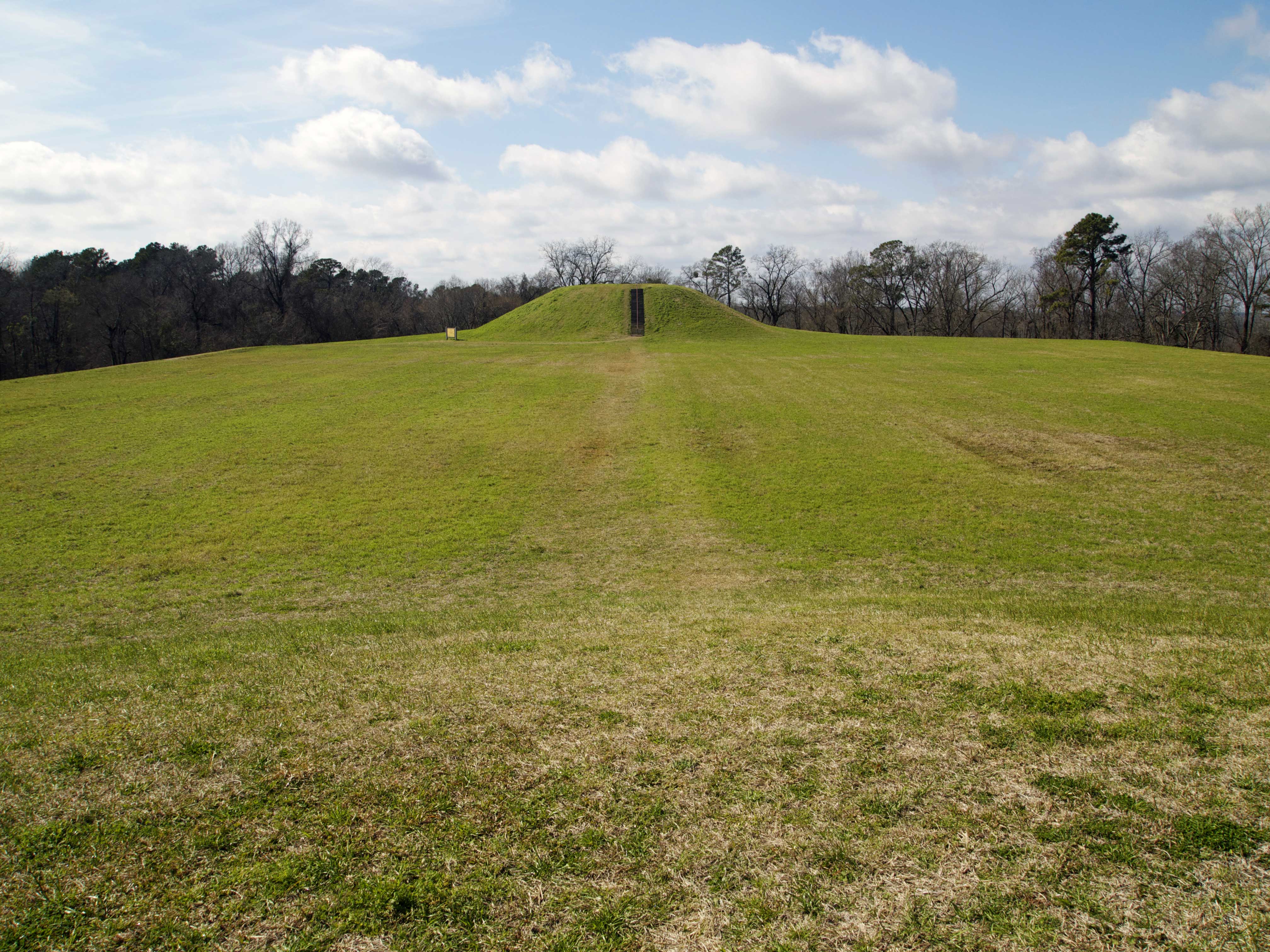
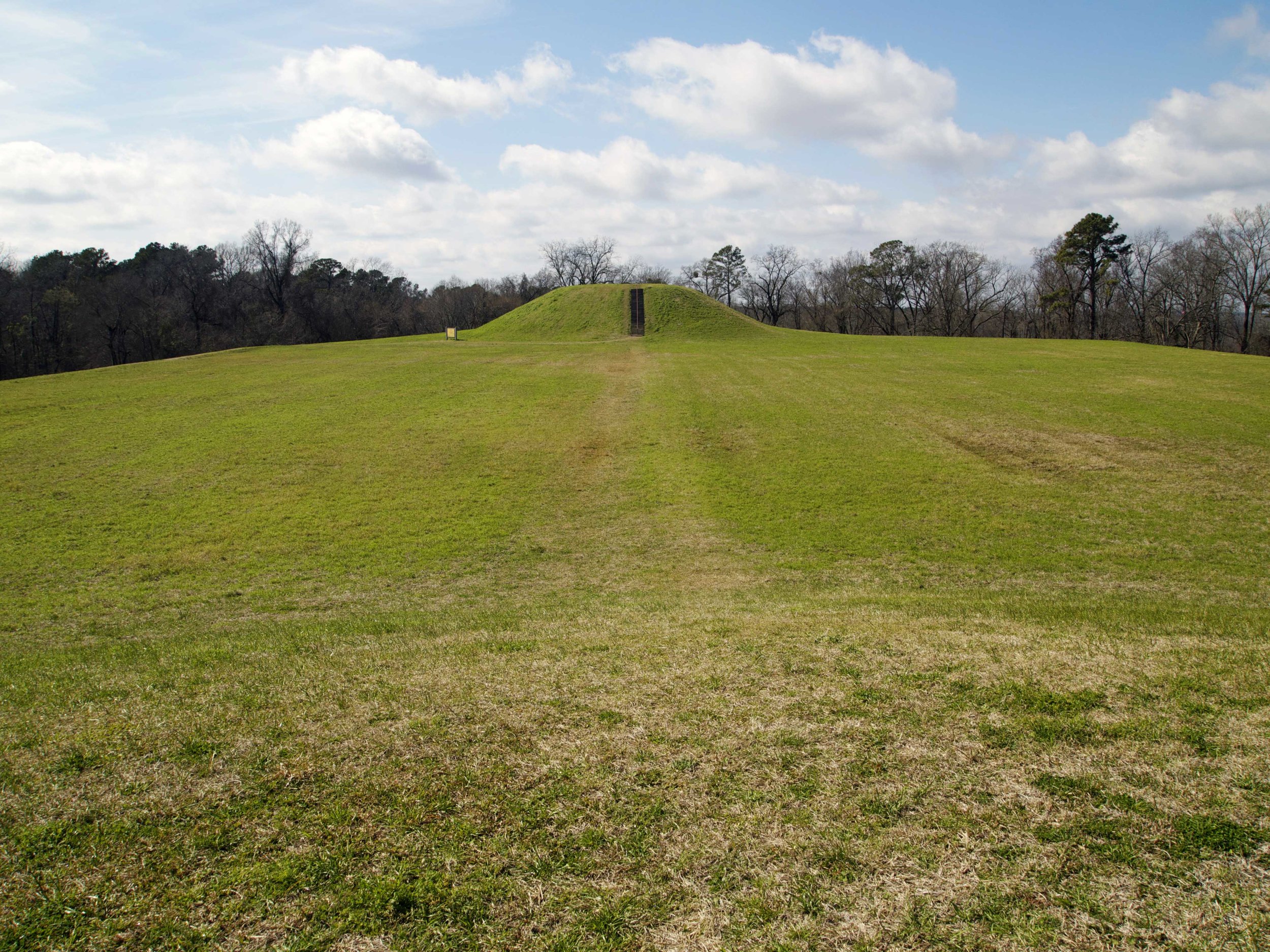
Poverty Point has one of the tallest and most ancient of the mounds built in the Mississippi river drainage and it is flanked by rows of semicircular ridges constructed around a huge plaza. With the higher vantage we had from the cab I started wondering if they moved around those incredible quantities of dirt just so they could get a better view of the landscape. A couple days earlier we had climbed Emerald mound on the other side of the Mississippi River. I knew that these two structures at over 65 feet tall traded claims of being the second largest pre-Columbian mounds but what I hadn’t yet learned was that the culture at Poverty Point had begun construction 1000 years before the Pyramids in Egypt had been built while Emerald mound had been created much later and was still in active use when Spanish and French explorers ventured into the region. These two sites are sort of bookends of a cultural phenomenon that spanned several thousand years, most of the length of the largest river on the continent and began with hunter-gatherers in what is now Louisiana. The fecund landscape provided by the flows of the Mississippi and the rich Southeastern forests offered foods from fish and crawdads out of the bayous to nuts, plants deer and bear in the woodlands.

Emerald Mound - Photo by Tim GillerEmerald Mound - Photo by Tim Giller

Emerald Mound – Photo by Tim Giller

These town sites and ceremonial structures have survived in an ever-morphing landscape of shifting river channels, mysterious and languid bayous and massive and regular flooding. They were built by people who respected the power of water and recognized the abundance that came from the replenishment provided by the Mississippi River. This civilization was comparable to the Aztecs or Mayans further south and had towns larger than any Colonial city would achieve until the 19th century, yet by the time that frontiersmen were settling in the region the population had fallen dramatically, most likely ravaged by European diseases acquired from those first visitors. Without advocates for the land and culture it was literally plowed under. Mounds and platforms are abundant in the region but often hidden in forest groves, covered by crops or with pioneer homes built atop them, a recognition of the value of higher ground.

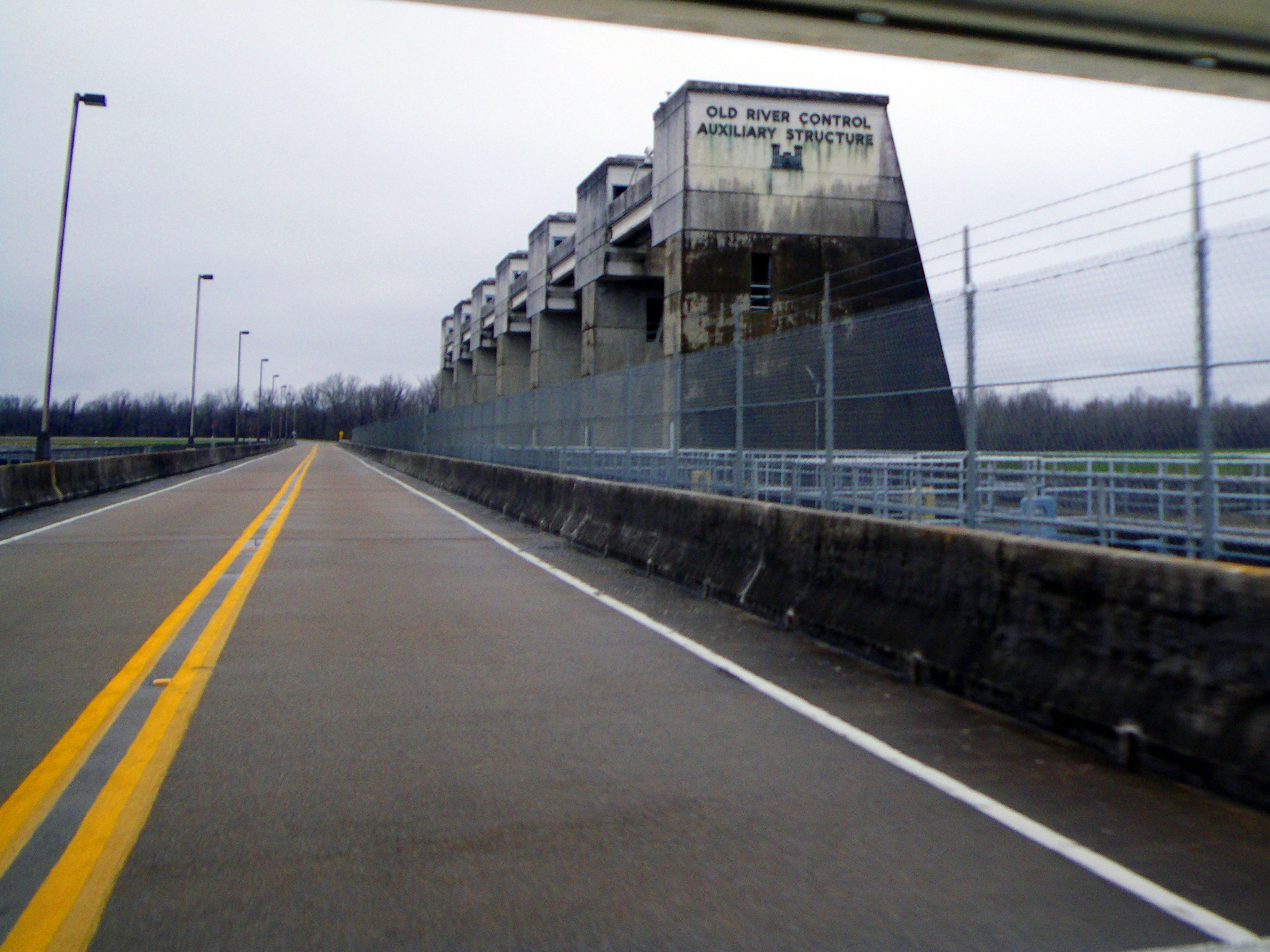
Army Corp Dam, Louisiana - Photo Bt Tim GillerArmy Corp Dam, Louisiana - Photo Bt Tim Giller

Army Corp Dam, Louisiana – Photo Bt Tim Giller

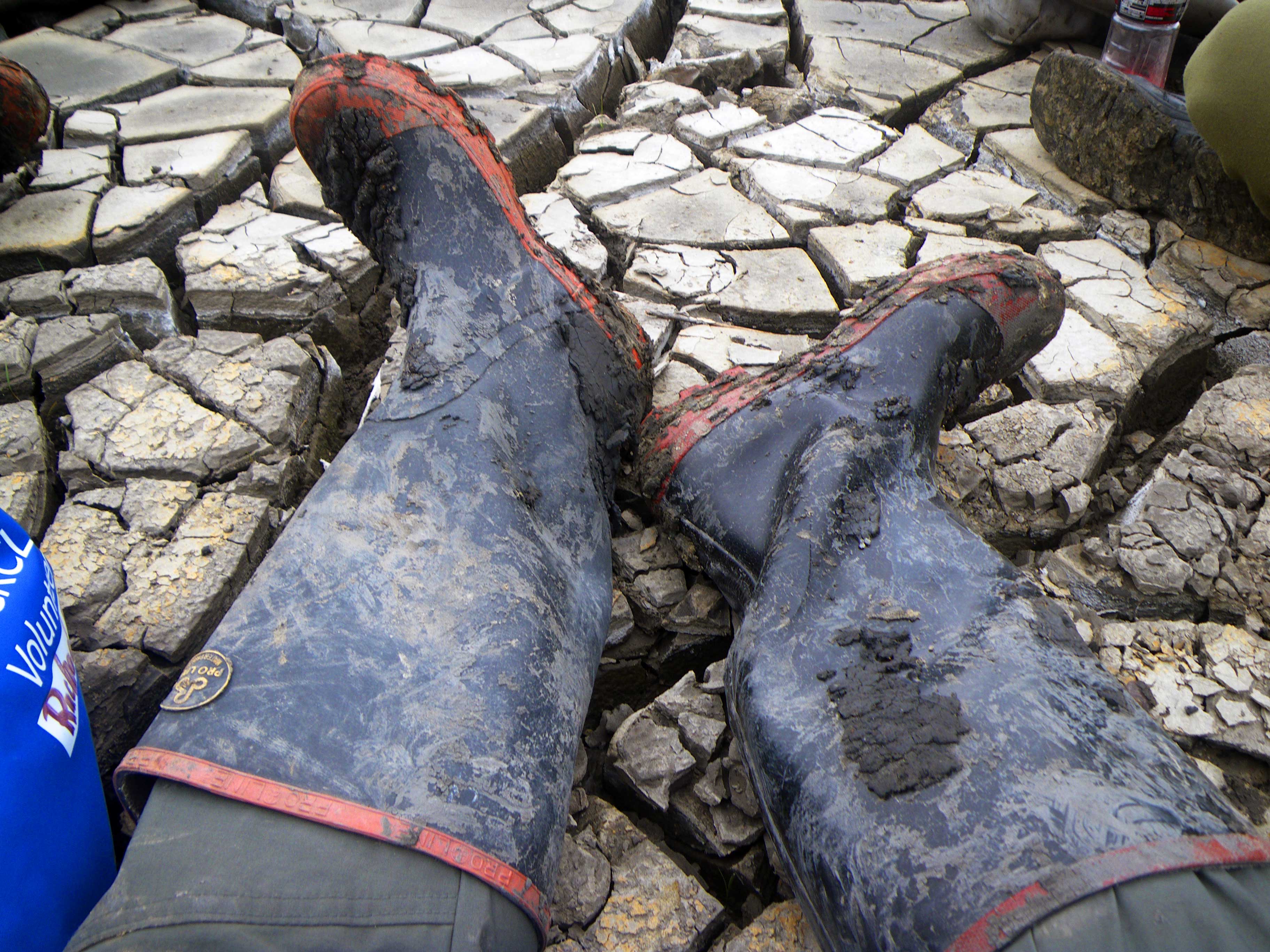
BootsBoots

Boots

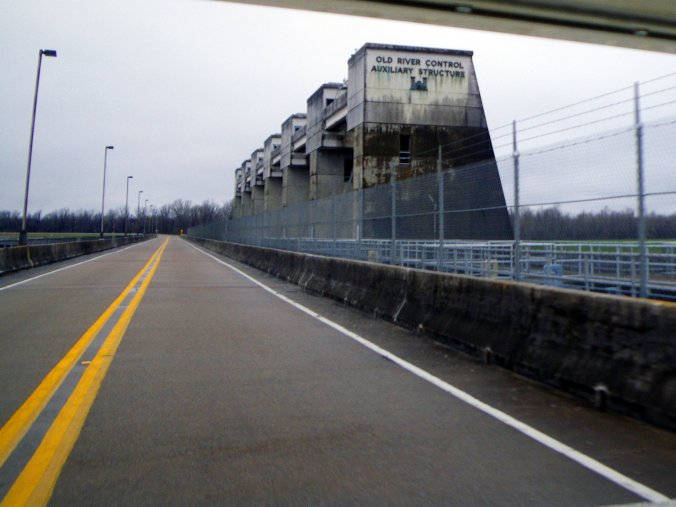
With our little guy patched up Rachael and I had an engagement to get to on the tenuous southern edge of Louisiana. I suppose after walking among the remnants of mysterious earthworks my eyes had become sensitive to the altered shapes of the landscape. However, it would have been hard to miss the massive plumbing that the Army Corp of Engineers and others have created in this flood prone environment and it was startling in contrast. Moving south along the Mississippi you can find yourself on a road high atop a berm that extends hundreds of miles in an attempt to keep this workhorse of a river just where we want it. Then upon descending the levees we found ourselves skirting back basins and crossing the channels, dams and locks of a vast system of flood control and navigation infrastructure. This monumental yoking of nature was exactly why we found ourselves at the once expanding foot of the continent. It is likely we are asking too much of these waters. Our mixed purposes of large-scale transportation and protecting fertile and populated farmland have stifled the regenerative system that brought this abundance to the region. The river system wants to spill out chaotically. It needs too. Those silt-laden waters of the “The Big Muddy” created half of the state over the past few thousand years. Today Louisiana loses two football fields an hour. The causes of this loss are multi-faceted but it is clear that human activity is the major culprit. Those sediment rich Mississippi waters are flushed out to the deep Gulf through the channelized waterway. A vast number of channels for the oil and gas industry have created saltwater intrusion pathways that spread erosion. Even an invasive South American rodent called nutria, brought here to produce furs, have exploded in numbers consuming a large amount of vegetation that would otherwise contribute to soil build up. This ethereal Gulf Coast edge of sandy barrier islands and once sprawling marshland is also what protects the region from hurricanes and their storm surges so a lot of players have a stake in this. Fishermen, lowland farmers, coastal dwellers and even the shipping and petroleum industries see the value in regenerating this natural buffer. Projected sea level rise only makes this more urgent. This is how we found ourselves lucky enough to spend a cold, windy day getting knee deep in boot swallowing mud with a motley bunch of people. Volunteers are not only trying to put a dent in the loss of these wetlands but we also hope that studying this work will teach us to do it most effectively. As I dragged a hundred pound sled loaded with mangrove and cordgrass along an old pipeline channel I couldn’t help feeling some connection to the long lost people who piled baskets full by the millions into elaborate and now mysterious mounds.

Mud Moving

“Do you think Lloyd has ever accidentally dumped a vehicle into one of these farm ditches?” I asked Rachael. Truck  I reached for the steering wheel and my foot was searching for the brake pedal even though I knew it was pointless. We had put our faith in the fact that Lloyd and his assistant Darren knew what they were doing out on these patched and potholed backcountry Louisiana farm roads, however my equilibrium had taken a lot of hours getting used to the suspension on Lil’ Squatch and being an extra five feet off the ground made going into an bumpy, off-camber turn feel more dangerous than a county fair rollercoaster that was missing a few cotter pins. And almost as fun. “I don’t think this is legal in California” said Rachael. “Uh-uh. Bet it ain’t legal here either, but here we are.” I had to admit that not only was it kind of pleasant to be sitting back and letting someone else cart us along but also the view was pretty great being this high off the ground. Unfortunately we were up on the back of Lloyd’s truck because Squatch’s water pump had seized about 3 miles from the Poverty Point archaeological site (a name that caused the truck dispatcher to chuckle unsympathetically) and we were being taken into his small town shop to fix it.

Poverty Point - Photo by Tim Giller

Poverty Point – Photo by Tim Giller

Poverty Point has one of the tallest and most ancient of the mounds built in the Mississippi river drainage and it is flanked by rows of semicircular ridges constructed around a huge plaza. With the higher vantage we had from the cab I started wondering if they moved around those incredible quantities of dirt just so they could get a better view of the landscape. A couple days earlier we had climbed Emerald mound on the other side of the Mississippi River. I knew that these two structures at over 65 feet tall traded claims of being the second largest pre-Columbian mounds but what I hadn’t yet learned was that the culture at Poverty Point had begun construction 1000 years before the Pyramids in Egypt had been built while Emerald mound had been created much later and was still in active use when Spanish and French explorers ventured into the region. These two sites are sort of bookends of a cultural phenomenon that spanned several thousand years, most of the length of the largest river on the continent and began with hunter-gatherers in what is now Louisiana. The fecund landscape provided by the flows of the Mississippi and the rich Southeastern forests offered foods from fish and crawdads out of the bayous to nuts, plants deer and bear in the woodlands.

Emerald Mound - Photo by Tim Giller

Emerald Mound – Photo by Tim Giller

These town sites and ceremonial structures have survived in an ever-morphing landscape of shifting river channels, mysterious and languid bayous and massive and regular flooding. They were built by people who respected the power of water and recognized the abundance that came from the replenishment provided by the Mississippi River. This civilization was comparable to the Aztecs or Mayans further south and had towns larger than any Colonial city would achieve until the 19th century, yet by the time that frontiersmen were settling in the region the population had fallen dramatically, most likely ravaged by European diseases acquired from those first visitors. Without advocates for the land and culture it was literally plowed under. Mounds and platforms are abundant in the region but often hidden in forest groves, covered by crops or with pioneer homes built atop them, a recognition of the value of higher ground.

Army Corp Dam, Louisiana - Photo Bt Tim Giller

Army Corp Dam, Louisiana – Photo Bt Tim Giller

With our little guy patched up Rachael and I had an engagement to get to on the tenuous southern edge of Louisiana. I suppose after walking among the remnants of mysterious earthworks my eyes had become sensitive to the altered shapes of the landscape. However, it would have been hard to miss the massive plumbing that the Army Corp of Engineers and others have created in this flood prone environment and it was startling in contrast. Moving south along the Mississippi you can find yourself on a road high atop a berm that extends hundreds of miles in an attempt to keep this workhorse of a river just where we want it. Then upon descending the levees we found ourselves skirting back basins and crossing the channels, dams and locks of a vast system of flood control and navigation infrastructure. This monumental yoking of nature was exactly why we found ourselves at the once expanding foot of the continent. It is likely we are asking too much of these waters. Our mixed purposes of large-scale transportation and protecting fertile and populated farmland have stifled the regenerative system that brought this abundance to the region. The river system wants to spill out chaotically. It needs too. Those silt-laden waters of the “The Big Muddy” created half of the state over the past few thousand years. Today Louisiana loses two football fields an hour. The causes of this loss are multi-faceted but it is clear that human activity is the major culprit. Those sediment rich Mississippi waters are flushed out to the deep Gulf through the channelized waterway. A vast number of channels for the oil and gas industry have created saltwater intrusion pathways that spread erosion. Even an invasive South American rodent called nutria, brought here to produce furs, have exploded in numbers consuming a large amount of vegetation that would otherwise contribute to soil build up. BootsThis ethereal Gulf Coast edge of sandy barrier islands and once sprawling marshland is also what protects the region from hurricanes and their storm surges so a lot of players have a stake in this. Fishermen, lowland farmers, coastal dwellers and even the shipping and petroleum industries see the value in regenerating this natural buffer. Projected sea level rise only makes this more urgent. This is how we found ourselves lucky enough to spend a cold, windy day getting knee deep in boot swallowing mud with a motley bunch of people. Volunteers are not only trying to put a dent in the loss of these wetlands but we also hope that studying this work will teach us to do it most effectively. As I dragged a hundred pound sled loaded with mangrove and cordgrass along an old pipeline channel I couldn’t help feeling some connection to the long lost people who piled baskets full by the millions into elaborate and now mysterious mounds.

I Swear I’m Not A Birder

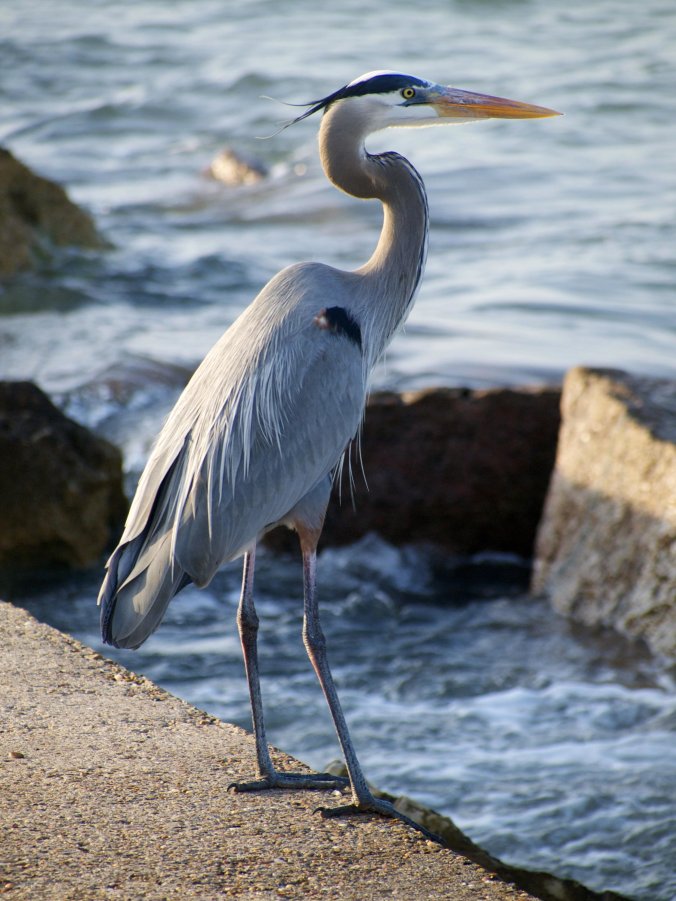
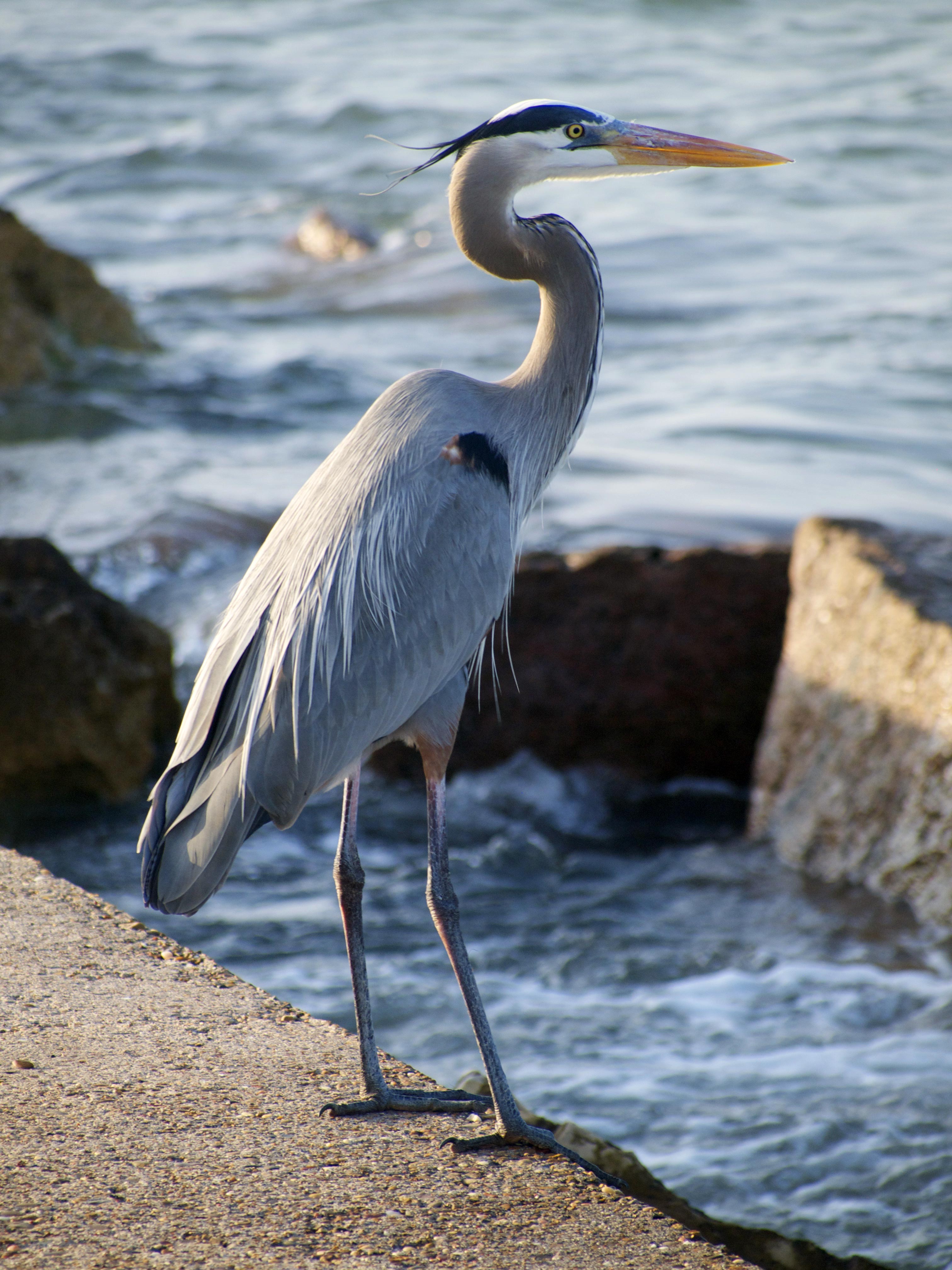
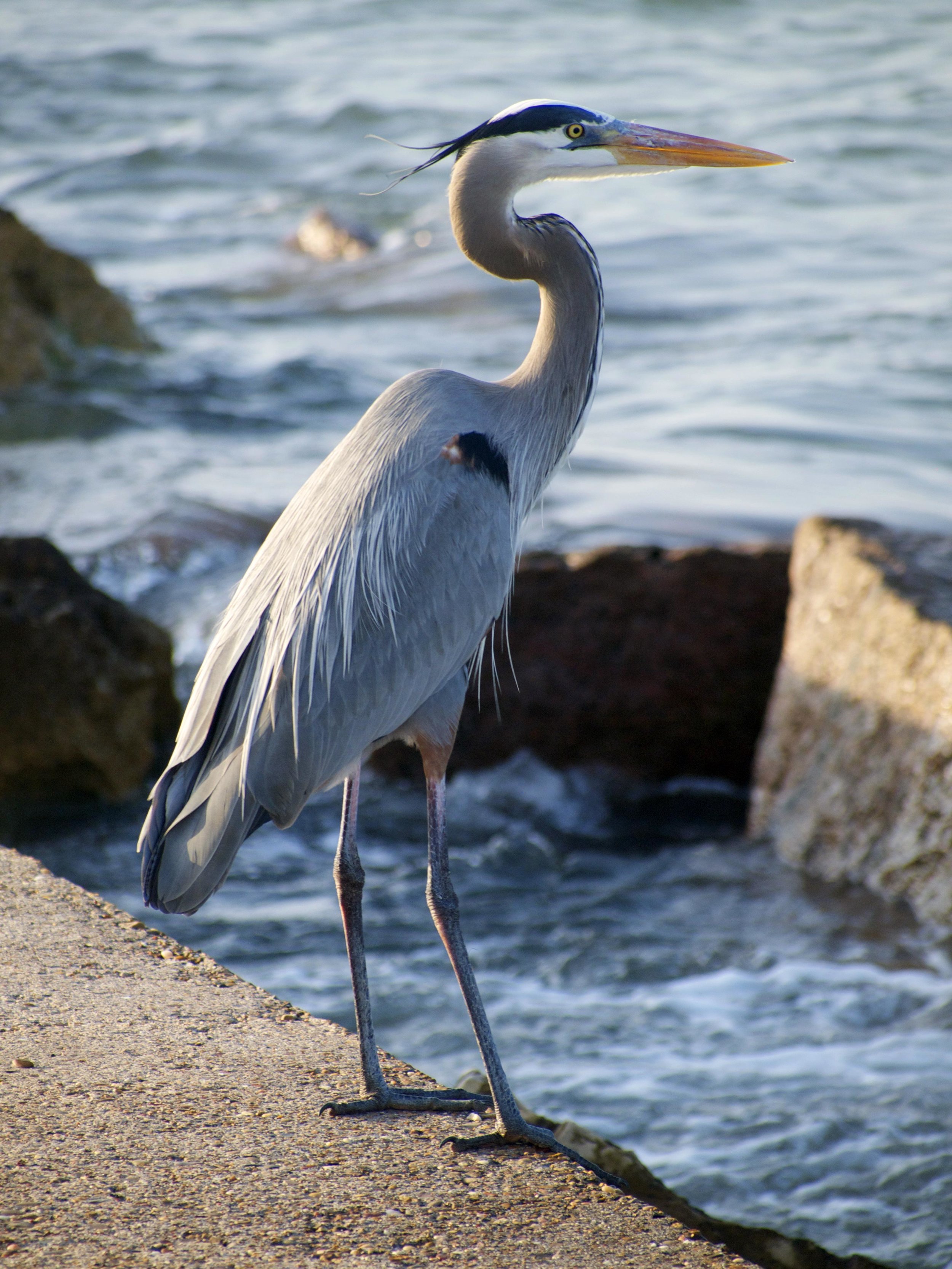
Great Blue Heron - Photo by Tim GillerGreat Blue Heron - Photo by Tim Giller

Great Blue Heron – Photo by Tim Giller

There have been a number of clues in these pages that I might have more than a casual interest in birds. I suppose I should just own up to the label of being a birder just as I got attached to my bike messenger nickname, “nice tim”. Neither of these titles will do much for my gritty urban street cred, but I guess I won’t worry about that because even though I’m feeling a whole new kind of roadtrip gritty, I’m not currently urban. So yes I’ll admit that I do a lot of bird watching. However I don’t really go out “birding”. I spend a lot of time outdoors for many reasons and the chance to see wildlife is one of the most important. Birds simply make themselves the most available and I imagine this is what attracts people to bird watching. You don’t even have to go outside to observe birds; by just looking out almost any window most of us can spot one within minutes. They are possibly the most animated and vocal expression of the fact that nature is always at hand.

Being able to fly they inspire our admiration and envy bringing us stories from afar with their songs. And, like the two of us, many do travel far to spend time in Texas. Because of it’s size, shape and diverse habitats an impressive variety of birds spend time here. It creates a sort of funnel for exotic birds that move north from the tropics or from even farther into South America. In summer, a number of birds go no further than the Rio Grande Valley or the Chisos Mountains in Big Bend. Wintertime brings birds that have nested and raised young in the far north. These travelers, north and south are remarkable survivors and for millennia have had no reason to concern themselves with political boundaries. Today their ancient flyways have become gauntlets with safe havens harder to come by as development has reduced and degraded their rest stops.

In Port Aransas we got the chance to participate in The Whooping Crane Festival, a celebration of a species that tells this story well. The tallest bird on the continent, a bird that needs a little bit of space, it was nearly wiped out, down to a couple dozen birds in the 1940’s. This animal is definitely walking the edge of survival. We’ve set aside some space for it on both ends of it’s migration and done breeding programs that have brought their numbers up but we have to hope that we haven’t pushed it to far. Nature can’t often respect our limited boundaries.

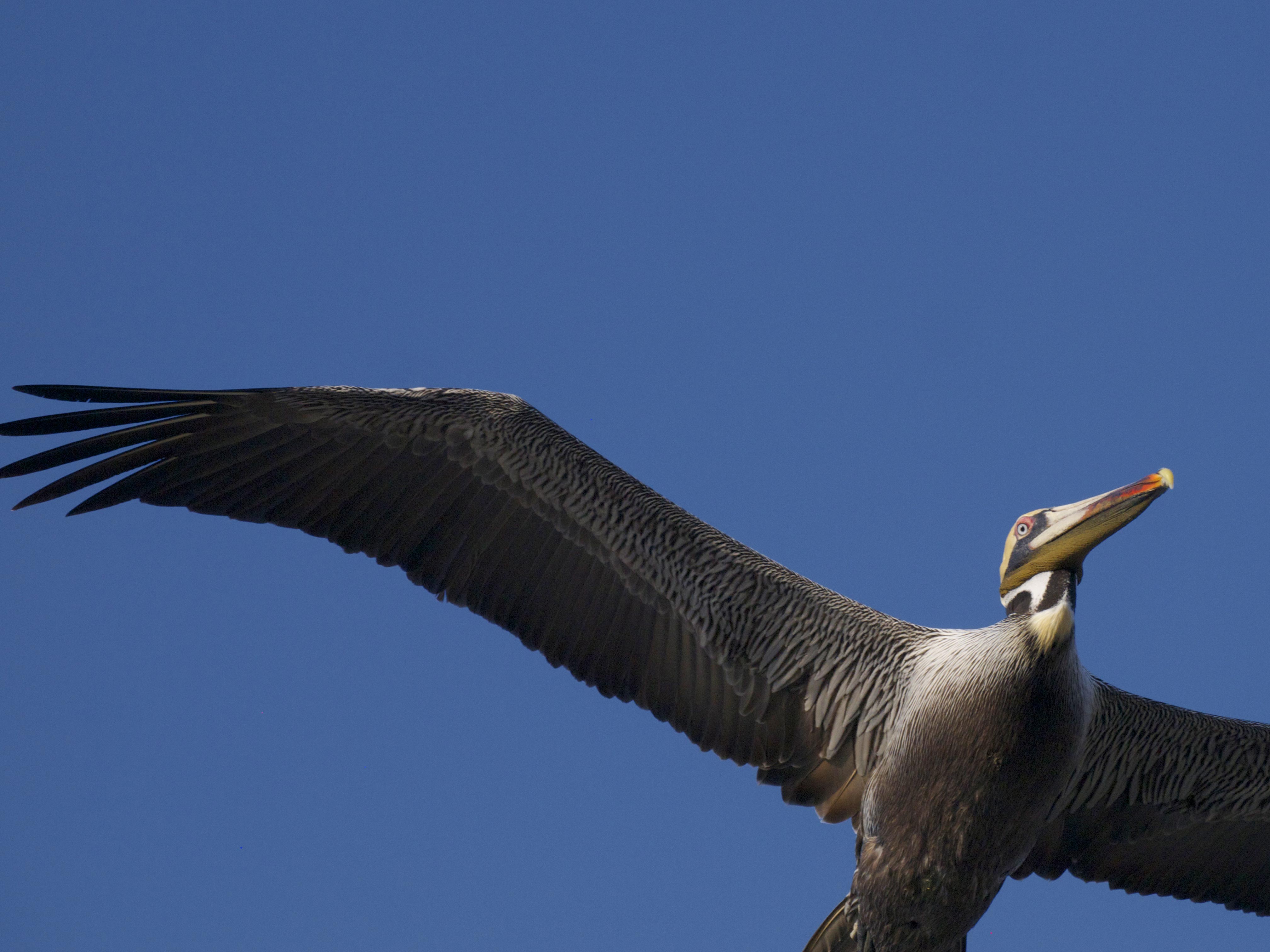
Brown Pelican - Photo by Tim GillerBrown Pelican - Photo by Tim Giller

Brown Pelican – Photo by Tim Giller

There is a sacrifice I suppose for the gift of flight; a certain vulnerability of body, a dependence on the larger world to be intact when you decide to come down to land. At a desert lake in Nevada I once held a recently dead barn owl. It was a beautiful creature, it’s feathers and body still possessed the lithe and tight smoothness that allowed it to silently traverse the night sky. In my hands though the body felt too insubstantial. It was as if only part of its form existed in the same world with me, but that there was another more substantial aspect that was held in some other universe.

I Swear I’m Not A Birder

Great Blue Heron - Photo by Tim Giller

Great Blue Heron – Photo by Tim Giller

There have been a number of clues in these pages that I might have more than a casual interest in birds. I suppose I should just own up to the label of being a birder just as I got attached to my bike messenger nickname, “nice tim”. Neither of these titles will do much for my gritty urban street cred, but I guess I won’t worry about that because even though I’m feeling a whole new kind of roadtrip gritty, I’m not currently urban. So yes I’ll admit that I do a lot of bird watching. However I don’t really go out “birding”. I spend a lot of time outdoors for many reasons and the chance to see wildlife is one of the most important. Birds simply make themselves the most available and I imagine this is what attracts people to bird watching. You don’t even have to go outside to observe birds; by just looking out almost any window most of us can spot one within minutes. They are possibly the most animated and vocal expression of the fact that nature is always at hand.

Being able to fly they inspire our admiration and envy bringing us stories from afar with their songs. And, like the two of us, many do travel far to spend time in Texas. Because of it’s size, shape and diverse habitats an impressive variety of birds spend time here. It creates a sort of funnel for exotic birds that move north from the tropics or from even farther into South America. In summer, a number of birds go no further than the Rio Grande Valley or the Chisos Mountains in Big Bend. Wintertime brings birds that have nested and raised young in the far north. These travelers, north and south are remarkable survivors and for millennia have had no reason to concern themselves with political boundaries. Today their ancient flyways have become gauntlets with safe havens harder to come by as development has reduced and degraded their rest stops.

In Port Aransas we got the chance to participate in The Whooping Crane Festival, a celebration of a species that tells this story well. The tallest bird on the continent, a bird that needs a little bit of space, it was nearly wiped out, down to a couple dozen birds in the 1940’s. This animal is definitely walking the edge of survival. We’ve set aside some space for it on both ends of it’s migration and done breeding programs that have brought their numbers up but we have to hope that we haven’t pushed it to far. Nature can’t often respect our limited boundaries.

Brown Pelican - Photo by Tim Giller

Brown Pelican – Photo by Tim Giller

There is a sacrifice I suppose for the gift of flight; a certain vulnerability of body, a dependence on the larger world to be intact when you decide to come down to land. At a desert lake in Nevada I once held a recently dead barn owl. It was a beautiful creature, it’s feathers and body still possessed the lithe and tight smoothness that allowed it to silently traverse the night sky. In my hands though the body felt too insubstantial. It was as if only part of its form existed in the same world with me, but that there was another more substantial aspect that was held in some other universe.

Crepuscular

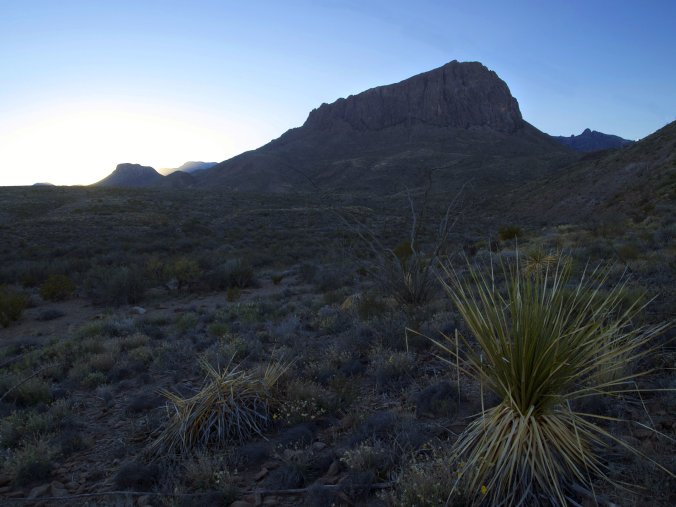
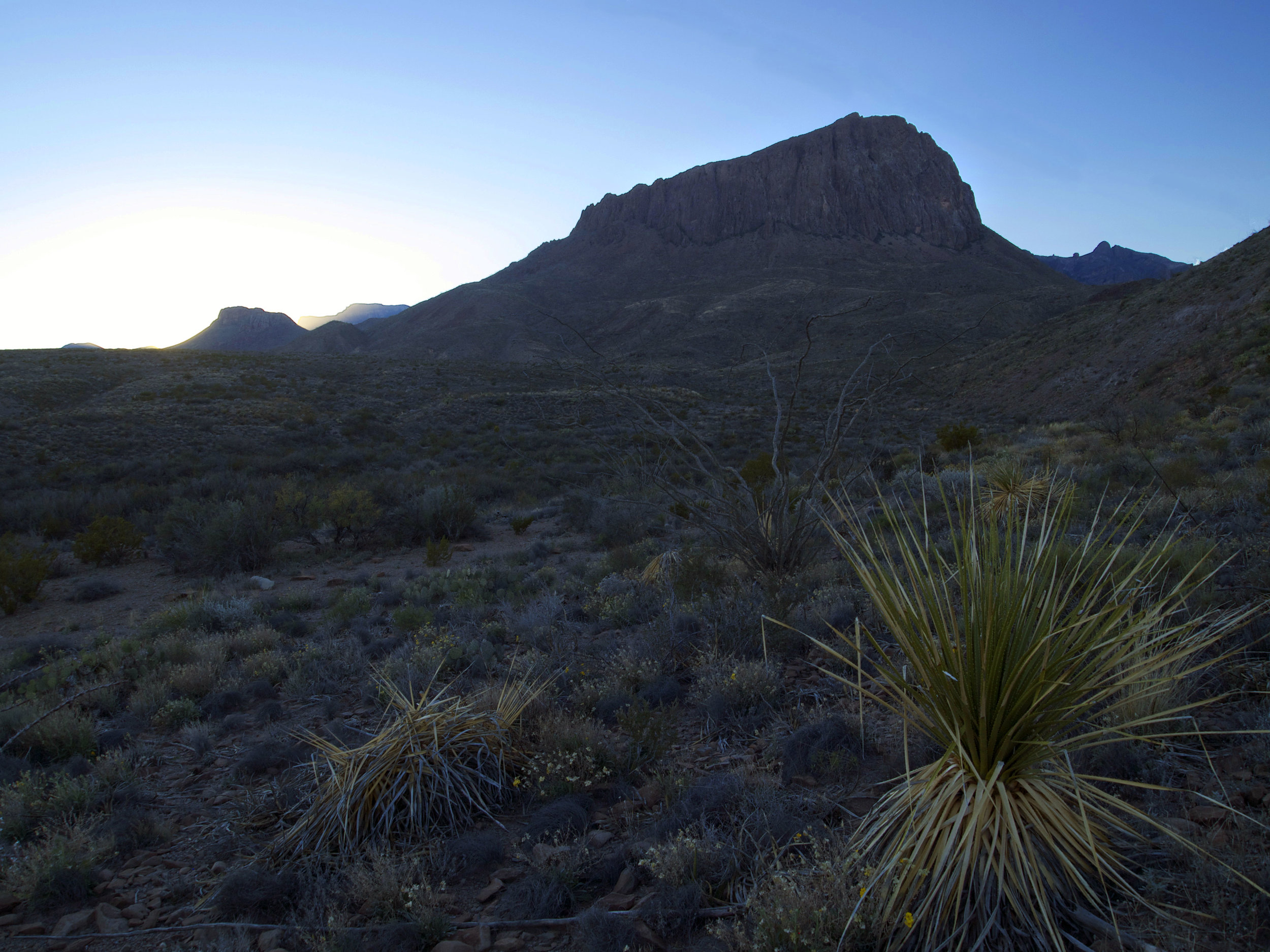
Nugent Mountain, Big Bend N.P. -Photo by Time GillerNugent Mountain, Big Bend N.P. -Photo by Time Giller

Nugent Mountain, Big Bend N.P. -Photo by Time Giller

Only a clear desert sunset sky can be so seamless. A complex landscape of buttes and mesas with the Chisos Mountains beyond has become a sharp black silhouette but rising from that is a prefect gradient, the glowing horizon of pastel yellow bleeding incrementally upward into oranges and reds eventually becoming a deep electric blue. The colors deepen imperceptibly defying measurement and obscuring time; my eyes struggle to adjust with the growing twilight. Puncturing the tapestry are the first celestial lights, Venus tonight, with Mars not far behind and over her shoulder. The varieties of daytime birds that populate the scrub and evade view have ceased their chattering end of day crescendo leaving silence in the still air. It is so silent that I can hear the leathery wings of a single bat that is breaking the perfection of the skyline, erratically hunting tiny insect prey. Soon high chirps from his companions tell me that he’s not alone. Suddenly a whirl of barely audible wing beats rises from the creosote in front of me tracing a few odd loops before abruptly becoming an oblong rock in the gravel before me. A Poorwill has mottled feathers that make it hard to distinguish in the dim light it prefers to hunt in, taking quick fights after moths then alighting back to the ground. Straining my eyes to make out this rarely seen bird I manage to notice that a Kangaroo Rat has also chosen to venture out now that the darkness has thickened. Light brown with a white belly and large black eyes, it has strong, oversized back legs that carry it around unpredictably and a long tufted tail whips along behind. If the Poorwill hadn’t drawn my eyes the other little critter would have been just another soft mysterious noise rising from the dusk.

It’s a really great word, crepuscular. From the Latin word for twilight, it refers to those creatures that are active primarily at dawn and dusk. The word has an exotic, enigmatic sound that matches these transition times between light and dark, the shadowy zone between worlds. In the desert this can be an especially useful time to be active. The heat of the day can be unforgiving for most animals and a majority of them take advantage of the cooler nighttime temperatures, especially predators. A little fella like a Kangaroo Rat avoids the daytime raptors who have gone to bed well as the nocturnal snakes who may not yet have awakened by slipping into the in between time. The subtle changes in lighting provide venue for camouflage.

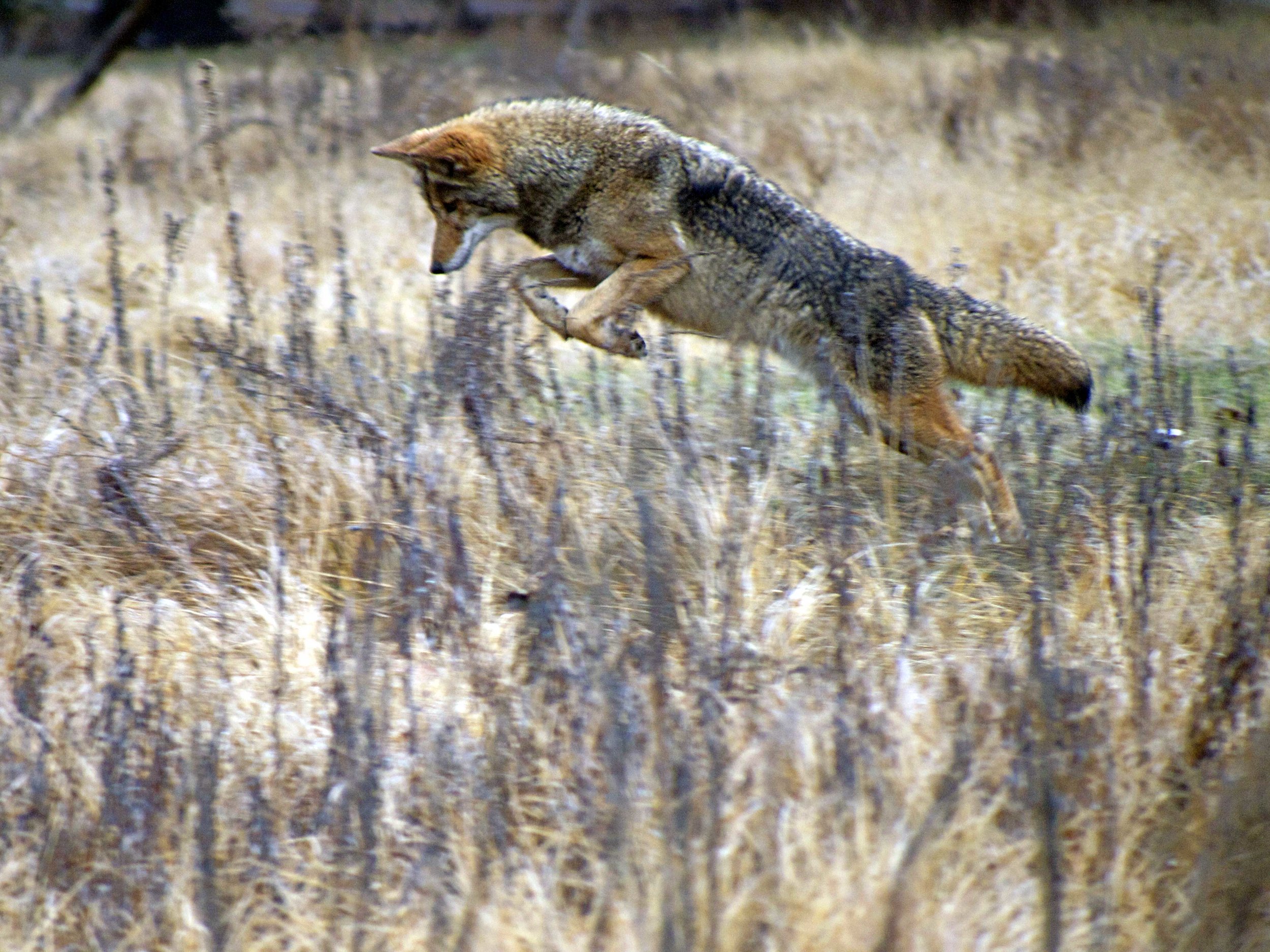
Coyote Yosemite N.P. - Photo by Tim GillerCoyote Yosemite N.P. - Photo by Tim Giller

Coyote Yosemite N.P. – Photo by Tim Giller

Wildlife doesn’t always conform to our labels though. I’ve seen owls awake at midday and like us, many diurnal creatures stay up late to finish their business. We humans clearly defy this categorization. Perhaps the coyote got his trickster reputation because of his refusal to conform to such labels. Generally considered a nocturnal animal they can be spotted at any hour, sometimes boldly making their presence known like the beautifully healthy one Rachael and I caught traipsing midday through the Presidio in San Francisco. These savvy animals also traverse the twilight period and we’ve heard their evening cackles on more evenings than not during our travels so far. Often deep into the night their yips and howls punctuate the darkness and on until the first hint of light in the east. I will never tire of this sound. At close range the disembodied laughing of coyote conversation on three sides of me does raise the hair on the back of my neck but it also ignites a primitive joy.