Whiskey & Cranes

If we hadn’t stopped at a bar in Tombstone we probably would have gotten to Whitewater Draw in time to see the massive flocks of cranes coming in for the evening. It was worth it though because where else are you going to find yourself sitting next to a real life gunslinger (reenactor) drinking whiskey? As he left to go to rehearsal we left to camp next to the Sandhill cranes. Even though in was getting dark and most of the birds had settled in, as soon as we shut off Lil’ Squatch’s engine you could hear them. The conversation at the bar was fun but these creatures speak an ancient tongue that is beyond description. It was so compelling that both Rachael and I, without speaking, began walking towards the sound. The cranes rest for the night standing in shallow water as protection from predators and the sound of thousands of their trilling voices carrying across the wetland penetrates you and reaches some primal part of your brain. It’s as if you can feel the thousands of years that this chorus has been raised nightly and it connects you to prehistoric ancestors who surely knew this sound well.

Whitewater Draw is a wildlife management area and one of several seasonal wetlands in the center of Sulphur Springs Valley an expansive example of basin and range country in the southeast corner of Arizona. With prairie and agricultural fields to feed in by day it is the perfect winter home for the cranes. It is also an excellent place to camp and we stayed here two nights, the all night conversations of the birds infiltrating my dreams. With some of the least light polluted skies in the US it is also an amazing place to see the stars, though with a bitter chill it was hard to bundle up enough to enjoy for very long. I was picturing the cranes huddled in together for warmth and gossip.

As dawn approaches the chattering trills begin to escalate. The sound grows to a crescendo as the sun is rising and with the sun the birds rise in groups of 20 or 30, then groups in the hundreds. The horizon fills with long lines of cranes flocked up to go to their chosen feeding sites in the valley. For some hours you can spot the now scattered groups rising and dispersing across the sky. As I said the sound of these magnificent birds is indescribable so even though this recording is also a poor substitution for hearing and feeling it in person, I’ll let the Sandhill cranes speak for themselves in this video I made: https://www.youtube.com/watch?v=WdQETjnDYik&feature=youtu.be
 

Vagabond Volunteers

PricklyPearPricklyPear

PricklyPear

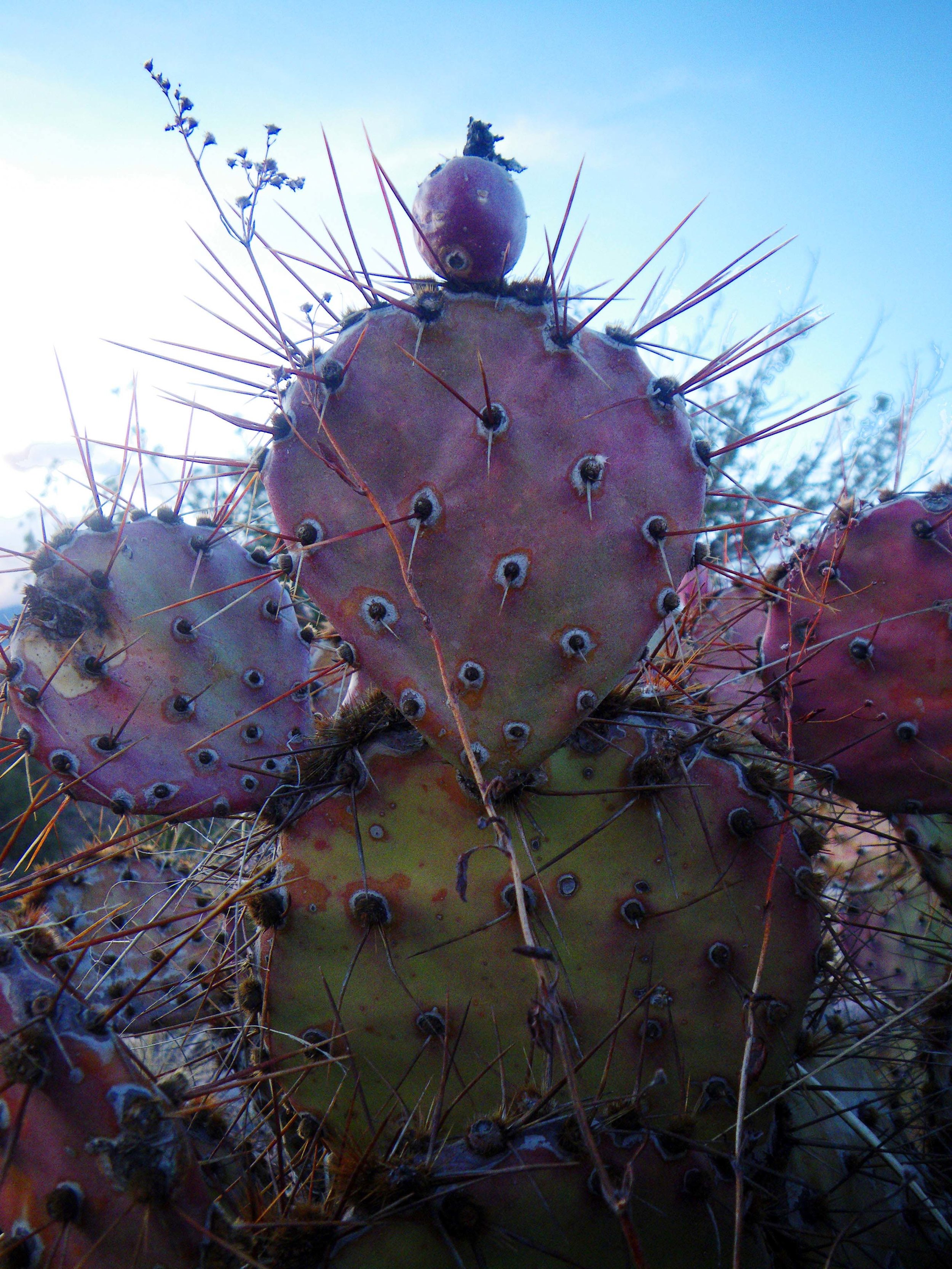
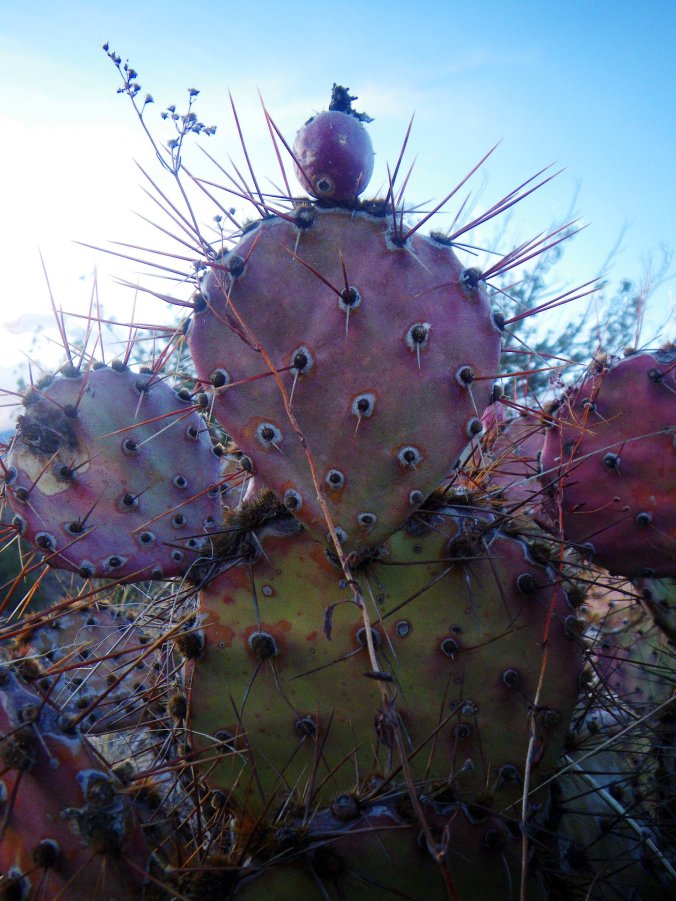
As I bent forward to look at a strange bit of Saguaro skeleton I felt a sharp sensation that quickly flashed me back to my earliest memory. I had to be less than 2 years old and my walking skills must have been mighty wobbly because as I was stumbling around outside our mobile home in the Mojave desert I promptly sat into a prickly pear cactus. My mom spent an hour plucking the needles out of my rear. This time around I only gave Rachael 10 minutes because we needed to come out from behind the mesquite tree and rejoin our fellow volunteers. Most deserts have a variety of foliage that endeavor to stab you, a successful defense mechanism for plants growing in a harsh environment with scarce food sources. The Sonoran desert however is greener and has more biomass than you’d expect for such a hot and dry place. This is largely the result of having two wet seasons; saturating winter rains and dramatic summer monsoon downpours. This doesn’t mean a lot of water but in a place where life waits out the dry in order to flourish with the wet the Sonoran in known for a higher variety and density of life. Life that is more than happy to fill my unobservant butt with barbed spines.
The good thing is we were here to get in close contact with the land and we were fortunate enough to find a drop in volunteer opportunity at Saguaro National Park. Though unfamiliar to us Californians, buffelgrass has become a widespread invasive plant in the deserts and rangelands of the Southwest an all to common example of a plant introduced as cattle feed that got out of hand. A fiend for water it can cheat the locals, tapping the scarce resource before it ever gets an inch into the soil. Removing exotic plants can appear futile. They come back with the repetitiveness of a bad horror movie villain. However native plants are intimately adapted to their environments and I’ve seen first hand that given a chance they can hold their own. This committed group of volunteers is trying to give the park that chance. By focusing on specific areas and with persistent effort the hope is to remove the invader and allow the native plant community to keep it at bay.

Hemmed in by suburban Tucson, Saguaro National Park has a lot of folks who spend time there on a regular basis. A number of the people we worked with had literally, while hiking or riding bikes through the park, stumbled upon the chance give back to a place they care about. After being mostly to ourselves in the desert for several days I think Rachael and I were in need of some social interaction and camaraderie. Getting a bit sweaty and dusty with these good folks was just what we needed. I don’t even hold any resentment toward my prickly pear friend. It was a good reminder to pay attention and be present in the moment.

Volunteers at Saguaro N.P.Volunteers at Saguaro N.P.

Volunteers at Saguaro N.P.

Vagabond Volunteers

PricklyPearAs I bent forward to look at a strange bit of Saguaro skeleton I felt a sharp sensation that quickly flashed me back to my earliest memory. I had to be less than 2 years old and my walking skills must have been mighty wobbly because as I was stumbling around outside our mobile home in the Mojave desert I promptly sat into a prickly pear cactus. My mom spent an hour plucking the needles out of my rear. This time around I only gave Rachael 10 minutes because we needed to come out from behind the mesquite tree and rejoin our fellow volunteers. Most deserts have a variety of foliage that endeavor to stab you, a successful defense mechanism for plants growing in a harsh environment with scarce food sources. The Sonoran desert however is greener and has more biomass than you’d expect for such a hot and dry place. This is largely the result of having two wet seasons; saturating winter rains and dramatic summer monsoon downpours. This doesn’t mean a lot of water but in a place where life waits out the dry in order to flourish with the wet the Sonoran in known for a higher variety and density of life. Life that is more than happy to fill my unobservant butt with barbed spines.

The good thing is we were here to get in close contact with the land and we were fortunate enough to find a drop in volunteer opportunity at Saguaro National Park. Though unfamiliar to us Californians, buffelgrass has become a widespread invasive plant in the deserts and rangelands of the Southwest an all to common example of a plant introduced as cattle feed that got out of hand. A fiend for water it can cheat the locals, tapping the scarce resource before it ever gets an inch into the soil. Removing exotic plants can appear futile. They come back with the repetitiveness of a bad horror movie villain. However native plants are intimately adapted to their environments and I’ve seen first hand that given a chance they can hold their own. This committed group of volunteers is trying to give the park that chance. By focusing on specific areas and with persistent effort the hope is to remove the invader and allow the native plant community to keep it at bay.

Hemmed in by suburban Tucson, Saguaro National Park has a lot of folks who spend time there on a regular basis. A number of the people we worked with had literally, while hiking or riding bikes through the park, stumbled upon the chance give back to a place they care about. After being mostly to ourselves in the desert for several days I think Rachael and I were in need of some social interaction and camaraderie. Getting a bit sweaty and dusty with these good folks was just what we needed. I don’t even hold any resentment toward my prickly pear friend. It was a good reminder to pay attention and be present in the moment.

Volunteers at Saguaro N.P.

Volunteers at Saguaro N.P.

What are we looking at?

Yellow Palo Verde with SaguarosYellow Palo Verde with Saguaros

Yellow Palo Verde with Saguaros

If you really want to follow our progress then there is probably no more accurate way than to check out our posts on iNaturalist. This is a website we’ve been using for a while to record some of the critters, plants and other lifeforms we’ve come across as we’re out in the world and each observation shows exactly where we saw it. iNaturalist is something of a social network where all types of folks, from enthusiastic kids just learning about nature to dedicated biologists in every field, can contribute to a massive database of information on species. What started as a Masters project by some students at UC Berkeley has grown into a worldwide resource. It now has a home and some funding after being adopted by the California Academy of Sciences. Anyone can participate and many people have created projects where others can contribute their observations. It’s kinda wide open as to how it can be used and over time it will surely become an invaluable record of what’s out there and where and how things are changing.

An easy trap that nature lovers, amateur naturalists and especially birders fall into is rote cataloging of sightings; simple checklists of species that bring little depth of knowledge or appreciation. This can definitely be a danger of using iNaturalist. Because you are connected to a huge community of nature observers and each plant or animal on the site has links to extra information, iNaturalist can also be a springboard for getting to know more about the creatures you encounter. Identifying and classifying life on earth has been incredibly valuable to our scientific understanding. This is not without pitfalls though and between the lumpers and the splitters you can find innumerable arguments on the fine points of where one creature ends and another begins. A red-shafted flicker and a yellow-shafted flicker probably don’t lose too much sleep over whether or not they are two separate species, especially since they can interbreed either way.

No species can exist is isolation anyway. Sometimes the interconnection between discreetly defined species is so locked that you have to wonder if they should be considered the same life-form. Most trees coexist with specific root fungi and the health of each is contingent on the other. The cells of our own bodies are outnumbered by a huge variety of microorganisms on and inside of us, the vast majority of which are either harmless or beneficial to our well being. A person is never truly alone.

Saguaro & IronwoodSaguaro & Ironwood

Saguaro & Ironwood

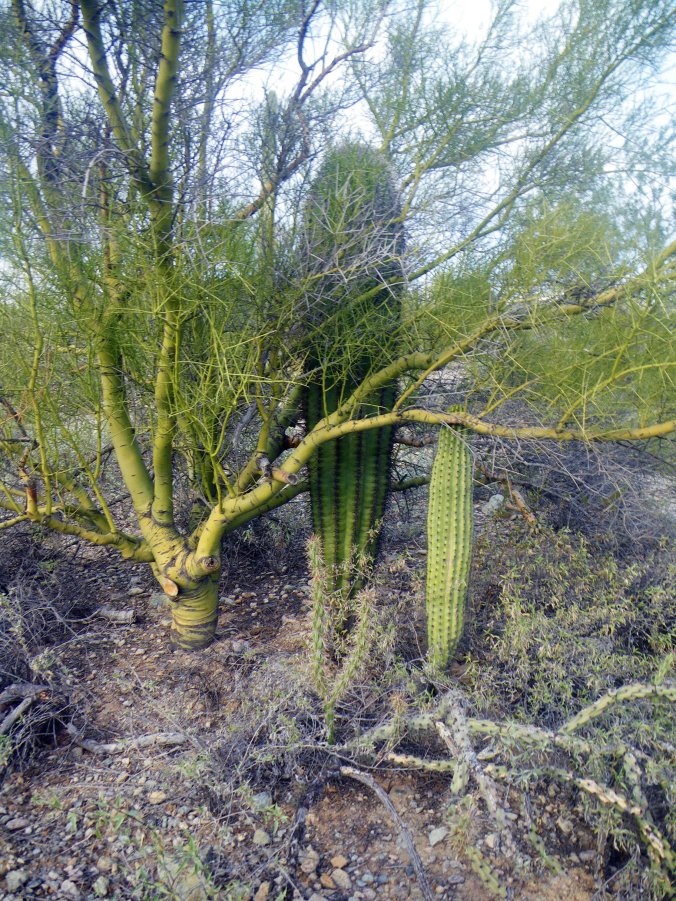
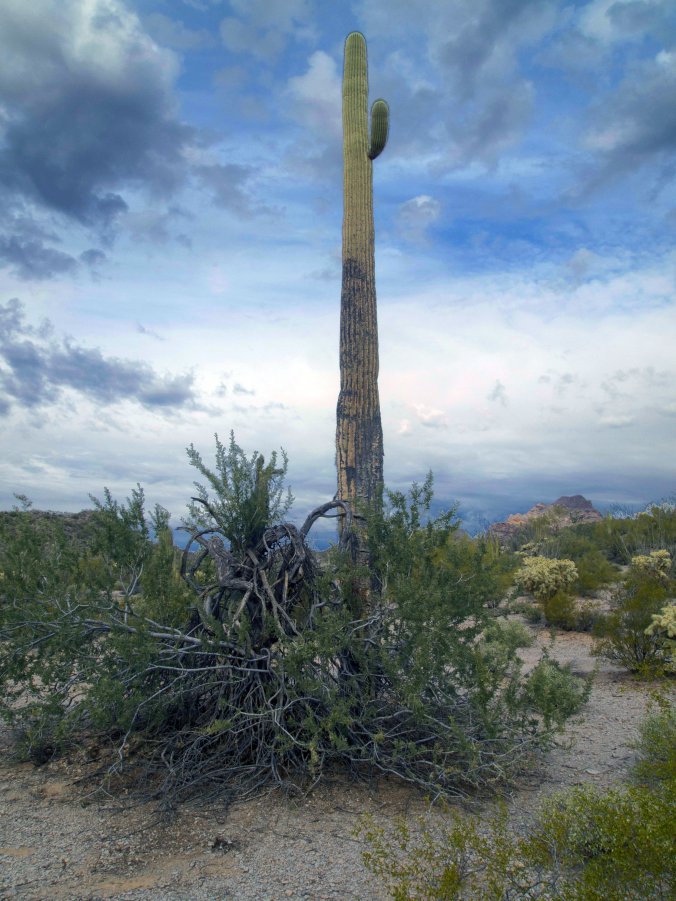
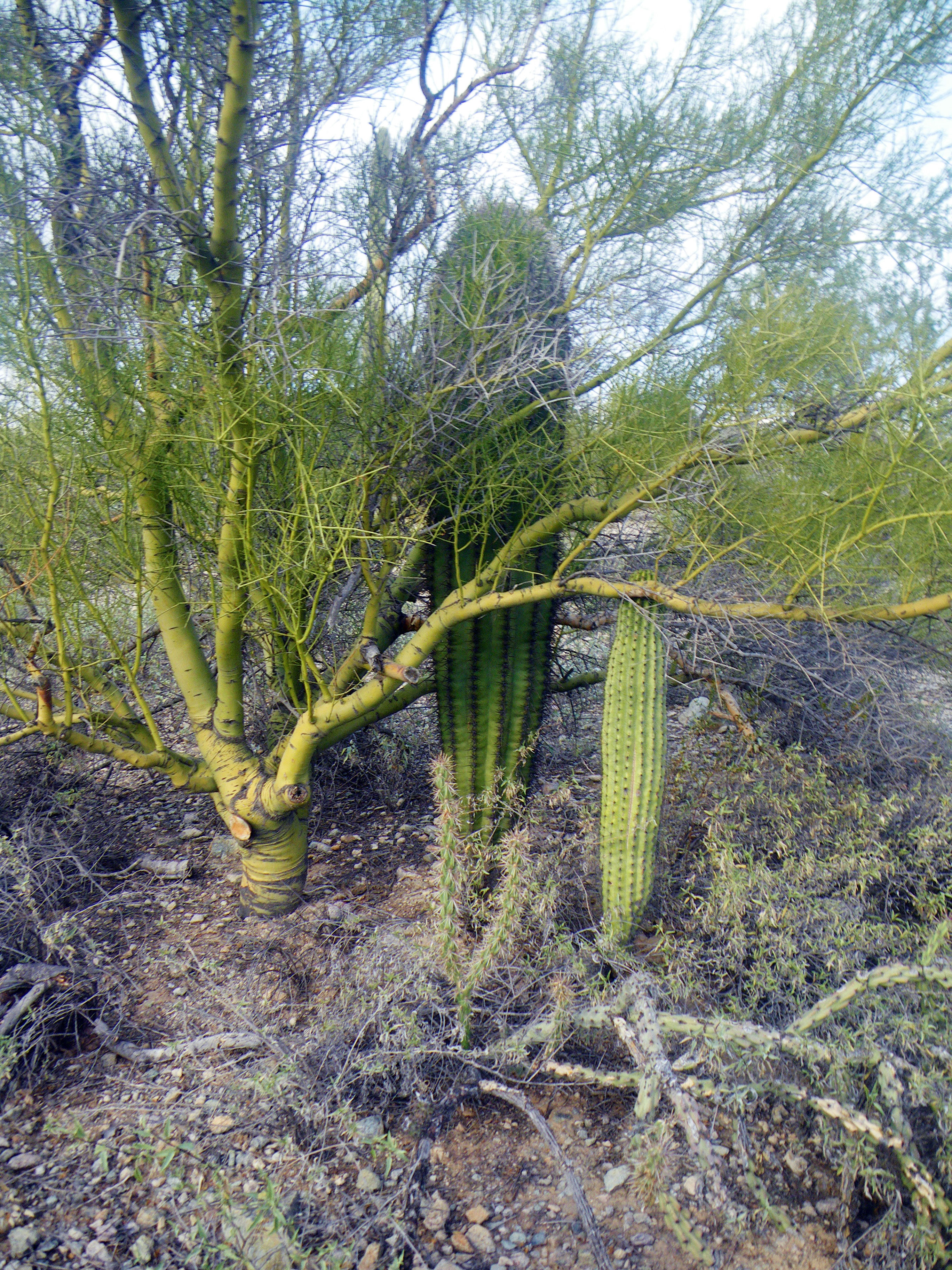
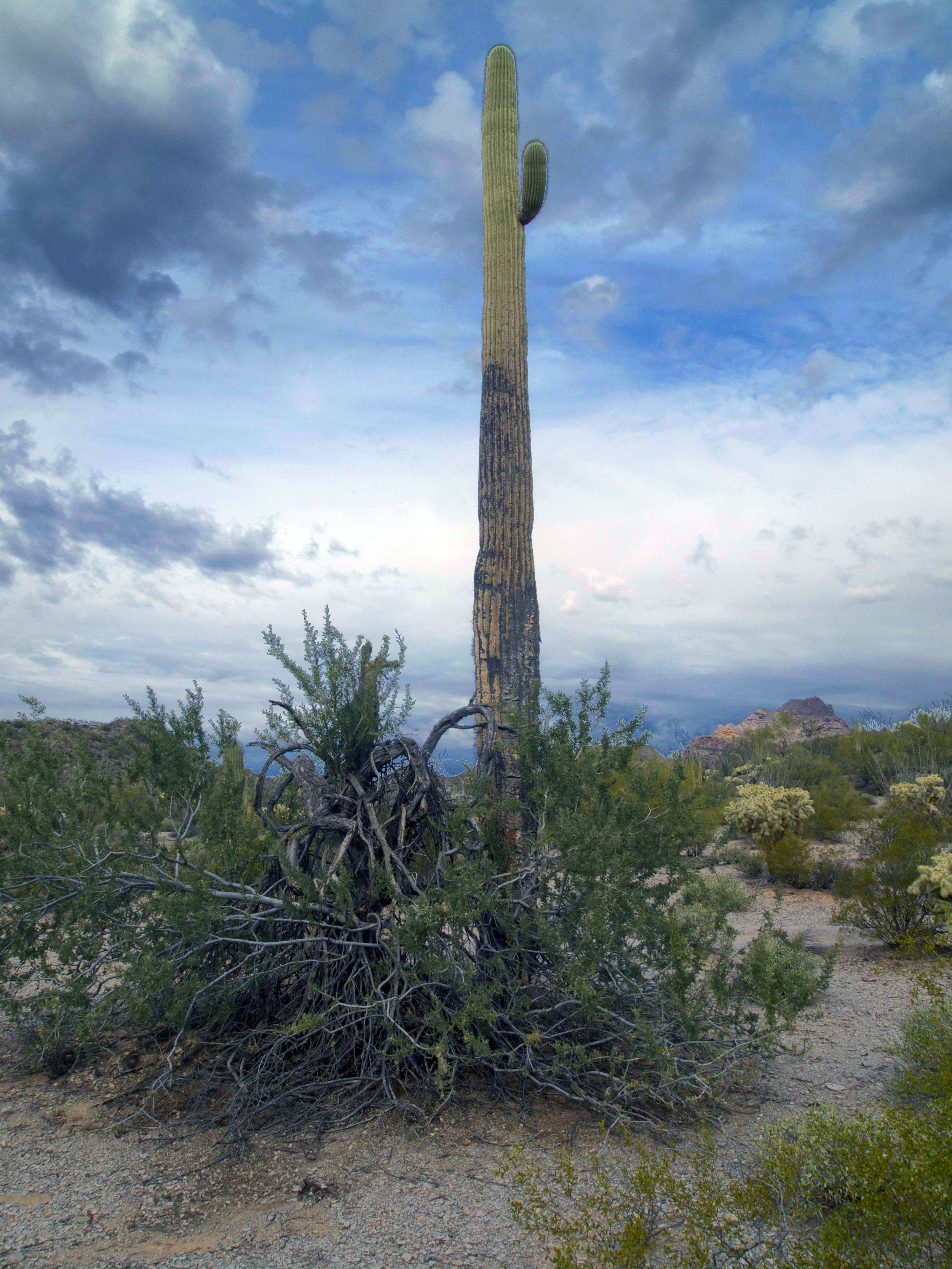
Currently if you click over to my observations you would learn that Rachael and I spent some time in Organ Pipe National Monument. Here I learned of a charming relationship between the Sonoran desert’s iconic Saguaro cactus and its fellow trees and shrubs. In order to grow into the unmistakable towering columns they become, Saguaros must first find shelter under an existing plant that can provide some cover until it has grown big enough to weather the extremes. No sooner had I learned this than I quickly noticed that nearly all the Saguaros are nestled in with one of their desert neighbors. A Saguaro can grow up to 50 feet tall and live over 150 years. I saw one stately elder emerging from an old Ironwood. Because this shorter tree grows slowly and can live to 1500 years, it may have sheltered many generations of the of the other’s ancestors.

What are we looking at?

Yellow Palo Verde with Saguaros

Yellow Palo Verde with Saguaros

If you really want to follow our progress then there is probably no more accurate way than to check out our posts on iNaturalist. This is a website we’ve been using for a while to record some of the critters, plants and other lifeforms we’ve come across as we’re out in the world and each observation shows exactly where we saw it. iNaturalist is something of a social network where all types of folks, from enthusiastic kids just learning about nature to dedicated biologists in every field, can contribute to a massive database of information on species. What started as a Masters project by some students at UC Berkeley has grown into a worldwide resource. It now has a home and some funding after being adopted by the California Academy of Sciences. Anyone can participate and many people have created projects where others can contribute their observations. It’s kinda wide open as to how it can be used and over time it will surely become an invaluable record of what’s out there and where and how things are changing.

An easy trap that nature lovers, amateur naturalists and especially birders fall into is rote cataloging of sightings; simple checklists of species that bring little depth of knowledge or appreciation. This can definitely be a danger of using iNaturalist. Because you are connected to a huge community of nature observers and each plant or animal on the site has links to extra information, iNaturalist can also be a springboard for getting to know more about the creatures you encounter. Identifying and classifying life on earth has been incredibly valuable to our scientific understanding. This is not without pitfalls though and between the lumpers and the splitters you can find innumerable arguments on the fine points of where one creature ends and another begins. A red-shafted flicker and a yellow-shafted flicker probably don’t lose too much sleep over whether or not they are two separate species, especially since they can interbreed either way.

No species can exist is isolation anyway. Sometimes the interconnection between discreetly defined species is so locked that you have to wonder if they should be considered the same life-form. Most trees coexist with specific root fungi and the health of each is contingent on the other. The cells of our own bodies are outnumbered by a huge variety of microorganisms on and inside of us, the vast majority of which are either harmless or beneficial to our well being. A person is never truly alone.

Saguaro & Ironwood

Saguaro & Ironwood

Currently if you click over to my observations you would learn that Rachael and I spent some time in Organ Pipe National Monument. Here I learned of a charming relationship between the Sonoran desert’s iconic Saguaro cactus and its fellow trees and shrubs. In order to grow into the unmistakable towering columns they become, Saguaros must first find shelter under an existing plant that can provide some cover until it has grown big enough to weather the extremes. No sooner had I learned this than I quickly noticed that nearly all the Saguaros are nestled in with one of their desert neighbors. A Saguaro can grow up to 50 feet tall and live over 150 years. I saw one stately elder emerging from an old Ironwood. Because this shorter tree grows slowly and can live to 1500 years, it may have sheltered many generations of the of the other’s ancestors.